Key takeaways
- Optical and laser tachometers read a reflective mark without touching the machine; they are the default for commissioning and maintenance checks.
- A contact tachometer touches the shaft centre or the surface; with a wheel attachment it also measures linear surface speed of belts, conveyors and rollers.
- A stroboscope freezes the motion when its flash rate matches the speed, but it also freezes at half, one-third and other fractions, so always confirm the reading.
- RPM = surface speed ÷ (π × diameter); belt slip shows up when the measured driven speed is lower than motor speed × pulley ratio.
- Handheld tachometers are for spot checks; continuous monitoring needs a fixed sensor and a panel display or BMS input.
What a tachometer measures and why it matters
A tachometer measures rotational speed, normally in revolutions per minute (RPM). On HVAC and industrial sites it is used to confirm that motors, pumps, fans and conveyors run at their design speed, to find belt slip, to verify variable frequency drive (VFD) settings during commissioning, and to record speed during performance and vibration surveys.
Speed matters because so much else follows from it. Under the fan and pump affinity laws, flow varies directly with speed, pressure with the square of speed and power with the cube of speed. A belt-driven AHU fan that runs 5% slow delivers roughly 5% less air, and a fan that runs fast can overload its motor. A simple RPM reading is often the quickest way to explain an airflow or flow shortfall.
The four main types compared
| Type | How it works | Best for | Limitations |
|---|---|---|---|
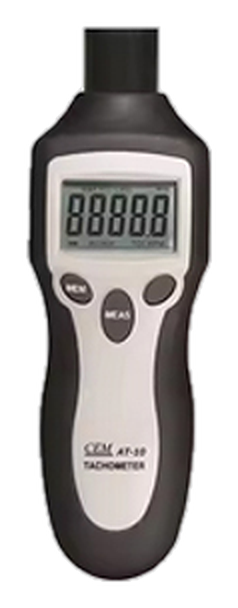
| Contact tachometer | A rubber cone or tip is pressed into the shaft centre, or a wheel runs on the surface | Shafts where no mark can be applied; surface speed of belts, rollers and conveyors (with wheel) | Needs safe, close access to a rotating part; slip at the tip can read low; may load very small shafts |
| Optical (photo) tachometer | A light beam is reflected from a reflective tape mark once per revolution and counted | Motors, pumps, fans, pulleys during commissioning and maintenance | Needs a mark and a line of sight; short working distance; shiny shafts can give false pulses |
| Laser tachometer | Same principle as optical, with a laser beam for a longer working distance and an easier aim | Guarded or hard-to-reach shafts, fans seen through an access opening | Needs a mark and a line of sight; observe laser safety precautions |
| Stroboscope | A lamp flashes at an adjustable rate; when it matches the speed the part appears stationary | Speed reading plus visual inspection of belts, couplings, fan blades and print or textile machinery while running | Can lock on to fractions or multiples of the true speed; needs a darker area for a clear image |
Many handheld instruments combine contact and non-contact modes in one body, which is useful for a maintenance or facility management kit. Range, resolution, accuracy and working distance depend on the model and should be taken from the datasheet.
How to choose: five questions
- Can you get safely close to the shaft? If not, use an optical or laser type through a guard opening, or a stroboscope. Never remove guards just to take a contact reading on running machinery.
- Can you apply a reflective mark? Optical and laser types need one. If the shaft is inaccessible when stopped, or the process does not allow tape, use a contact or stroboscope reading.
- Do you need RPM or linear speed? For belt, conveyor, cable or web speed in m/min, use a contact tachometer with a surface-speed wheel.
- Do you need to see the part? If you want to inspect blade flutter, belt flap or coupling condition while running, a stroboscope does both jobs.
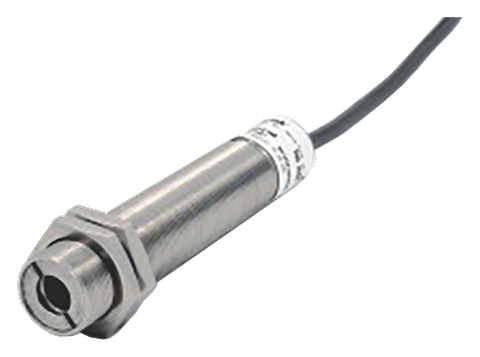
- Spot check or continuous? Handheld tachometers are for spot checks. For a permanent record, alarm or control input, specify a fixed speed sensor (for example an inductive proximity sensor reading a key or gear teeth) with a panel tachometer or a pulse/4–20 mA input to the PLC or BMS.
Useful formulas
| To find | Formula | Example |
|---|---|---|
| RPM from surface speed | RPM = V ÷ (π × D), with V in m/min and D in m | Conveyor drum D = 0.4 m, belt speed 75 m/min: 75 ÷ (3.1416 × 0.4) ≈ 60 RPM |
| Surface speed from RPM | V = π × D × RPM | Roller D = 0.1 m at 300 RPM: 3.1416 × 0.1 × 300 ≈ 94 m/min |
| Expected driven pulley speed | N2 = N1 × D1 ÷ D2 | Motor 1,440 RPM, motor pulley 150 mm, fan pulley 300 mm: about 720 RPM |
| Belt slip | Slip % = (expected N2 − measured N2) ÷ expected N2 × 100 | Expected 720 RPM, measured 690 RPM: about 4% slip |
| Reading with several marks | RPM = displayed count ÷ number of marks | Two marks, display 2,880: shaft speed 1,440 RPM |
A belt-driven fan normally runs slightly below the pulley-ratio speed because of belt creep, so judge slip by comparing readings over time and against the belt manufacturer's guidance rather than expecting zero difference.
Getting a correct reading
- Reflective mark: use one piece of reflective tape on a clean, dry, dark surface. On a bright or polished shaft, blacken the area around the tape (matt paint or black tape) so the meter does not count reflections from the shaft itself.
- Aim: hold the beam roughly perpendicular to the mark and within the working distance in the datasheet; a slight angle helps avoid glare from shiny surfaces.
- Contact tip: press the cone squarely into the shaft centre with light, steady pressure and keep the tachometer in line with the shaft axis. Use the wheel for surface speed and select the matching unit.
- Stroboscope: start above the expected speed and come down; the highest flash rate that gives a single stationary image is the true speed. At double the true speed you see two images; at half you still see a single frozen image, which is the common error.
- Steady state: take readings after the machine has settled, record min/max/average where the instrument offers it, and note VFD frequency alongside RPM.
Typical HVAC and plant applications
| Application | Usual choice | What the reading tells you |
|---|---|---|
| AHU and exhaust fan commissioning | Optical or laser | Whether fan speed matches the fan curve duty point; belt slip |
| Pump speed on VFD | Optical or laser | Actual speed versus drive setting |
| Cooling tower fans | Laser or stroboscope | Speed through an inspection opening; blade condition |
| Conveyors, rollers and winders | Contact with wheel | Line speed in m/min |
| Laboratory centrifuges and stirrers | Optical | Speed check without touching the rotor |
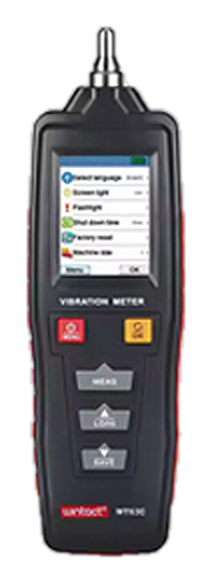
| Vibration surveys | Optical or laser, with a vibration meter | Running speed, needed to interpret 1× and 2× vibration components |
Calibration and specification tips
Ask for a calibration certificate traceable to national standards with the instrument and recalibrate at the interval your quality system sets, commonly once a year. For a consultant specification or BOQ, state the measurement modes needed (contact, non-contact, surface speed), the RPM range of the machines to be checked, the required working distance, data hold and min/max/average functions, and whether data logging is needed. Pioneer supplies contact, optical and laser tachometers and stroboscopes and confirms range, resolution and accuracy on the model datasheet with the quotation.