Environmental Monitoring · SI
Tachometers — Contact, Optical and Laser RPM Meters
Pioneer supplies digital tachometers for measuring rotational speed in RPM: contact tachometers that touch the shaft, non-contact optical and laser tachometers that read a reflective mark, and stroboscopes, with data hold and min/max/average, and data logging on selected models.
- Display: Digital
Overview
What it does and where it fits.
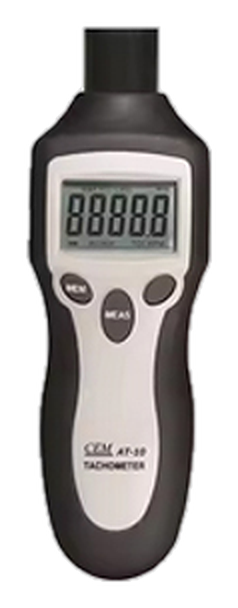
A tachometer measures how fast a shaft, pulley, fan or wheel turns, in revolutions per minute (RPM). Speed checks confirm that motors, pumps, fans and conveyors run at their design speed, show up belt slip, and verify drive settings during commissioning. They are also part of performance testing and overspeed checks on rotating machinery.
A contact tachometer has a tip or wheel held against the shaft, so it needs safe access to the shaft. A non-contact optical tachometer reads a strip of reflective tape on the shaft with a light beam; a laser tachometer does the same from a longer distance. A stroboscope flashes at an adjustable rate, and when the flash matches the speed the part appears frozen, allowing a speed reading and visual inspection without stopping the machine.
Range, resolution and accuracy depend on the model. Pioneer confirms them on the model datasheet with the quotation.
Types
- Contact tachometerTip or wheel held against the rotating shaft; useful where a reflective mark cannot be applied.
- Optical (non-contact) tachometerReads a reflective tape mark with a light beam, without touching the machine.
- Laser tachometerLaser beam for a longer working distance than an optical type.
- StroboscopeFlashing light that freezes the motion of a rotating part for speed reading and visual inspection.
Features
- Contact and non-contact measurement
- RPM reading on a digital display
- Data hold
- Min/Max/Avg readings
- Data logging on selected models
- Stroboscopes for inspection while running
Applications
- Motor, pump and fan speed checks during commissioning
- Belt slip checks on belt-driven fans and AHUs
- Variable speed drive verification
- Conveyor and process machinery speed
- Laboratory centrifuges and stirrers
- Engine and turbine performance testing
Specifications
Spec table.
Standard ranges and materials. Tell us your medium, range and connection and we will match the model.
| Parameter | Value |
|---|---|
| Measured variable | Rotational speed, RPM |
| Types | Contact, optical (non-contact), laser (non-contact), stroboscope |
| Display | Digital |
| Functions | Data hold, Min/Max/Avg |
| Data logging | Available on selected models |
RPM range, resolution, accuracy and working distance depend on the model. Pioneer confirms them on the model datasheet with the quotation.
For consultants
Consultant spec clause.
Paste it into your technical specification or BOQ, then adjust ranges and quantities to your schedule.
1. Supply of a portable digital tachometer for measuring the speed of fans, motors and pumps during commissioning, to be handed over with the facility management instrument kit.
2. The tachometer shall be a non-contact optical or laser type (contact type where a reflective mark cannot be applied), reading in RPM on a digital display.
3. The instrument shall have data hold and Min/Max/Avg functions, with data logging where specified in the schedule.
4. Measuring range and accuracy shall cover the speeds of all rotating equipment in the schedule and shall be stated in the bidder's technical datasheet for approval.
5. The instrument shall be supplied with reflective tape, batteries, carrying case, operating manual and a manufacturer's test/calibration certificate.
Make: Pioneer Industrial Instruments, Pune, or approved equivalent.
Should I choose a contact or a non-contact tachometer?
Non-contact (optical or laser) is the usual choice for running machines: you fix a small reflective mark on the shaft or pulley and read from a safe distance without opening guards. Choose a contact tachometer where a mark cannot be applied and the shaft is safely accessible. Laser types work from further away than optical ones, which helps with fans behind guards or in large plant.
How do I measure the fan speed of a belt-driven AHU?
Stop and isolate the unit, fix a small piece of reflective tape on the fan pulley or shaft, close up, restart and read from outside the guard with an optical or laser tachometer, never reaching into the unit. Measure the motor pulley the same way. Comparing actual fan speed with the speed expected from motor RPM and the pulley ratio shows belt slip.
What is a stroboscope used for?
A stroboscope flashes light at an adjustable rate. When the flash rate equals the rotation speed, a mark on the part appears stationary, so you can read the speed and inspect belts, couplings, blades and rolls while they run. Take care: the part also appears frozen at a half, a third and other fractions of the true speed, so start at a high flash rate and come down.
Can a tachometer show whether a motor is overloaded?
It gives a useful indication. An induction motor runs slightly below its synchronous speed, and the difference, called slip, grows with load. A measured speed close to synchronous speed means a lightly loaded motor; a speed at or below the nameplate full-load speed suggests full load or overload. Confirm with a clamp meter reading of running current against the nameplate current.
Related