Specialty Instruments · XT
Wind Direction Sensors — Wind Vanes and Ultrasonic Wind Sensors
Pioneer supplies wind direction sensors for weather stations, building automation and environmental monitoring: potentiometer and encoder wind vanes, and ultrasonic wind sensors that measure speed and direction with no moving parts. Outputs are analogue (voltage or current) or digital serial, for mast, tower or roof mounting.
Overview
What it does and where it fits.
A wind direction sensor reports the direction the wind is coming from. Paired with wind speed, it is basic input data for weather stations, air pollution dispersion studies, wind resource assessment and site safety on construction projects and airfields.
In buildings, wind direction is used by the BMS for natural ventilation and smoke ventilation, opening windows and vents on the leeward side and closing them on the windward side. On industrial sites it shows which way a gas release or stack plume will travel.
Choose a wind vane for a simple, low-cost installation, and an ultrasonic sensor where icing, dust or maintenance access make moving parts a problem, or where wind speed and direction are needed from one instrument.
Types
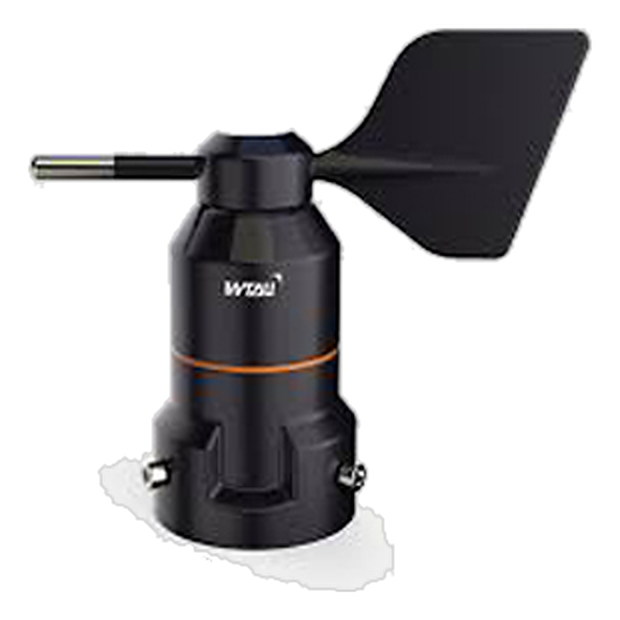
- Potentiometer wind vaneVane turns a potentiometer to give an analogue signal proportional to direction; simple and economical.
- Encoder wind vaneVane drives an encoder for a digital direction output, avoiding the potentiometer dead band.
- Ultrasonic wind sensorMeasures wind speed and direction from the transit time of ultrasonic pulses, with no moving parts.
Features
- Wind vane or ultrasonic sensing
- Analogue voltage or current output
- Digital serial output on encoder and ultrasonic models
- Ultrasonic models measure speed and direction together
- Mast, tower or building mounting
- Weatherproof construction for outdoor use
Applications
- Weather stations
- Environmental and air quality research
- Building automation and natural ventilation control
- Wind energy resource assessment
- Agriculture and spray planning
- Aviation, marine and port operations
- Construction sites and crane operations
Specifications
Spec table.
Standard ranges and materials. Tell us your medium, range and connection and we will match the model.
| Parameter | Value |
|---|---|
| Sensing types | Potentiometer wind vane, encoder wind vane, ultrasonic |
| Output | Analogue (voltage or current) or digital serial, by model |
| Ultrasonic models | Wind speed and direction, no moving parts |
| Mounting | Mast, tower or building |
Accuracy, resolution, starting threshold, output range and supply voltage are confirmed per model at enquiry.
For consultants
Consultant spec clause.
Paste it into your technical specification or BOQ, then adjust ranges and quantities to your schedule.
1. A wind direction sensor shall be provided on the roof mast [weather station mast] at the location shown on the drawings.
2. The sensor shall be a wind vane with encoder [potentiometer] output, or an ultrasonic wind sensor where wind speed and direction are both required from one instrument.
3. Output shall be 4–20 mA [0–10 V / RS485 serial] for connection to the BMS or data logger.
4. The sensor shall be weatherproof and suitable for continuous outdoor exposure to sun, rain and wind.
5. The sensor shall be mounted at the top of the mast, clear of obstructions and roof-top turbulence, with its north reference aligned to true north.
6. The bidder shall state accuracy, resolution and starting threshold, and shall supply a manufacturer's test certificate, mounting bracket and wiring diagram.
Make: Pioneer Industrial Instruments, Pune, or approved equivalent.
Should I choose a wind vane or an ultrasonic wind sensor?
A wind vane is simple, low-cost and easy to understand, and suits most building and weather station uses. Its bearings wear and it can stick in icing or dusty conditions. An ultrasonic sensor has no moving parts, needs little maintenance, responds faster and gives speed and direction from one unit, but costs more. Choose ultrasonic for remote, dusty, coastal or hard-to-reach locations.
What is the dead band on a potentiometer wind vane?
A potentiometer cannot cover a full circle, so there is a small gap, usually a few degrees, near the north position where the output is undefined or jumps between minimum and maximum. Data loggers and BMS logic must handle this jump. Encoder vanes and ultrasonic sensors give a continuous direction reading without a dead band, so they are preferred where direction near north matters.
How should a wind direction sensor be mounted?
Mount it at the top of a mast, above the turbulence created by the building or nearby obstructions. Meteorological practice uses 10 m above open ground, and on roofs the sensor should sit well above parapets and plant. Align the sensor's north mark with true north, not magnetic north, using a compass with the local declination applied or a known reference.
How is wind direction used in a building management system?
The BMS uses wind direction, usually with wind speed, to control natural ventilation and smoke vents: opening vents on the leeward side, closing windward vents in strong wind, and selecting smoke vents so smoke is not pushed back into the building. It can also close louvres and dampers in high winds and alert security staff on sites handling hazardous gases.
Related