Flow Instruments · FT
Vortex Flowmeters — for Steam, Gas and Liquids
A vortex flowmeter measures the volumetric flow of steam, gases and clean liquids by counting vortices shed from a bluff body in the pipe, with no rotating parts. Pioneer supplies inline vortex flowmeters with a digital display, 24 V DC supply and RS 485 and HART communication, rated to 150 °C process temperature.
- Flow range: Sized to the application data
- Accuracy: Typically ±1% of reading
- Principle: Vortex shedding
Overview
What it does and where it fits.
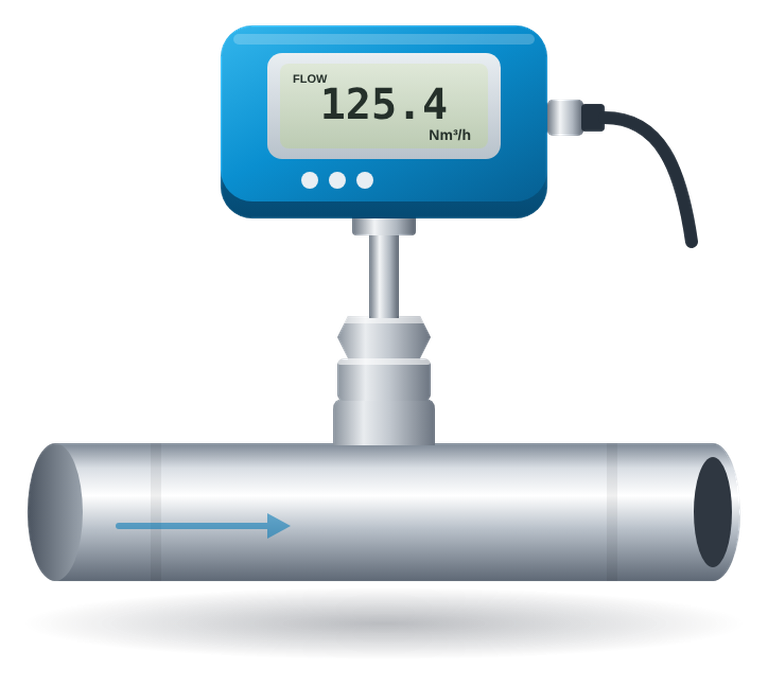
When fluid flows past a bluff body (shedder bar) across the pipe, vortices form alternately on each side. Their frequency is proportional to velocity, and a sensor behind the bar counts them. The meter has no rotating parts and a modest pressure drop, and one design covers liquids, gases and steam.
Vortex meters are a common choice for boiler steam distribution, compressed air and utility gas lines, and clean water or thermal fluid where the fluid does not conduct electricity. Accuracy is typically around ±1% of reading over a turndown of about 10:1 or better.
Vortex shedding needs a minimum velocity: below a Reynolds number of about 10,000 the signal becomes unreliable, so the meter is often one size smaller than the line. Send the fluid, pressure, temperature and minimum, normal and maximum flow, and the meter will be sized to suit.
Types
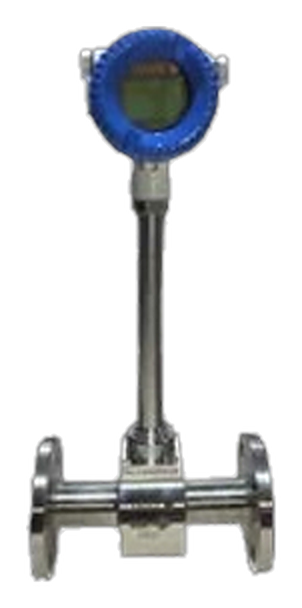
- Flanged inline vortex meterFor steam, gas and liquid lines with integral transmitter and local display.
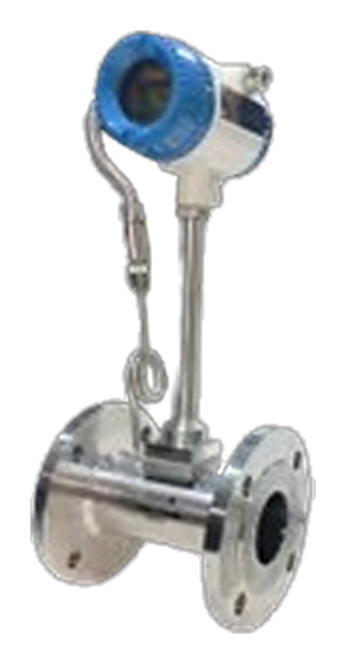
- Vortex meter for steamMeasures saturated steam flow; add pressure or temperature compensation for mass flow in kg/h.
- Vortex meter for compressed air and gasesFor utility air and gas consumption monitoring; pressure and temperature compensation gives normalised flow.
Features
- Measures liquids, gases and steam with one technology
- No rotating parts; low maintenance
- Typical turndown 10:1 or better
- Low pressure drop compared with orifice plates
- Digital local display
- RS 485 and HART communication
- 24 V DC power supply
Applications
- Saturated steam distribution and boiler output
- Compressed air consumption monitoring
- Natural gas and process gas lines
- Clean water, thermal fluid and process liquids
- Chemical processing utilities
- Power generation and process plant utilities
Specifications
Spec table.
Standard ranges and materials. Tell us your medium, range and connection and we will match the model.
| Parameter | Value |
|---|---|
| Principle | Vortex shedding |
| Media | Liquids, gases and steam |
| Process temperature | Up to 150 °C |
| Accuracy | Typically ±1% of reading |
| Turndown | Typically 10:1 or better |
| Display | Digital |
| Power supply | 24 V DC |
| Communication | RS 485, HART |
| Flow range | Sized to the application data |
Line size, end connection, materials and higher-temperature steam service on request: send fluid, pressure, temperature and flow range.
For consultants
Consultant spec clause.
Paste it into your technical specification or BOQ, then adjust ranges and quantities to your schedule.
1. Flowmeter shall be of vortex shedding type with no rotating parts, suitable for saturated steam (compressed air / gas / liquid as specified).
2. Meter size shall be selected from the minimum, normal and maximum flow so that minimum flow remains within the linear range, and may be smaller than the line size.
3. Accuracy shall be ±1% of reading or better over a turndown of at least 10:1.
4. Meter shall be rated for the specified process pressure and a process temperature up to 150 °C, with process connections as specified.
5. Transmitter shall be integral with a local digital display of flow rate and totaliser, powered by 24 V DC, with HART (RS 485) communication.
6. Pressure and temperature compensation shall be provided where mass or normalised flow is required.
7. Installation shall provide straight upstream and downstream lengths as recommended by the manufacturer, free of vibration.
8. Each flowmeter shall be supplied with a manufacturer's calibration certificate and installation manual.
Make: Pioneer Industrial Instruments, Pune, or approved equivalent.
Can a vortex flowmeter measure steam?
Yes, steam is one of the most common uses of vortex meters. The meter measures volumetric flow at line conditions, so to report steam in kg/h it needs density compensation: a pressure input for saturated steam, or pressure and temperature for superheated steam. State the steam pressure and temperature at enquiry so the meter rating and compensation can be matched.
Why is my vortex meter reading zero at low flow?
Vortex shedding becomes unstable below a Reynolds number of roughly 10,000, so every vortex meter has a minimum measurable velocity and cuts off below it. If the line runs well below its design flow, the meter may be oversized. Vortex meters are therefore often one or two sizes smaller than the pipe, with concentric reducers, so the normal flow sits comfortably above the cut-off.
How much straight pipe does a vortex meter need?
Vortex meters are sensitive to swirl and distorted velocity profiles. A common guide is 15 to 20 pipe diameters straight upstream and 5 downstream, rising to 25 or more after two elbows in different planes and 50 after a control valve. Mount pressure and temperature tappings downstream of the meter, and avoid locations with strong pipe vibration.
Vortex or electromagnetic flowmeter for water?
For conductive water, effluent and slurries, an electromagnetic meter is usually better: there is no obstruction, no minimum Reynolds number and it reads down to 0.2 m/s. Choose a vortex meter when the liquid does not conduct, such as demineralised water, thermal oil or hydrocarbons, or when the same meter type is wanted across steam, air and water utilities.
Related