Key takeaways
- Critical GMP room-pressure differences need a transmitter or room monitor feeding a validated monitoring system; a dial cannot record or alarm.
- Analogue low differential pressure gauges remain the practical choice for AHU filter banks and for local indication at airlock doors.
- For 10–15 Pa cascade steps, use a 0–60 Pa or ±60 Pa scale; a 0–250 Pa gauge can be out by more than half the reading.
- Convert percent-of-full-scale accuracy into pascals and compare it with your alert band before choosing an instrument.
- Handle door-opening transients with justified alarm delays, separate alert and action limits, and continuous logging of the raw value.
- The audit trail sits in the monitoring software, not the transmitter, so specify instrument and software requirements separately.
How the two types work
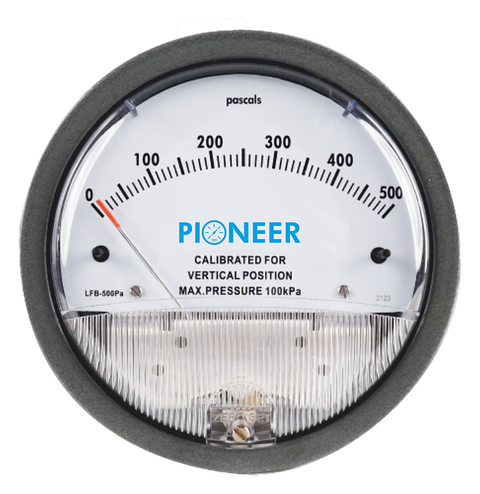
An analogue low differential pressure gauge has a diaphragm connected to high and low pressure ports. The diaphragm deflects against a calibrated range spring and drives the pointer through a low-friction magnetic linkage. It needs no power, has no electronics and shows the pressure difference directly on a dial, typically 100 mm (4 inch) in diameter.
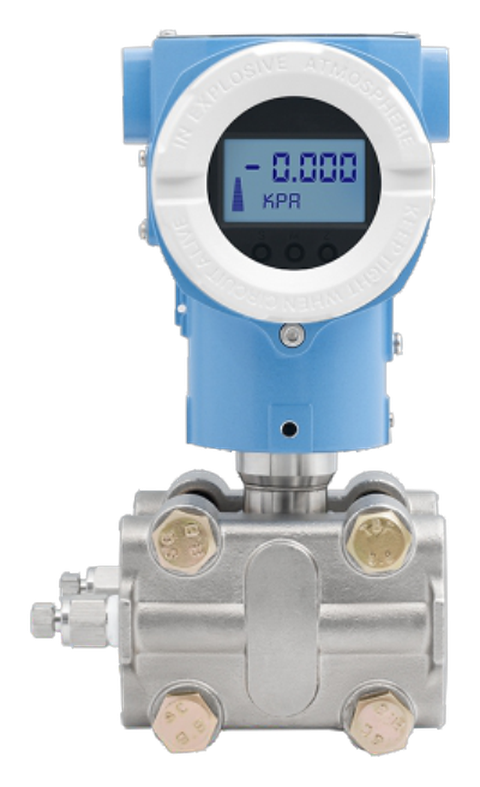
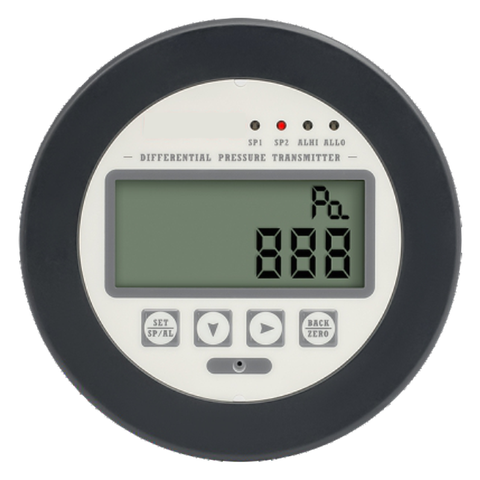
A digital differential pressure instrument uses an electronic sensing element and converts the pressure difference into a displayed value, an output signal, or both. Three forms are often confused in specifications:
- Digital differential pressure gauge: a local numeric display, sometimes with alarm relays.
- Differential pressure transmitter: a 4–20 mA or 0–10 V output to a BMS, PLC or environmental monitoring system (EMS), with or without a local display.
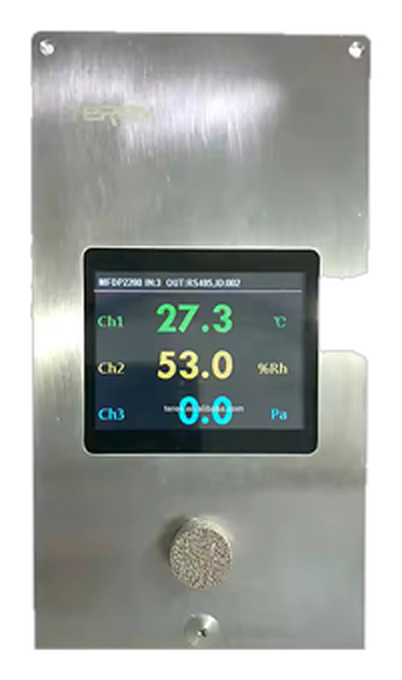
- Cleanroom room monitor: a flush wall panel that displays room differential pressure, often with temperature and humidity, and provides local alarms and outputs to the EMS.
Accuracy and range at 10 to 15 Pa
Cleanroom cascades work with small numbers. EU GMP Annex 1 gives a guidance value of at least 10 Pa between adjacent rooms of different grades, and many designs use steps of 10–15 Pa. At these values the instrument error, usually quoted as a percentage of full scale, decides whether a reading means anything.
Analogue low differential pressure gauges are generally specified at a few percent of full scale; Pioneer's current listing quotes figures between ±2.5% and ±4% of full scale. The error applies anywhere on the dial, so it is a much bigger share of a small reading. The table uses ±3% of full scale as an illustration.
| Gauge range | Error at ±3% of full scale | Share of a 12 Pa reading |
|---|---|---|
| 0–60 Pa | ±1.8 Pa | about 15% |
| 0–125 Pa | ±3.75 Pa | about 31% |
| 0–250 Pa | ±7.5 Pa | about 63% |
For a 10–15 Pa cascade step, use the smallest range that covers the worst case, normally 0–60 Pa. Where the differential can reverse, for example across an airlock serving a containment area or during an HVAC upset, use a centre-zero ±60 Pa scale. Pioneer lists analogue gauges in 0–60, 0–125, 0–250, 0–500 and 0–750 Pa, a ±60 Pa centre-zero version, and 0–1 kPa to 0–8 kPa ranges.
Digital transmitters are commonly specified at ±0.25% to ±1% of span. On a 0–100 Pa span, ±0.5% is ±0.5 Pa, comfortably inside a typical alert band. At low ranges, look past the headline accuracy to zero stability and temperature effect, because a 1 Pa zero drift matters more than a linearity figure. Pioneer's differential pressure transmitter is listed at ±0.5% of full scale (±0.25% optional), with stability of ±0.25% of full scale per year.
AHU filter monitoring
Filter monitoring is where the analogue gauge is hardest to beat. The pressure drop across a pre-filter, fine filter or HEPA bank runs to hundreds of pascals, a few percent of full scale is ample, and the technician only needs to see whether the pointer has reached the change mark.
- Choose a range where the filter maker's recommended final pressure drop falls at roughly half to two-thirds of the scale. For a final drop of about 250–300 Pa, a 0–500 Pa gauge suits; HEPA banks with higher final drops usually need 0–750 Pa or 0–1 kPa.
- Fit one gauge per filter stage, high port upstream and low port downstream of the filter.
- Mark the clean (initial) and change (final) pressure drops on the dial or a label at commissioning.
- Where the BMS needs a dirty-filter alarm, add a differential pressure switch or transmitter on the same tappings rather than relying on someone to read the dial.
AHUs serving GMP areas often carry both: a dial for the technician and a transmitter so the monitoring system can trend filter loading.
Alarms, BMS outputs and door-opening transients
An analogue gauge has no output. It cannot raise an alarm or keep a record, so if a room's pressure difference must be alarmed, the instrument has to be electronic, or a separate switch or transmitter has to share the tapping.
Door openings cause most nuisance alarms. When a door between two rooms opens, the differential across it collapses towards zero within seconds and recovers after the door closes. A sound alarm scheme handles this as follows:
- Use an alarm delay that covers a normal door cycle. Annex 1 expects alarm delays to be assessed and justified within the contamination control strategy (CCS).
- Separate an alert level (early warning) from an action or alarm level, both inside the validated range.
- Log the raw value continuously, not only alarm events, so an investigator can tell a door transient from a sustained loss of cascade.
- Where door discipline matters, bring door contacts into the EMS so a door held open is alarmed in its own right.
- Give the room a local visual and audible alarm at the entry door, not only an alarm in the control room.
On an analogue dial the same transient shows as the pointer dipping and recovering. That helps an operator standing at the door but leaves no evidence afterwards.
For outputs, two-wire 4–20 mA is the usual choice for long cable runs and makes a broken loop detectable; 0–10 V suits short runs into BMS controllers. Pioneer's transmitter offers 4–20 mA two-wire or 0–10 V three-wire output, and its clean room monitor accepts up to three 4–20 mA or 0–10 V inputs and provides up to three 0–10 V outputs.
Data integrity and audit trail in GMP areas
Annex 1 states that air pressure differences identified as critical should be continuously monitored and recorded, with a warning system that is not overridden without assessment. A dial cannot meet that on its own, and a handwritten log of dial readings is a periodic snapshot, not continuous monitoring.
The audit trail does not live in the transmitter. It lives in the EMS or BMS software that records the signal. For GMP use that software is validated as a computerised system (EU GMP Annex 11, and 21 CFR Part 11 for US-regulated sites), with user access control, time-stamped records, an audit trail of setpoint and alarm changes, and backup. Keep the two scopes separate when you specify:
- Instrument: range, accuracy, output, tag number, serial number, and a calibration certificate with as-found and as-left values.
- Software: recording interval, alarm handling, audit trail, electronic records and signatures, and validation documents.
Analogue gauges still have a place in GMP areas as local indication, for example beside each airlock door so staff can confirm the cascade before entering. Tag and calibrate them, but do not treat them as the system of record for critical rooms.
Calibration and zero checks
- Calibrate against a reference micromanometer or pressure calibrator traceable to national standards, with an uncertainty several times better than the instrument under test.
- Check zero with both ports open to the same pressure. Zero an analogue gauge in its final mounting position: these gauges are calibrated with the diaphragm vertical and read differently if mounted flat.
- Check several points across the working range, concentrating on the setpoint region, for example 10, 15 and 30 Pa on a 0–60 Pa instrument.
- Record as-found and as-left results. An out-of-tolerance as-found result on a critical-room instrument should trigger an assessment of the data recorded since the last calibration.
- Set intervals by SOP and risk assessment. Annual calibration is common, with shorter intervals for instruments that show drift.
- Leak-check tubing and fittings at the same time; a cracked tube or loose barb reads as a low differential.
Installation points that decide the reading
- Use a dedicated, capped wall pressure port in each room, away from supply diffusers, return grilles and the door swing, so air velocity does not distort the static pressure.
- Decide the reference. Measuring each room against the adjacent room shows each cascade step directly; measuring every room against a common reference such as the corridor lets you compare rooms and add up the cascade. Show the choice on the room pressure drawing.
- Mount the instrument outside the room at eye level beside the entry door, and run the tubing through sealed penetrations so it does not become a leak path.
- Keep tubing short, unkinked and protected from crushing.
- The analogue gauge is for dry, clean, non-corrosive air and compatible gases. Pioneer's version has 1/8 inch NPT female high and low ports duplicated on the side and back, and comes with tube adapters and flush-mounting adapters, so it can be surface or flush mounted.
Comparison table
| Criterion | Analogue low DP gauge | Digital gauge, transmitter or room monitor |
|---|---|---|
| Power | None | Loop or low-voltage supply |
| Typical accuracy | A few percent of full scale (Pioneer lists ±2.5% to ±4%) | Commonly ±0.25% to ±1% of span (Pioneer transmitter ±0.5%, ±0.25% optional) |
| Lowest Pioneer range | 0–60 Pa and ±60 Pa | Check the datasheet for the span required |
| Reading near 10 Pa | Coarse; limited by dial resolution and parallax | Direct numeric value |
| Output and alarms | None | 4–20 mA or 0–10 V; local alarms on room monitors |
| Records and audit trail | None; manual log only | Through validated EMS or BMS software |
| Door transients | Pointer dips and recovers; no record | Logged; alarm delays and door contacts filter nuisance alarms |
| Calibration | Simple; front zero adjustment | Loop calibration; watch zero drift |
| Typical failure | Sticking pointer, damaged diaphragm after overpressure | Loss of power or signal, detectable on a 4–20 mA loop |
| Best fit | Filter banks, local door indication, non-critical rooms | Critical GMP cascades, BMS alarms, trending |
Decision checklist
- Is this pressure difference critical to product or patient protection? If yes, specify a transmitter or room monitor connected to a validated monitoring system with recording and alarms.
- Does an operator need to see the cascade at the door? Add a local display or analogue gauge there as well.
- What is the setpoint? Choose the smallest range that covers the worst case: 0–60 Pa or ±60 Pa for 10–15 Pa steps, hundreds of pascals only for filters.
- Can the differential reverse? Use a centre-zero range.
- What is the accuracy in pascals? Convert the full-scale error and compare it with your alert band.
- How will door openings be handled? Define alarm delays, alert and action limits and door contacts, and justify them in the CCS.
- Which output does the BMS or EMS accept, 4–20 mA or 0–10 V, and who owns software validation?
- What calibration documentation and interval does your SOP require?
What Pioneer supplies
Pioneer supplies analogue low differential pressure gauges from 0–60 Pa to 0–8 kPa, differential pressure transmitters with 4–20 mA or 0–10 V output, panel-type clean room monitors with built-in temperature, humidity and differential pressure sensing, and differential pressure gauges for filter and process duty. Send your room pressure schedule or filter list with the ranges and outputs you need, and Pioneer will quote, typically within 48 hours.