Key takeaways
- Hot-wire (thermal) anemometers are the most sensitive at low velocity and suit cleanrooms, fume hoods and room air, but need clean, dry air.
- Vane anemometers average the flow over a larger face and are the usual choice at grilles, diffusers and filter faces.
- A pitot tube has no moving parts or heated element, so it suits duct traverses, hot or dusty air and higher velocities; below about 3 m/s the pressure signal becomes very small.
- Velocity from a pitot tube at standard air density: V (m/s) ≈ 1.29 × √(velocity pressure in Pa). Correct for temperature and altitude when air is not near 20 °C and sea level.
- Airflow is velocity × area, so a good traverse (many points, straight duct, correct area) matters as much as the instrument.
The three instruments in one table
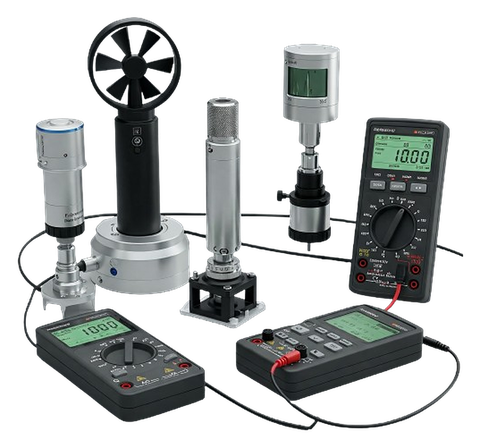
An air velocity meter is any instrument that measures how fast air moves, usually in m/s or feet per minute (1 m/s ≈ 197 fpm). In HVAC work three sensing principles cover almost every job. The table compares them on the points that decide selection.
| Point | Hot-wire / thermal anemometer | Vane anemometer | Pitot tube + manometer |
|---|---|---|---|
| How it works | Heated sensor is cooled by moving air; cooling rate gives velocity | A small rotor spins with the air; rotation speed gives velocity | Measures velocity pressure (total minus static); velocity is calculated from it |
| Best velocity range | Very low to moderate (from about 0.1 m/s) | Low to moderate; poor at very low velocity because of bearing friction | Moderate to high; weak signal below about 3 m/s |
| Measuring area | Point (a few mm) | Area of the vane head (larger heads average more) | Point |
| Typical use | Cleanroom laminar flow, fume hoods, biosafety cabinets, room air, small ducts | Grilles, diffusers, louvres, filter faces, cooling-tower and coil faces | Duct traverses, AHU and fan testing, hot or dusty exhaust |
| Limits | Dust, moisture and high temperature affect the sensor; directional | Moving parts; head blocks small ducts; turbulence at grilles | Needs a sensitive manometer; density correction required |
| Calibration need | Regular, sensor drifts with contamination | Regular, bearing wear | Pitot itself is a primary device; calibrate the manometer |
Hot-wire (thermal) anemometers: low velocity and cleanrooms
A thermal anemometer keeps a small sensor above air temperature and measures the power needed to do so. Faster air removes more heat. Because the signal is strong even at a few tenths of a metre per second, this is the instrument of choice where air moves slowly:
- Cleanroom unidirectional (laminar) flow under HEPA filters, where design velocities are typically around 0.3–0.5 m/s.
- Fume hood and biosafety cabinet face velocity checks.
- Room air movement and draught checks for comfort studies.
Most hot-wire probes on telescopic wands also read air temperature and some read humidity, which is useful for HVAC balancing. Keep them out of dusty, oily, wet or very hot air: deposits on the sensor change its heat transfer and the reading drifts. The probe is also directional, so align the marked side with the airflow.
Vane anemometers: grilles, diffusers and filter faces
A vane anemometer is a small propeller in a ring. Its big advantage is area: a 70–100 mm head averages velocity over a much larger face than a point probe, which is what you want at a supply grille or return louvre where velocity varies a lot from one spot to the next.
For grilles and diffusers, measure at several positions across the face (or sweep the head slowly), average, and multiply by the effective free area of the grille, not its overall size. Many technicians fit a flow hood or cone to the vane head so the whole outlet passes through it and the meter reads flow directly in m³/h or CFM.
Vanes are less suitable at very low velocity, where bearing friction stops the rotor turning freely, and inside small ducts, where the head itself blocks part of the flow.
Pitot tubes: the reference method for duct traverses
A pitot-static tube has two concentric tubes: the tip faces the airflow and senses total pressure, side holes sense static pressure. The difference is velocity pressure, read on a differential pressure gauge or digital manometer. For air at about 1.2 kg/m³ (20 °C, sea level):
V (m/s) ≈ 1.29 × √Pv (Pa), or Pv ≈ 0.6 × V².
| Air velocity | Velocity pressure (approx.) | What it means |
|---|---|---|
| 2 m/s | 2.4 Pa | Too small for most gauges; use a thermal probe |
| 5 m/s | 15 Pa | Readable on a good digital manometer |
| 10 m/s | 60 Pa | Comfortable range for duct work |
| 20 m/s | 240 Pa | Easy to read; typical of high-velocity ducts |
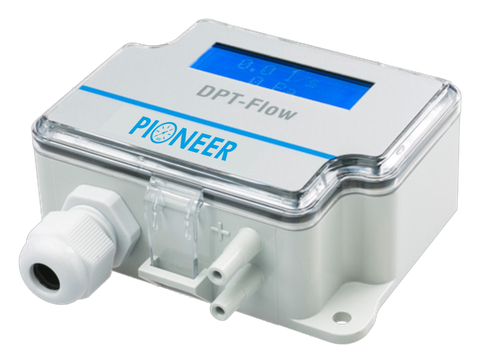
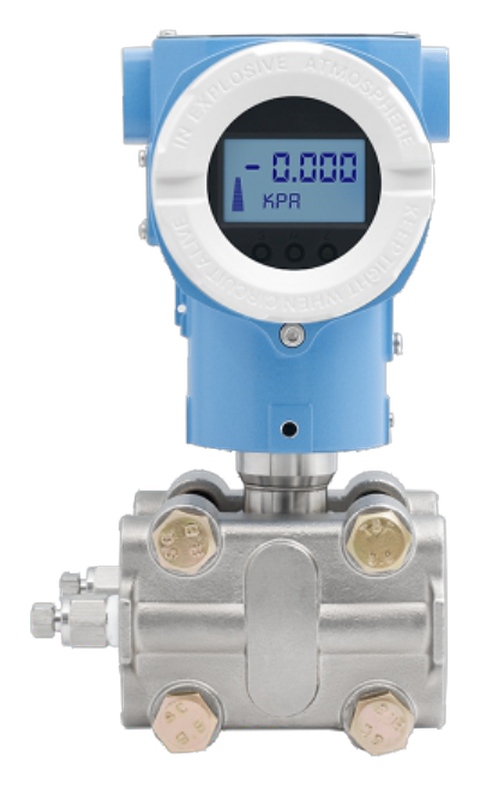
Because the pitot tube has no heated element or moving parts, it tolerates hot, dusty and humid air, and it is the method named in duct-testing standards. For hot or high-altitude air, correct the density: lighter air gives a lower velocity pressure for the same velocity, so uncorrected readings understate velocity. Fixed averaging pitot arrays with a differential pressure transmitter are used for continuous duct airflow monitoring in BMS systems.
How to measure duct airflow correctly
Volume flow is average velocity × duct cross-section area (Q = V × A). A single centre-line reading usually overstates the average, because air is slower near the walls. A proper traverse fixes this:
- Choose a straight section. Measure as far as practical from elbows, dampers, fans and transitions. Disturbed flow gives scattered, unreliable readings.
- Use a recognised point pattern. Equal-area or log-Tchebycheff positions are the common methods (ASHRAE Standard 111 and ISO 3966 describe traverse practice). Rectangular ducts need a grid of points across the face; round ducts are traversed along two diameters at right angles.
- Average velocities, not pressures. With a pitot tube, convert each reading to velocity first, then average. Averaging pressures and then converting gives a biased result.
- Use the internal area. Measure inside dimensions and allow for internal insulation or lining.
- Record conditions. Note air temperature and, for pitot work, correct to actual density.
| Job | First choice | Alternative |
|---|---|---|
| Cleanroom HEPA filter face / laminar flow | Hot-wire anemometer | Vane with small head |
| Supply and return grilles, diffusers | Vane anemometer or flow hood | Hot-wire with multiple points |
| Main duct traverse, AHU testing | Pitot tube + digital manometer | Hot-wire (clean air, moderate velocity) |
| Kitchen or process exhaust, hot or dusty air | Pitot tube | — |
| Fume hood face velocity | Hot-wire anemometer | Vane (large hoods) |
| Continuous BMS airflow monitoring | Duct air velocity transmitter or averaging pitot + DP transmitter | — |
Portable meter or fixed transmitter?
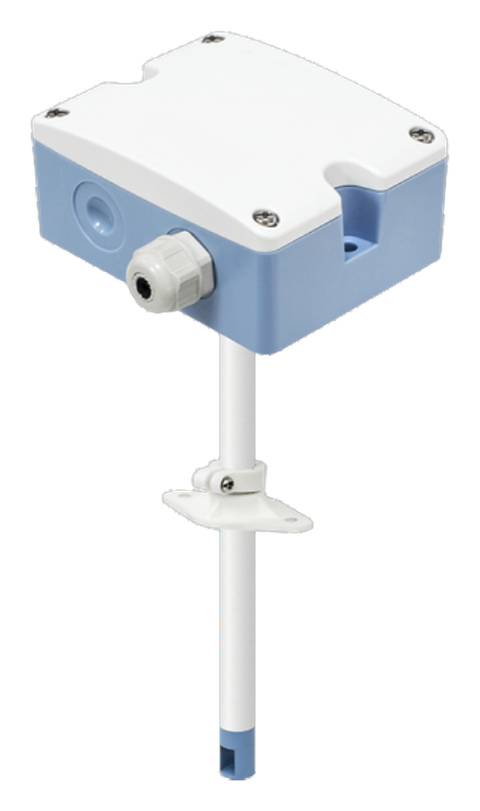
Portable anemometers are for testing, balancing and commissioning, and for periodic checks during validation. When the airflow has to be watched all the time, for example minimum fresh air in an office, exhaust airflow in a lab, or airflow alarms in a pharma AHU, use a fixed air velocity transmitter with a 4–20 mA, 0–10 V or Modbus output to the BMS. See our duct air flow measurement page for fixed probes and transmitters.
When specifying either, state the velocity range you need to read (not just the maximum), air temperature, whether the air is clean, the duct size, the output signal and whether a calibration certificate is required.