Key takeaways
- Put normal operating pressure in the middle third of the scale and keep maximum working pressure below about 75% of full scale for steady pressure, or about two-thirds for fluctuating pressure.
- Accuracy class is a percentage of span: class 1 on a 0–10 bar gauge means ±0.1 bar anywhere on the dial, so an oversized range wastes accuracy.
- Use stainless steel 316 wetted parts for corrosive media, steam and ammonia; brass is fine for clean air, water and oil.
- Glycerine filling damps vibration and pulsation, but do not use it on oxygen or strongly oxidising media.
- Steam always needs a water-filled siphon; pulsating pumps and water hammer call for a snubber; slurries, viscous, crystallising or hygienic media need a diaphragm seal.
- BSP and NPT threads are not interchangeable; state the thread form, size and sealing method on every order.
Start with the duty
Write down five things about the measuring point first. Most selection mistakes come from leaving one out.
- Medium: air, water, oil, steam, gas, chemical, slurry, food product, oxygen. This decides the wetted materials and whether a seal is needed.
- Pressure: normal operating pressure, maximum working pressure, any test pressure, and whether the pressure is steady, fluctuating or pulsating.
- Temperatures: of the medium at the tapping and of the surroundings.
- Conditions at the gauge: vibration, outdoor exposure, washdown, corrosive atmosphere.
- Use of the reading: a quick operator check, a value logged in a report, or a reference for calibrating other gauges.
For gauge pressure from about 1 kg/cm² upwards, a Bourdon tube gauge is the normal choice. Below that, use a diaphragm or capsule gauge, and for air pressure differences in pascals, a low differential pressure gauge.
Range: the middle-third rule
A Bourdon tube gauge is most accurate and lasts longest when it works in the middle of its scale. Two rules of thumb, consistent with the selection guidance in EN 837-2, cover most cases:
- Normal operating pressure should fall in the middle third of the scale. A full scale of roughly twice the operating pressure is a good starting point.
- Maximum working pressure should stay below about 75% of full scale for steady pressure, and below about two-thirds where the pressure fluctuates.
Example: a line runs at 5 kg/cm² and peaks at 7 kg/cm² with steady pressure. A 0–10 kg/cm² gauge puts normal pressure at 50% and the peak at 70% of scale, which meets both rules. A 0–6 gauge would sit at 83% in normal service and fatigue the Bourdon tube; a 0–25 gauge would show it on a fifth of the dial.
Standard ranges follow the series 1, 1.6, 2.5, 4, 6, 10, 16, 25, 40, 60, 100 and so on. Pioneer's Bourdon gauges cover 0–1 to 0–600 kg/cm², with vacuum (0–760 mmHg) and compound ranges for lines that go below atmospheric pressure, such as pump suctions. Order in the unit the plant uses: kg/cm², bar, psi or kPa, or a dual scale where two units are in use.
Overrange tolerance is protection against an occasional surge, not working range. Pioneer's SS gauges tolerate 130% of full scale, but sustained operation in the top quarter of the dial shortens gauge life.
Accuracy classes: EN 837-1 and IS 3624
Mechanical gauge accuracy is expressed as a percentage of span. EN 837-1, the European standard for Bourdon tube gauges, defines accuracy classes 0.1, 0.25, 0.6, 1, 1.6, 2.5 and 4. IS 3624, the Indian standard for Bourdon tube pressure and vacuum gauges, also states accuracy as a percentage of full-scale deflection (FSD).
| Use of the reading | Typical accuracy | Typical dial size |
|---|---|---|
| Compressed air lines, utility points | ±1.6% to ±2.5% | 40–63 mm |
| Process and plant monitoring, HVAC chilled and condenser water | ±1% (class 1) | 100–150 mm |
| Checking or calibrating other gauges, hydrostatic tests | ±0.25% or better | 150–250 mm |
Convert the class into pressure before deciding. A class 1 gauge on 0–10 kg/cm² is within ±0.1 kg/cm² anywhere on the scale, which is ±2% of a 5 kg/cm² reading. A reference gauge used for calibration should be several times more accurate than the gauge under test; a ratio of about 4:1 is a common target.
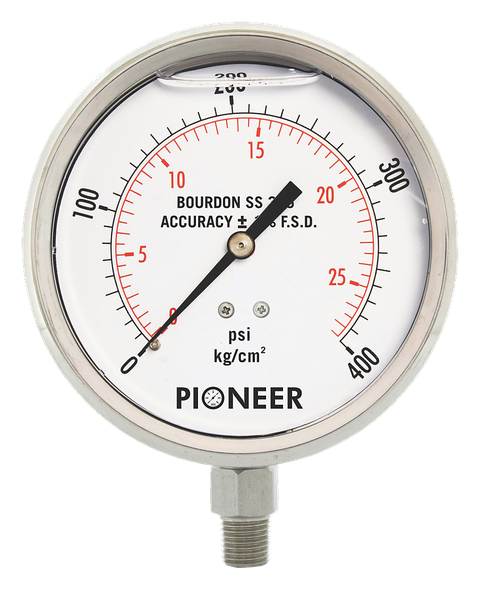
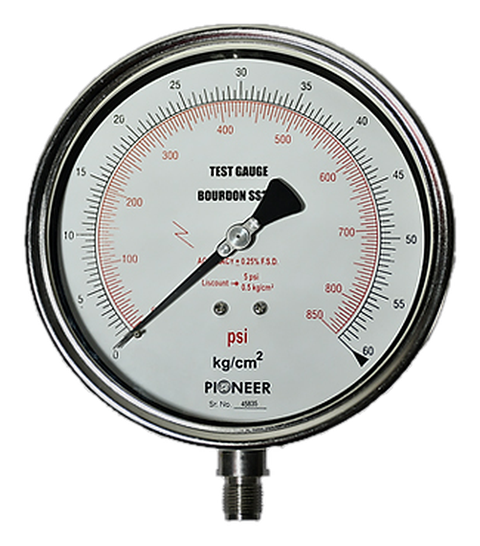
Pioneer's SS Bourdon gauges are calibrated to ±1% FSD as per IS 3624, and its test gauges to ±0.25% FSD. For readings you need to log or resolve finely, a digital pressure gauge (±0.5% of full scale, with peak hold) avoids parallax and reading errors.
Dial size
- 40–63 mm: compressors, pneumatic regulators, compact machines and panels, where the gauge is read at arm's length and space is tight.
- 100 mm: the general process and HVAC size, readable from 1–2 metres.
- 150 mm: pump headers, plant rooms and gauges read from a walkway.
- 200–250 mm: long viewing distances and test gauges, where finer scale divisions make the extra accuracy usable.
A larger dial does not change the accuracy class but makes small divisions readable. Pioneer lists 40, 50, 63, 100, 150, 200 and 250 mm across its pressure gauge range.
Wetted materials and case
The wetted parts are the socket and the Bourdon tube, or the diaphragm where a seal is fitted. These decide compatibility with the medium.
- Brass or copper alloy: clean air, water, oil and non-corrosive gases. Economical for hydraulic and pneumatic machinery; Pioneer's commercial gauges use a brass system in a powder-coated MS case.
- Stainless steel 316: corrosive liquids and gases, steam (with a siphon), ammonia refrigeration (copper alloys are attacked by ammonia), food, pharmaceutical and outdoor plant. Pioneer's SS gauges use an SS 316 Bourdon tube and socket, SS 304 case and movement, and IP65/IP67 protection.
- Media SS 316 cannot handle: use a diaphragm seal with a suitable diaphragm material and check compatibility with the supplier.
The case matters too. Outdoors, in washdown areas and in humid plant rooms, specify a stainless steel weatherproof gauge. A painted steel case with sheet glass suits dry indoor machinery.
Liquid filling for vibration and pulsation
Vibration from pumps, compressors and engines makes a dry gauge pointer flutter until it cannot be read, and it wears the movement. Filling the case with liquid damps the pointer and lubricates the movement.
- Glycerine (usually a glycerine-water mixture) is the standard fill for pumps, hydraulics and compressors at normal ambient temperatures.
- Silicone oil stays fluid over a wider temperature range and suits cold locations or large temperature swings.
- Do not use glycerine filling on oxygen, chlorine or other strongly oxidising media. Use a dry gauge cleaned for the service, or a fill confirmed as compatible.
Liquid filling helps with mechanical vibration and mild pulsation. For sharp pressure spikes, add a snubber as well. Pioneer offers glycerine and silicone filling.
Siphons, snubbers and diaphragm seals
Siphons for steam and hot condensable vapour
Live steam reaching a Bourdon tube overheats it and causes large errors and early failure. A siphon, either a pigtail or a U-loop, traps condensate so the gauge sees water at a much lower temperature. Fill the siphon with water before first commissioning, and mount the gauge so the loop stays full.
Snubbers for pulsation and water hammer
Reciprocating pumps, fast-acting valves and water hammer send pressure spikes that can bend the Bourdon tube or break the movement. A snubber, a porous element or small orifice in the connection, smooths these out. Snubbers can block on dirty media, so check them during maintenance.
Diaphragm seals for difficult media
A diaphragm seal separates the medium from the gauge using a flexible diaphragm and a sealed fill liquid. Use one for slurries, viscous or crystallising media, highly corrosive chemicals, hygienic food and pharmaceutical lines, and very hot media (with a capillary). A seal adds some error and slows the response, and the fill liquid must suit the process temperature. Size the seal for the range: a small diaphragm on a low range reads poorly.
Isolation valves
Fit a needle valve or ball valve at every gauge so it can be removed for calibration without shutting down the line. Pioneer supplies siphon tubes, snubbers, needle valves and ball valves as gauge accessories.
Mounting and connection threads
Mounting styles:
- Direct (stem) mounting, bottom entry: the gauge is carried on the pipe connection. This is the most common style.
- Surface (wall) mounting, bottom entry: the gauge is fixed to a wall or bracket and connected by tube. Use it where the line vibrates or the tapping is hard to see.
- Flush or panel mounting, back entry with clamps or a front flange: for control panels and gauge boards.
Threads: common gauge connections are 1/4, 3/8 and 1/2 inch BSP or NPT, and M20 × 1.5. NPT is a tapered thread that seals on the thread. BSP comes as parallel or taper, and the parallel form seals on a washer or bonded seal. BSP and NPT have different thread angles (55° and 60°): they may start to engage, but they will not seal reliably. Always state the size, the thread form and the connection location, for example "1/2 inch NPT male, bottom". Pioneer offers 3/8 and 1/2 inch BSP and NPT and M20 × 1.5 on its SS gauges, and 1/4 inch BSP on commercial gauges.
When to specify a safety pattern
If the Bourdon tube ruptures, the case fills with pressurised medium in a fraction of a second. A blow-out device in the back of the case lets that pressure escape backwards instead of through the window. EN 837-1 defines safety levels for gauge cases. The highest, S3, adds a solid baffle wall between the measuring element and the dial, so the front of the gauge is protected even if the element bursts.
Consider a solid-front safety pattern for:
- Gases and compressed air at high pressure, where stored energy is greatest
- Steam and hot media
- Oxygen and other hazardous gases
- Gauges an operator stands directly in front of, for example on test benches
Pioneer's SS weatherproof gauges have a blow-off disc at the back of the case. If your specification calls for a solid-front safety pattern, state it on the enquiry so the right construction is quoted.
Comparison table
| Gauge type | Typical accuracy | Best for | Watch out for |
|---|---|---|---|
| Brass system, painted steel case | Typically ±1.6% to ±2.5% | Pneumatic and hydraulic machinery, dry indoor locations | Not for corrosive media, steam or outdoor exposure |
| SS 316 Bourdon, weatherproof | ±1% FSD (IS 3624) | Process, utilities, HVAC, outdoor and washdown areas | Needs a siphon for steam and a snubber for pulsation |
| Liquid-filled SS Bourdon | ±1% FSD | Pumps, compressors, vibrating machinery | No glycerine on oxygen or strong oxidisers |
| Test gauge | ±0.25% FSD | Checking gauges, laboratories, hydrostatic tests | A reference instrument, not for continuous line service |
| Digital pressure gauge | ±0.5% FS | Testing, diagnostics, peak capture, unit switching | Battery-powered; check the operating temperature range |
| Diaphragm or seal gauge | Lower than an unsealed gauge | Low pressure, slurries, viscous, hygienic or aggressive media | Size the seal and choose the fill liquid for the process temperature |
Common mistakes
- Choosing the range from the pump's shut-off head or the design pressure, so normal pressure reads in the bottom fifth of the dial.
- Running a gauge permanently in the top quarter of its scale.
- Fitting a dry gauge on a pump or compressor that vibrates.
- Connecting a gauge to steam without a siphon, or never priming the siphon.
- Using brass wetted parts on ammonia or corrosive media.
- Mixing BSP and NPT threads, then adding sealant to stop the leak.
- Fitting no isolation valve, so the gauge is never removed for calibration.
- Specifying "pressure gauge 0–10" without the unit, dial size, connection or material.
Specification checklist
- Medium and process temperature
- Normal and maximum working pressure, and whether steady, fluctuating or pulsating
- Range and unit, using the middle-third rule; single or dual scale
- Accuracy, for example ±1% FSD as per IS 3624 or EN 837-1 class 1
- Dial size, for example 100 mm or 150 mm
- Wetted parts and case material, for example SS 316 Bourdon and socket with SS 304 case
- Liquid filling: none, glycerine or silicone
- Accessories: siphon, snubber, diaphragm seal, needle or ball valve
- Mounting style and connection, for example 1/2 inch BSP bottom, direct mounting
- Safety pattern, ingress protection and calibration certificate requirements
Send this list to Pioneer for any of its pressure gauges, and you will typically receive a quotation within 48 hours.