Key takeaways
- pH tells you how acidic or alkaline a sample is; conductivity tells you how much dissolved ionic material it carries. Most water-treatment checks need both.
- The electrode or conductivity cell decides accuracy more than the meter does: match it to the sample (pure water, general water, viscous, solids-laden or hot).
- Calibrate pH with at least two buffers that bracket your samples (pH 7 plus pH 4 or 10); a healthy electrode shows a slope of roughly 95 to 105 % and an offset near 0 mV.
- Pick the conductivity cell constant by range: K = 0.1 for pure and RO water, K = 1.0 for general water, K = 10 for high-conductivity samples.
- Use automatic temperature compensation and report conductivity at 25 °C, otherwise readings taken at different temperatures cannot be compared.
pH vs conductivity: what each one tells you
pH is a measure of hydrogen-ion activity on a scale of 0 to 14: 7 is neutral, below 7 is acidic and above 7 is alkaline. Because the scale is logarithmic, a change of one pH unit is a tenfold change in acidity. A pH meter measures the small voltage produced by a glass electrode against a reference electrode; at 25 °C an ideal electrode produces about 59.16 mV per pH unit (the Nernst slope).
Conductivity is the ability of a solution to carry electric current, which rises with the amount of dissolved ions (salts, acids, alkalis). It is reported in µS/cm or mS/cm. Conductivity does not tell you which ions are present, only how much ionic material there is, which is why it is the standard quick check on RO permeate, DM water, boiler feed water and cooling tower blowdown.
| Sample | Typical conductivity at 25 °C |
|---|---|
| Ultrapure water (18.2 MΩ·cm) | 0.055 µS/cm |
| RO permeate / DM water | about 1 to 50 µS/cm |
| Drinking water | about 50 to 1,500 µS/cm |
| Cooling tower water | about 1,000 to 5,000 µS/cm |
| Seawater | about 50 to 55 mS/cm |
Many meters also show TDS (total dissolved solids). This is calculated from conductivity using a factor, usually between 0.5 and 0.7, so a TDS reading is only as good as the factor set in the meter.
Portable, benchtop or combination meter?
| Format | Best for | Points to check |
|---|---|---|
| Portable / handheld | Field checks, plant rounds, cooling towers, effluent outlets, site commissioning | Rugged housing, battery life, automatic temperature compensation, simple 1 to 3 point calibration |
| Benchtop | Laboratory QC, pharma and food labs, water testing labs | More calibration points, data storage or printing, stable electrode stand, GLP records |
| Combination (pH + conductivity) | Water treatment and utilities where both are checked at the same point | Separate inputs for electrode and cell, both with temperature compensation |
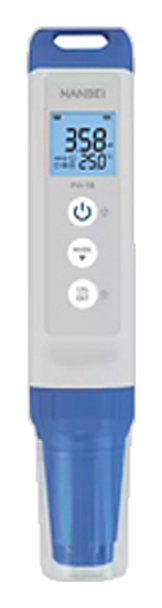
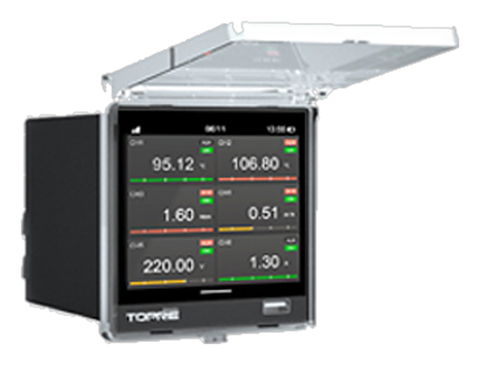
For continuous monitoring of a process line or tank, a handheld meter is the wrong tool: use an online pH or conductivity transmitter with a 4 to 20 mA output to the PLC or BMS, and keep a portable meter for cross-checks. See our pH and conductivity meters for the portable, benchtop and combination formats we supply.
Choosing the pH electrode
The electrode is the part that wears out and the part that most often causes poor readings. Match it to the sample:
- General purpose (gel or refillable, glass body or epoxy body): clean water, buffers and most aqueous samples. Epoxy bodies are tougher for field use; glass bodies tolerate solvents and higher temperatures.
- Low-ionic-strength water (RO, DM, condensate, rainwater): needs an electrode with a free-flowing or high-flow junction, because standard electrodes drift and respond slowly in pure water.
- Viscous, oily or solids-laden samples (sludge, emulsions, food): an open or sleeve junction that does not clog easily.
- High temperature: an electrode rated for the process temperature; general electrodes are usually limited to well below boiling.
- Solid or semi-solid samples: a spear-tip electrode.
Store the electrode wet in its storage solution (normally 3 M KCl), never in distilled or DI water, which leaches the reference electrolyte and slows the response. A pH electrode is a consumable; plan to replace it when slope or response time no longer meets your acceptance criteria.
Choosing the conductivity cell constant
A conductivity cell is described by its cell constant K (in cm⁻¹), which depends on the electrode area and spacing. A low K suits low-conductivity water; a high K suits concentrated samples. Using the wrong constant reduces accuracy at the ends of the range.
| Cell constant K | Typical range | Typical samples |
|---|---|---|
| 0.01 to 0.1 cm⁻¹ | below about 20 µS/cm | Ultrapure, RO permeate, DM water, boiler feed |
| 1.0 cm⁻¹ | about 10 µS/cm to 20 mS/cm | Drinking water, cooling tower, general process water |
| 10 cm⁻¹ | about 1 mS/cm and above | Seawater, brines, effluent, chemical solutions |
Two-electrode cells are simple and accurate in clean, low to medium conductivity water. Four-electrode cells resist polarisation and fouling and cover a wider range, so they suit high-conductivity and dirty samples.
How to calibrate a pH meter
- Use fresh, in-date buffers; standard sets are pH 4.01, 7.00 and 10.01 at 25 °C. Never pour used buffer back into the bottle.
- Rinse the electrode with DI water and blot (do not wipe) between buffers.
- Calibrate at pH 7 first, then pH 4 for acidic samples or pH 10 for alkaline samples. Use all three when samples span both sides of neutral.
- Let the buffer and electrode reach the same temperature, or use automatic temperature compensation with the temperature probe in the buffer.
- Read the slope and offset the meter reports. Typical acceptance: slope about 95 to 105 % and offset within about ±30 mV of 0. Outside that, clean or replace the electrode.
- Check against a third buffer or a check standard and record the result.
How often? Daily or before each batch for laboratory and QC work; at least weekly for field meters in regular use, and whenever the electrode has been cleaned, dried out or replaced. Regulated laboratories follow their own procedures, for example USP <791> for pharmaceutical pH measurement.
How to calibrate a conductivity meter and compensate for temperature
Calibrate with a potassium chloride (KCl) standard close to the range you measure. Common standards are 84 µS/cm, 1,413 µS/cm (0.01 M KCl) and 12.88 mS/cm (0.1 M KCl), all at 25 °C. One point is often enough for a single range; use two when samples span a wide range. Low-conductivity standards are easily contaminated by air and handling, so use them once and discard.
Temperature compensation matters more for conductivity than for pH. Conductivity of most natural and process waters rises by roughly 2 % per °C, so a sample at 35 °C reads about 20 % higher than the same sample at 25 °C. Meters correct this with a temperature coefficient (commonly 2 %/°C for general water) and report the result referenced to 25 °C. Ultrapure water and some chemical solutions need non-linear or specific coefficients; pharmaceutical water testing under USP <645> uses non-temperature-compensated readings compared against a temperature table.
For logging trends between spot checks, a data logger can record readings with time stamps, and our environmental monitoring range covers related water and air checks.
Common causes of wrong readings
| Symptom | Likely cause | What to do |
|---|---|---|
| pH reading drifts and never settles | Clogged junction, low-ionic sample, dry electrode | Clean junction, use a pure-water electrode, rehydrate in storage solution |
| Slow pH response | Ageing or coated glass bulb | Clean as per manufacturer's instructions; replace if slope stays low |
| Conductivity reads high and unstable in RO water | CO₂ from air dissolving in the sample, wrong cell constant | Measure in a flow cell or quickly in a closed vessel; use K = 0.1 cell |
| Readings differ between morning and afternoon | Temperature compensation off or wrong coefficient | Enable ATC, check coefficient and reference temperature (25 °C) |