Pressure Instruments · PI
Bourdon Type SS Pressure Gauge — All Stainless Steel
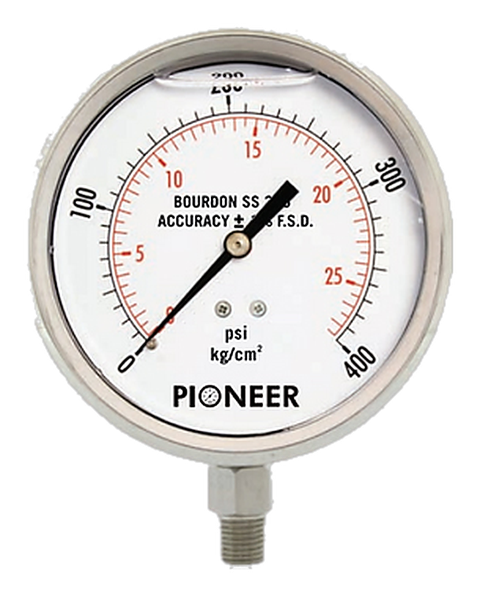
The Bourdon type SS pressure gauge is Pioneer's all-stainless process gauge: SS 316 Bourdon tube and socket, SS 304 case and movement, ±1% FSD to IS 3624. Ranges run from 0–1 to 0–600 kg/cm² plus vacuum and compound, on 100 to 250 mm dials, dry or glycerine filled.
- Over-range: 130% of full scale
- Dial scale: Single or dual scale
- Accuracy: ±1% FSD as per IS 3624

Overview
What it does and where it fits.
Stainless steel throughout makes this the gauge to specify for chemical, petrochemical, food and power plant service, where a brass system would corrode or contaminate the product. The socket is welded directly to the case, and the knife-edge micrometer pointer allows fine reading and zero setting.
Choose the glycerine-filled version where the gauge sees high dynamic pressure loads or vibration, such as pump discharge and compressor lines. The dry version suits steady pressures. The medium must not be viscous or crystallising enough to block the Bourdon tube; for those services, add a diaphragm seal or use a diaphragm gauge.
Types
- DryFor steady pressures on clean liquids and gases.
- Glycerine filledDamps pointer flutter on pump, compressor and hydraulic lines with pulsation or vibration.
- Silicone filledLiquid-filled option for low ambient temperatures, per the all-SS gauge datasheet.
- Vacuum and compound ranges0–760 mmHg vacuum, or compound scales that read both vacuum and positive pressure.
- Dual scaleTwo units on one dial, for example kg/cm² and psi.
Features
- SS 316 Bourdon tube with SS 316 socket
- Socket welded directly to case
- SS 304 case and movement
- Knife-edge micrometer adjustable pointer
- ±1% FSD, calibrated as per IS 3624
- IP 65 / IP 67 protection
- Mechanical shock rating 15 g, 6 ms
- Dry or liquid filled
Applications
- Chemical and petrochemical plants
- Oil and gas installations
- Refrigeration plants
- Power plants
- Food processing
- Gaseous or liquid media that will not obstruct the pressure system
Specifications
Spec table.
Standard ranges and materials. Tell us your medium, range and connection and we will match the model.
| Parameter | Value |
|---|---|
| Dial size | 100, 150, 200, 250 mm (40, 50 and 63 mm also available in the all-SS build) |
| Range | 0–1, 1.6, 2.5, 4, 6, 10, 16, 25, 40, 60, 100, 160, 250, 400, 600 kg/cm²; vacuum 0–760 mmHg; compound ranges |
| Units | kg/cm², psi, bar, kPa |
| Dial scale | Single or dual scale |
| Accuracy | ±1% FSD as per IS 3624 |
| Over-range | 130% of full scale |
| Protection | IP 65 / IP 67 |
| Mechanical shock | 15 g, 6 ms |
| Storage temperature | −20 °C to 60 °C |
| Case | SS 304, weatherproof and dust-proof |
| Dial | Aluminium, black graduations on white background |
| Window | Shatterproof glass or toughened glass |
| Measuring system | SS 316 Bourdon tube with SS 316 socket |
| Movement | SS 304 |
| Pointer | Knife-edge, micrometer adjustable |
| Process connection | 3/8" BSP, 3/8" NPT, 1/2" BSP, 1/2" NPT (M20 × 1.5 available) |
| Mounting | Direct mounting, bottom entry (surface, flush and panel mounting available) |
| Filling | Dry or glycerine filled (silicone filled available) |
Other ranges, units and connections on request.
For consultants
Consultant spec clause.
Paste it into your technical specification or BOQ, then adjust ranges and quantities to your schedule.
1. Pressure gauges shall be Bourdon tube type, all stainless steel, with SS 316 Bourdon tube and SS 316 socket welded to the case, and SS 304 movement.
2. Case shall be SS 304, weatherproof and dust-proof, protected to IP 65 (IP 67 where specified).
3. Dial shall be 150 mm (100 / 200 / 250 mm), aluminium with black graduations on white, single scale in kg/cm² (dual scale kg/cm² and psi where specified).
4. Pointer shall be knife-edge type with micrometer zero adjustment; window shall be shatterproof (toughened) glass.
5. Accuracy shall be ±1% FSD as per IS 3624, with over-range protection to 130% of full scale.
6. Range shall be selected so that normal working pressure is about 50% and not more than 75% of full scale; vacuum and compound ranges as scheduled.
7. Process connection shall be 1/2" BSP (1/2" NPT / 3/8" BSP / 3/8" NPT), bottom entry, direct mounting.
8. Gauges on pulsating or vibrating service shall be glycerine filled; gauges on steam service shall be fitted with a siphon and isolation valve.
9. Each gauge shall be supplied with a manufacturer's test certificate.
Make: Pioneer Industrial Instruments, Pune, or approved equivalent.
FAQ
Questions about Bourdon Type SS Pressure Gauge.
Anything else? Call or WhatsApp +91 93700 39974.
Why choose an all-stainless gauge over one with brass internals?
Brass Bourdon tubes and movements are attacked by ammonia, many acids, seawater and some process chemicals, and can contaminate food or pharmaceutical lines. An SS 316 Bourdon tube and socket with an SS 304 case and movement resists corrosion inside and out, and holds calibration longer in humid or chemical atmospheres. The extra cost is usually small against the cost of replacing failed gauges.
What does ±1% FSD as per IS 3624 mean in practice?
FSD is full-scale deflection. On a 0–10 kg/cm² gauge, ±1% FSD allows an error of ±0.1 kg/cm² anywhere on the scale. Because the error is fixed in absolute terms, the percentage error grows towards the bottom of the scale, which is another reason to size the range so the working pressure sits near mid-scale. IS 3624 is the Indian standard for pressure and vacuum gauges.
Can this gauge be used on steam lines?
Yes, provided a siphon (U-type or pigtail) is fitted between the line and the gauge, with an isolation valve. Condensate collects in the siphon and keeps live steam away from the Bourdon tube, so the gauge works near ambient temperature. Fill the siphon with water before first commissioning. Without a siphon, steam temperature affects accuracy and can damage the movement, window seal and case filling.
Do I need a vacuum or a compound range?
Use a vacuum range (0–760 mmHg) where the line only runs below atmospheric pressure, such as vacuum systems or pump suction from a sump. Use a compound range where pressure swings either side of atmospheric, for example pump suction that can go positive, or condensate return lines. A positive-only gauge on these services simply rests at zero during vacuum, hiding the real condition.
Which dial size should I choose?
Choose by reading distance. A 100 mm dial suits gauges read at arm's length on pipework and skids; 150 mm is the common choice in plant rooms read from a few metres; 200 and 250 mm dials suit high-mounted gauges or where finer graduations are needed. A larger dial does not change the accuracy class, but it reduces reading error.