Environmental Monitoring · XI
Light Meters — Digital Lux Meters for Illuminance Surveys
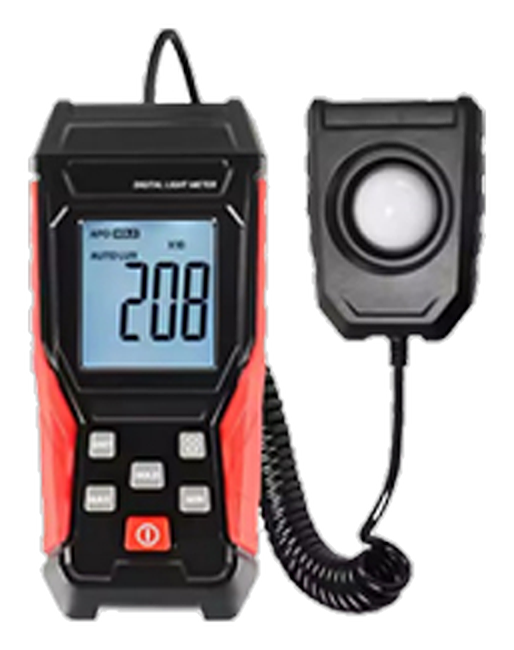
Pioneer supplies digital light meters (lux meters or illuminance meters) that read in lux and foot-candles, with data hold and min/max/average, and cosine correction and data logging on selected models, for lighting commissioning, workplace safety surveys and building audits.
- Display: Digital, backlit on selected models
Overview
What it does and where it fits.
A light meter measures illuminance, the amount of light falling on a surface. The SI unit is the lux (one lumen per square metre); the foot-candle (one lumen per square foot) is still used in some American documents, and one foot-candle is about 10.76 lux.
Lux surveys are part of lighting commissioning, workplace safety audits and daylighting documentation for green buildings. Readings are taken on a grid at the working plane, such as desk height in offices or floor level in corridors and car parks, and compared with the design levels for the space.
For survey work, specify a meter with a cosine-corrected sensor so that light arriving at a low angle is weighted correctly, and recalibrate it periodically. Range, resolution and accuracy depend on the model; Pioneer confirms them on the model datasheet with the quotation.
Types
- Handheld lux meterDirect illuminance reading in lux or foot-candles, with data hold and min/max/average.
- Data-logging lux meterRecords illuminance over time, for daylight studies and longer monitoring.
Features
- Readings in lux and foot-candles
- Data hold
- Min/Max/Avg recording
- Cosine correction on selected models
- Backlit display on selected models
- Data logging on selected models
Applications
- Lighting commissioning in offices, schools and hospitals
- Workplace and factory lighting safety audits
- Daylight measurement for green building documentation
- Museums and galleries where light exposure is limited
- Horticulture and greenhouse lighting checks
- Stage, studio and photography lighting set-up
Specifications
Spec table.
Standard ranges and materials. Tell us your medium, range and connection and we will match the model.
| Parameter | Value |
|---|---|
| Measured variable | Illuminance |
| Units | lux (lx), foot-candle (fc) |
| Functions | Data hold, Min/Max/Avg |
| Cosine correction | On selected models |
| Display | Digital, backlit on selected models |
| Data logging | Available on selected models |
Measuring range, resolution and accuracy depend on the model. Pioneer confirms them on the model datasheet with the quotation.
For consultants
Consultant spec clause.
Paste it into your technical specification or BOQ, then adjust ranges and quantities to your schedule.
1. Supply of a portable digital lux meter for illuminance measurement during lighting commissioning, to be handed over with the facility management instrument kit.
2. The meter shall read illuminance in lux (foot-candle selectable) and shall have a cosine-corrected sensor.
3. The meter shall have data hold and Min/Max/Avg functions, with data logging where specified in the schedule.
4. Measuring range shall cover the design illuminance of all areas from external and car-park lighting to task areas, and range, resolution and accuracy shall be stated in the bidder's technical datasheet for approval.
5. The meter shall be supplied with batteries, carrying case, operating manual and a manufacturer's test/calibration certificate.
Make: Pioneer Industrial Instruments, Pune, or approved equivalent.
How do I carry out a lux survey in an office or factory?
Switch the lighting on and let the lamps stabilise, and exclude daylight if you are checking artificial lighting alone. Mark a grid over the room, hold the sensor flat at the working plane, such as desk height, and keep your body and shadow away from it. Record every point, then report the average, the minimum and the uniformity (minimum divided by average) against the design values.
What is cosine correction and do I need it?
Light often reaches the sensor at an angle, from windows or from luminaires off to one side. A cosine-corrected sensor has a diffuser that weights that light correctly, in proportion to the cosine of its angle of incidence. Without it, the meter under-reads oblique light and survey results come out low. Specify cosine correction for any building lighting or daylight survey.
What is the difference between lux and foot-candles?
Both measure illuminance. One lux is one lumen per square metre; one foot-candle is one lumen per square foot, about 10.76 lux. Indian and European lighting standards give levels in lux, while some American documents use foot-candles. Pioneer supplies meters that read in both units, so readings can be reported in whichever unit the specification uses.
Can a lux meter measure LED lighting accurately?
Yes, if its spectral correction is good. A lux meter uses a filter to match the eye's sensitivity to different colours. LED spectra are peaky, so a sensor with poor spectral matching can read LED or coloured light with a larger error than it would under daylight. For commissioning LED installations, choose a meter whose datasheet states its spectral matching, and keep it in calibration.
Related