Level Instruments · LT
Radar and Ultrasonic Level Transmitters — Non-Contact Continuous Level Measurement
Pioneer supplies non-contact level transmitters for tanks, sumps, wells and silos: ultrasonic level meters with measuring ranges from 5 m up to 70 m, 0.2–0.5% of full-scale accuracy, 4–20 mA, RS485 and relay outputs, in integrated or separated (remote sensor) versions, and radar level transmitters for vapour, dust and high-temperature duties.
- Measuring range, integrated: 5, 10, 15, 20, 30, 50 m
- Accuracy: 0.2–0.5% of full scale
- Digital output: RS485
Overview
What it does and where it fits.
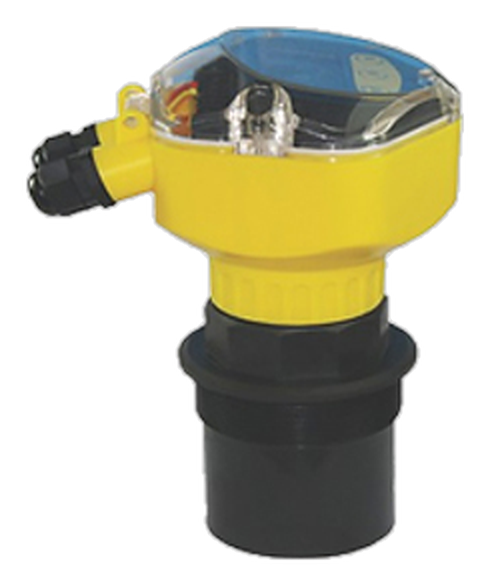
An ultrasonic level transmitter mounts on top of the tank and sends sound pulses down to the liquid or solid surface. It times the echo, converts the distance to level, and outputs 4–20 mA, RS485 and relay alarms. Nothing touches the medium, so there is no wear and no contamination.
Pioneer's ultrasonic level meter has a built-in temperature sensor to compensate for the effect of air temperature on the speed of sound. Upper and lower alarm points and the output can be set on site, and the blind zone can be set manually to ignore interference near the transducer. The integrated version covers 5 to 50 m; the separated version, with the transducer on a 10 m cable, covers 5 to 70 m.
Radar works on the same time-of-flight idea with microwaves instead of sound. Radar is largely unaffected by vapour, dust, foam, temperature and pressure changes, so it is the better choice for closed process vessels, solvents, hot liquids and dusty silos. Ultrasonic is usually the more economical choice for water, wastewater and open tanks.
Types
- Ultrasonic level meter, integrated typeTransducer and electronics in one top-mounted unit, ranges 5 to 50 m; explosion-protected option per datasheet.
- Ultrasonic level meter, separated typeTransducer on a 10 m cable with remote electronics, ranges 5 to 70 m; for hot, inaccessible or wet-well locations.
- FMCW radar level transmitterHigh accuracy and resolution, even in difficult conditions such as vapour and foam.
- Pulsed radar level transmitterA more economical radar option for less demanding applications.
- Guided wave radarMicrowave pulse travels along a probe; used for interface detection and low-reflectivity liquids.
Features
- Non-contact measurement, no wetted moving parts
- Measuring range 5 m to 70 m (ultrasonic)
- Accuracy 0.2–0.5% of full scale; resolution 3 mm or 0.1% FS
- Built-in temperature compensation
- 4–20 mA output; 1–5 V, 0–5 V, 0–10 V optional
- RS485 digital output
- Programmable relay alarm outputs
- LCD display of level, distance, temperature, echo state and alarms
- Adjustable blind zone to mask interference
Applications
- Water and wastewater treatment tanks
- Pumping stations and collection wells
- Biochemical reaction and sedimentation tanks
- Power plant and mining mortar pools and coal slurry ponds
- Chemical storage tanks (radar for vapour-heavy liquids)
- Silos and bins for powders and granules (radar)
Specifications
Spec table.
Standard ranges and materials. Tell us your medium, range and connection and we will match the model.
| Parameter | Value |
|---|---|
| Type | Ultrasonic level meter, integrated or separated |
| Measuring range, integrated | 5, 10, 15, 20, 30, 50 m |
| Measuring range, separated | 5, 10, 15, 20, 30, 50, 70 m |
| Accuracy | 0.2–0.5% of full scale |
| Resolution | 3 mm or 0.1% FS, whichever is larger |
| Blind zone | 0.2–0.6 m |
| Display | LCD (English): level, distance, ambient temperature, echo state, alarms, algorithm selection |
| Analogue output, integrated | 4–20 mA, 2-wire (750 Ω load) or 4-wire (250 Ω load); 1–5 V, 0–5 V, 0–10 V (3-wire) optional |
| Analogue output, separated | 4–20 mA (750 Ω load) optional; 1–5 V, 0–5 V, 0–10 V (3-wire) |
| Relay / alarm output | 250 V AC, 8 A; 30 V DC, 5 A; state programmable (optional) |
| Digital output | RS485 |
| Working pressure | 2 bar (5 bar for explosion-protected type) |
| Sensor ambient temperature | -20 to +80 °C |
| Protection, integrated | IP65 / IP66 |
| Protection, separated | IP65 / IP68 |
| Explosion protection | Ex (ia) CT6 optional on integrated type; not available on separated type |
| Sensor cable, separated | 10 m standard |
| Installation | Screwed, top mounted |
Radar level transmitter specifications are not listed here; send the medium, range, process connection and conditions and we will propose a radar model with its datasheet.
For consultants
Consultant spec clause.
Paste it into your technical specification or BOQ, then adjust ranges and quantities to your schedule.
1. Level transmitters for water and wastewater tanks, sumps and wells shall be non-contact ultrasonic type, top mounted, with built-in temperature compensation.
2. Measuring range shall suit the tank height plus blind zone as per the instrument schedule (5, 10, 15, 20, 30 or 50 m integrated; up to 70 m separated).
3. Accuracy shall be 0.5% of full scale or better, with resolution of 3 mm or 0.1% FS, whichever is larger.
4. Output shall be 4–20 mA [2-wire or 4-wire as per the schedule], with RS485 digital output and programmable relay alarm contacts rated 250 V AC, 8 A.
5. Transmitter shall have an LCD display showing level, distance and alarm status, with on-site setting of span, alarms and blind zone.
6. Enclosure protection shall be IP65 minimum [IP68 transducer for separated type in wet wells]; separated type shall be supplied with 10 m transducer cable.
7. Transmitter shall be installed clear of inlets, ladders and wall obstructions so the beam reaches the surface without false echoes; the maximum level shall stay outside the blind zone.
8. Closed vessels with vapour, foam, dust or high temperature shall use radar level transmitters, specified separately.
9. Each transmitter shall be supplied with a manufacturer's test certificate.
Make: Pioneer Industrial Instruments, Pune, or approved equivalent.
FAQ
Questions about Radar and Ultrasonic Level Transmitters.
Anything else? Call or WhatsApp +91 93700 39974.
Should I choose a radar or an ultrasonic level transmitter?
Ultrasonic uses sound and is the economical choice for water, wastewater, sumps and open tanks at near-atmospheric conditions. Sound is affected by heavy vapour, foam, dust and large temperature or pressure changes. Radar uses microwaves, which pass through vapour and are largely unaffected by these conditions, so it suits closed chemical vessels, solvents, hot liquids and dusty silos.
What is the blind zone, and how does it affect installation?
The blind zone is the short distance below the transducer where the instrument cannot measure, because the transducer is still ringing from its own pulse. For Pioneer's ultrasonic meter it is 0.2 to 0.6 m. Mount the transmitter so the highest liquid level stays below this zone, for example by raising it on a standpipe nozzle, or the reading will be wrong when the tank is full.
How should an ultrasonic level transmitter be positioned on the tank?
Mount it on top, pointing vertically at the surface, away from the inlet stream, ladders, pipes and internal supports that give false echoes. Keep it clear of the tank wall so the beam does not hit the wall, and avoid the centre of domed roofs, which focus echoes. Outdoors, fit a sun shade to reduce temperature swings at the transducer.
When should I choose the separated type instead of the integrated type?
Choose the separated type when the electronics should not sit at the measuring point: deep wet wells and pits, hot or humid tank roofs, or places that are hard to reach for set-up. The transducer comes on a 10 m cable and is rated IP68, while the display and settings are at a convenient panel. It also offers the longest range, up to 70 m.
Can an ultrasonic transmitter measure foam or powders?
Heavy foam absorbs sound and can lose the echo, so foaming liquids are better measured by radar or detected with a vibrating fork switch. Ultrasonic can measure many granular and bulk solids in silos and bins, but dust and sloping material surfaces weaken the echo. For dusty silos and fine powders, radar is usually the reliable choice.