Temperature Instruments · TT
Temperature Transmitters — RTD and Thermocouple to 4–20 mA
Pioneer supplies temperature transmitters that convert RTD, thermocouple or thermistor signals into a standard 4–20 mA (or 0–10 V) output for PLC, DCS, BMS and data loggers, including a 2-wire duct-mount Pt1000 transmitter with ±0.5 °C accuracy at 50 °C.
- Temperature range: Selectable
- Accuracy: ±0.5 °C at 50 °C
- Output: 4–20 mA
Overview
What it does and where it fits.
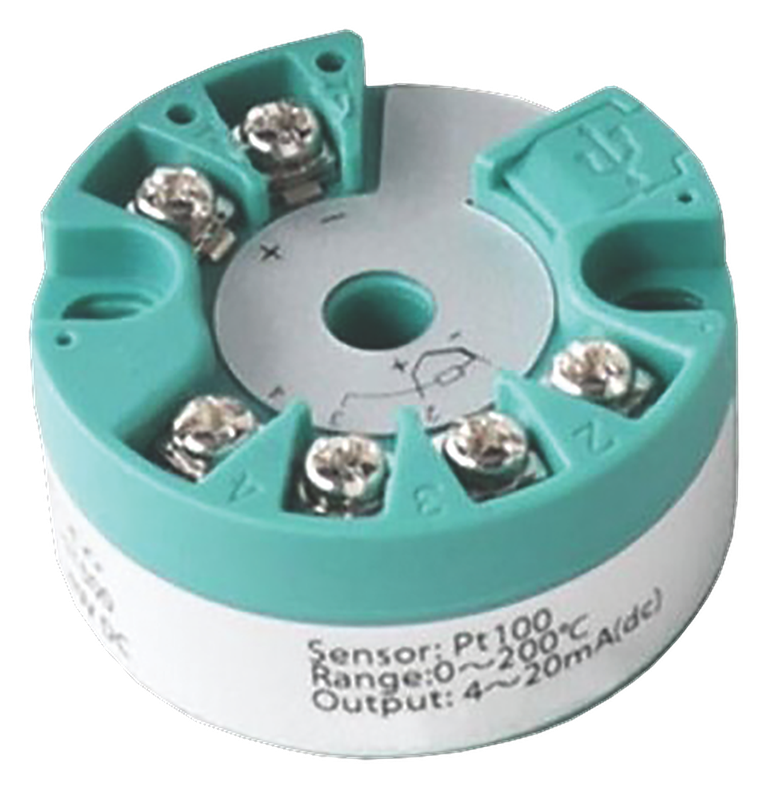
A temperature transmitter takes the small, often non-linear signal from an RTD or thermocouple and converts it into a robust standard signal, usually 4–20 mA. That signal can travel long cable runs to a control room, PLC or BMS without picking up noise or lead-resistance error.
Transmitters also linearise the sensor curve, which matters most for thermocouples, and can isolate the control system from electrical noise and high voltages. The measuring range is configured to the application, so the full output span covers the temperatures that matter.
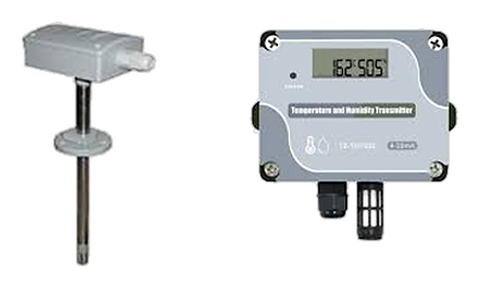
Pioneer's duct-mount transmitter uses a Pt1000 element to EN 60751 Class B in an 8 mm x 200 mm AISI 316 stem with a duct mounting flange. It is a 2-wire, loop-powered unit working on 15–35 V DC, with a plastic IP54 housing and M16 cable entry, and an accuracy of ±0.5 °C at 50 °C.
Types
- Duct-mount temperature transmitterPt1000 stem with duct flange and 2-wire 4–20 mA output for AHU supply, return and fresh air ducts.
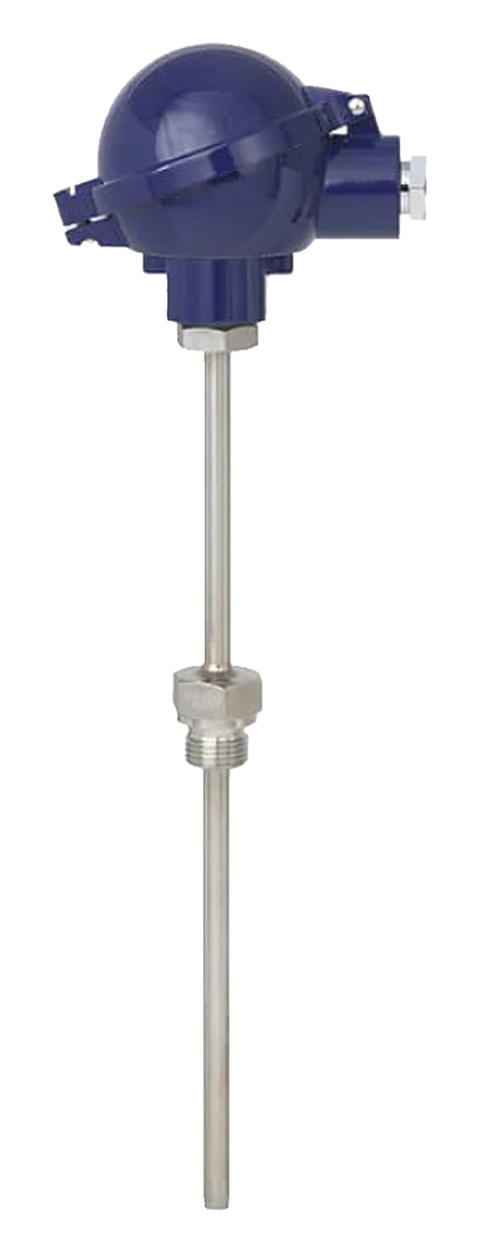
- Head-mounted transmitterFits inside the terminal head of an RTD or thermocouple assembly, converting the signal at the measuring point.
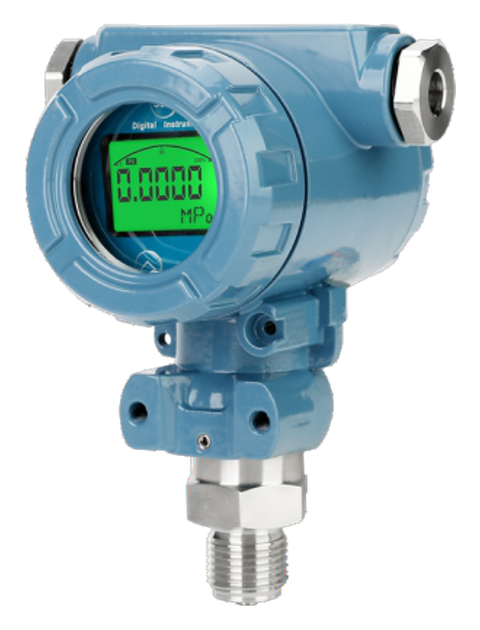
- Field transmitter with local displayProcess-connected transmitter that shows the reading locally as well as sending the output signal.
- Panel or enclosure-mounted transmitterCompact unit installed in a control panel, taking the sensor signal from the field.
Features
- Inputs from RTDs, thermocouples and thermistors
- 4–20 mA output (most common); 0–10 V and other standard signals available
- Linearisation of non-linear sensor signals
- Configurable measuring range
- Signal isolation to protect control equipment
- HART communication on some models
- Compact design for panels, enclosures and ducts
Applications
- BMS temperature monitoring in AHU and HVAC ducts
- Chilled water and hot water plant control
- Remote temperature monitoring in a central control room
- Process control loops on PLC and DCS
- Data acquisition and temperature trend logging
Specifications
Spec table.
Standard ranges and materials. Tell us your medium, range and connection and we will match the model.
| Parameter | Value |
|---|---|
| Type | Duct-mount temperature transmitter, 2-wire |
| Sensor | Pt1000, EN 60751 Class B |
| Output | 4–20 mA |
| Supply voltage | 15–35 V DC |
| Temperature range | Selectable |
| Accuracy | ±0.5 °C at 50 °C |
| Stem | Ø 8 mm x 200 mm, AISI 316 |
| Mounting | Duct mounting flange |
| Housing | Plastic (below 120 °C) |
| Protection | IP54, cable entry or stem down |
| Cable entry | M16 |
| Ambient temperature | 0 to 60 °C |
Head-mounted, field and panel transmitters for RTD or thermocouple inputs are specified per application; confirm input, range, output and HART at enquiry.
For consultants
Consultant spec clause.
Paste it into your technical specification or BOQ, then adjust ranges and quantities to your schedule.
1. Temperature transmitters shall be 2-wire, loop-powered type with 4–20 mA output proportional to temperature, operating on 15–35 V DC.
2. Sensing element shall be Pt1000 to EN 60751 Class B [Pt100 or thermocouple input where specified in the instrument schedule].
3. Measuring range shall be configured to suit the application as per the instrument schedule.
4. Accuracy shall be ±0.5 °C or better at 50 °C.
5. Duct-mount transmitters shall have an Ø 8 mm x 200 mm AISI 316 stem with duct mounting flange, installed in a straight duct section away from coils and humidifiers.
6. Housing protection shall be IP54 minimum, with M16 cable entry, suitable for 0 to 60 °C ambient.
7. Each transmitter shall be supplied with a manufacturer's test certificate and wiring diagram.
Make: Pioneer Industrial Instruments, Pune, or approved equivalent.
Why use a transmitter instead of wiring the RTD straight to the PLC?
An RTD or thermocouple signal is small and is easily affected by cable resistance and electrical noise over long runs. A transmitter close to the sensor converts it to 4–20 mA, which travels hundreds of metres without losing accuracy. It also linearises thermocouple signals and handles cold-junction compensation, so the PLC or BMS only needs a standard analogue input.
What does 2-wire, loop-powered mean?
The same two wires carry both the supply and the signal. The control system or a separate DC supply powers the loop, and the transmitter varies the current between 4 and 20 mA with temperature. Pioneer's duct transmitter works on 15–35 V DC. Fewer wires keep installation simple, and the 4 mA live zero lets the system detect a broken cable.
Should I choose 4–20 mA or 0–10 V output for a BMS?
Prefer 4–20 mA for long cable runs and noisy plant rooms, because current is not affected by cable resistance and the live zero shows a fault if the loop opens. A 0–10 V output is acceptable for short runs inside a panel or where the controller only has voltage inputs. Check the BMS controller input type before specifying.
Where should a duct temperature transmitter be installed?
Mount it in a straight section of duct where the air is well mixed, away from coils, humidifiers, dampers and fan outlets that cause stratification or local heating. The 200 mm stem should reach into the main airstream, ideally near the duct centre. Seal the flange to stop leakage, and keep the cable entry facing down or sideways to avoid water ingress.
How should I set the measuring range?
Set the range so normal operating temperature falls well inside the span without excessive margin. A narrower span gives better resolution per milliampere: for an AHU supply air point, a span around 0 to 50 °C resolves small changes better than -50 to 150 °C. Keep the configured range the same in the transmitter and the PLC or BMS scaling.