Level Instruments · LI
Level Gauges — Magnetic, Tubular, Reflex and Transparent Liquid Level Indicators
Pioneer supplies level gauges for direct visual indication of liquid level in tanks, vessels and boilers, including SS 304 magnetic flap level gauges with ±3 mm measurement accuracy and a process temperature range of -190 to 425 °C, as well as tubular, reflex and transparent glass gauges.
- Measurement accuracy: ±3 mm
- Material: SS 304
Overview
What it does and where it fits.
A level gauge shows the liquid level in a vessel without power. It is the operator's first check on a tank and the reference against which level transmitters and switches are verified.
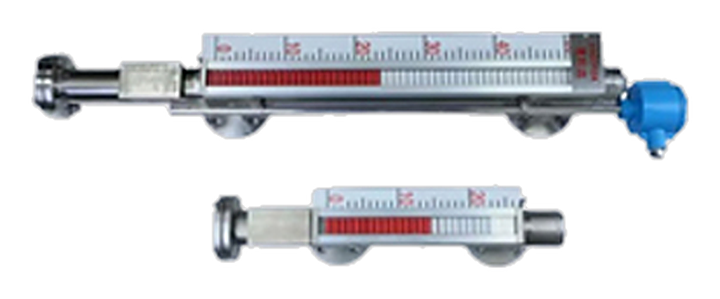
In a magnetic level gauge, a float carrying a magnet rides on the liquid inside a chamber fitted to the side of the vessel. Coloured flaps on an external indicator rail turn over as the magnet passes, so the level shows as a clear colour bar. The process liquid stays sealed inside the chamber, so magnetic gauges suit hazardous, toxic, hot or pressurised liquids where glass would be a risk.
Glass gauges remain a good choice for simpler duties. Tubular gauges suit low-pressure tanks, reflex gauges make clear liquids easy to read, and transparent gauges allow the liquid itself to be seen. Send the medium, density, operating pressure and temperature, centre-to-centre distance and nozzle details, and we will propose the gauge.
Types
- Magnetic level gaugeFloat-and-magnet gauge with flap indicator outside a sealed chamber; for hazardous, hot or pressurised liquids.
- Tubular level gaugeTransparent glass or plastic tube showing the liquid level directly; for low-pressure tanks.
- Reflex level gaugePrismatic glass that shows liquid dark and vapour bright, making clear liquids easy to read.
- Transparent level gaugeTwo glass plates with the liquid between them, for higher pressure and temperature and for viewing liquid colour or interface.
Features
- Direct visual indication without power
- Magnetic flap type with sealed process chamber
- SS 304 construction (magnetic flap type)
- Measurement accuracy ±3 mm (magnetic flap type)
- Process temperature -190 to 425 °C (magnetic flap type)
- Glass gauge types for simpler duties
Applications
- Storage tanks for water, chemicals and fuels
- Process vessels, reactors and mixing tanks
- Boiler drums and condensate tanks
- Hydraulic reservoirs
- Separators and tanks in oil and gas plants
Specifications
Spec table.
Standard ranges and materials. Tell us your medium, range and connection and we will match the model.
| Parameter | Value |
|---|---|
| Type | Magnetic flap level gauge |
| Construction | All in one (chamber and indicator) |
| Material | SS 304 |
| Measurement accuracy | ±3 mm |
| Process temperature | -190 to 425 °C |
Centre-to-centre distance, connections, pressure rating, float material and switch or transmitter add-ons are selected for each vessel and confirmed at enquiry.
For consultants
Consultant spec clause.
Paste it into your technical specification or BOQ, then adjust ranges and quantities to your schedule.
1. Level gauges shall be magnetic flap type, comprising a sealed chamber with magnetic float and an external flap indicator, in SS 304 [SS 316 where the medium requires].
2. Float shall be selected to suit the density, pressure and temperature of the process liquid as per the instrument schedule.
3. Measurement accuracy shall be ±3 mm.
4. Centre-to-centre distance and visible length shall be as per the vessel nozzle drawing.
5. Process connections shall be flanged side connections matching vessel nozzles, size and rating as per the instrument schedule.
6. Each gauge shall have isolation valves on the vessel connections and a drain/vent valve on the chamber.
7. Where specified in the instrument schedule, magnetic level switches shall be mounted on the gauge chamber at the stated alarm points.
8. Each gauge shall be supplied with a manufacturer's test certificate and a general arrangement drawing.
Make: Pioneer Industrial Instruments, Pune, or approved equivalent.
When should I use a magnetic level gauge instead of a glass gauge?
Choose magnetic when the liquid is toxic, flammable, corrosive, hot or under pressure, or when breakage of glass would be a hazard. The liquid stays inside a sealed metal chamber and only the magnet's field reaches the indicator. Glass gauges are simpler and cheaper for water and benign liquids in low-pressure tanks, and transparent gauges let you see the liquid colour or an interface.
What data do I need to send for a magnetic level gauge?
Send the liquid and its specific gravity (density), operating and design pressure and temperature, the centre-to-centre distance between the vessel nozzles, the nozzle size, rating and facing, the chamber and float material, and whether switches or a transmitter are needed. Density matters most, because the float is sized to sink to the correct depth in that liquid.
Can I add level switches or a transmitter to a magnetic level gauge?
Usually, yes. Magnetic reed-type switches can be clamped to the outside of the chamber at high and low alarm points; they operate from the same float magnet and have no wetted parts. A level transmitter can also be mounted on the chamber to send a continuous signal. This gives indication, alarms and remote level from one nozzle pair. State the switch points and outputs in the enquiry.
How do I maintain a magnetic level gauge?
Drain and flush the chamber periodically if the liquid carries sediment, since build-up can stick the float. Check that all flaps follow the float by raising and lowering the level, and reset any flaps that have flipped by vibration with a magnet. Keep strong external magnetic fields and steel objects away from the indicator rail.