
Flow Instruments · FT
Clamp-on Ultrasonic Flowmeters — Fixed Transit-Time Flow Meters
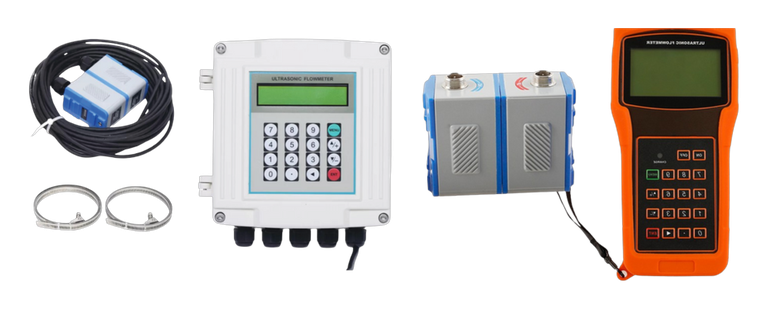
A clamp-on ultrasonic flowmeter measures liquid flow from outside the pipe by the transit-time method, so there is no pipe cutting, no shutdown and no pressure drop. Pioneer supplies wall-mounted transit-time flowmeters with clamp-on transducers for pipes from 15 mm to 4570 mm, accuracy ±1% of reading above 0.5 m/s, plus insertion versions for pipes where clamp-on signals are weak.
- Velocity range: ±12 m/s, bidirectional
- Transmitter size and weight: 251 × 190 × 96 mm, under 2.5 kg
- Accuracy: ±1% of reading at velocity above 0.5 m/s
Overview
What it does and where it fits.
Two transducers on the pipe send ultrasonic pulses to each other, one with the flow and one against it. The pulse travelling with the flow arrives slightly sooner, and the time difference is proportional to the average velocity across the pipe. The transmitter multiplies velocity by the pipe's internal area to give volumetric flow and a running total.
Because nothing touches the liquid, clamp-on meters suit retrofits on live chilled water, condenser water, raw water and process lines, and large pipes where an inline meter would be costly. The transducers fit with stainless steel straps; insertion transducers are fitted through isolating ball valves for old, lined or thick-walled pipes.
Two series are available. The main series gives ±1% of reading with three transducer sizes and 24 V DC, 110 V AC or 240 V AC supply. A water-service series covers DN 50 to DN 2000 at ±2% with IP68 transducers and RS 485 Modbus. Tell us the pipe outside diameter, wall thickness, material, lining and liquid so the right transducer can be selected.
Types
- Clamp-on transducersStrapped to the outside of the pipe; no cutting, welding or process interruption.
- Insertion transducersInserted into the pipe through an isolating ball valve assembly, for pipes above 65 mm where welding is possible and wall thickness is under 20 mm.
- Full-bore (spool) typeTransducers fitted diagonally in a flanged spool piece, for new lines where an inline meter is acceptable.
- High-temperature transducersFor liquids up to 250 °C, such as hot water and thermal fluid lines.
Features
- Non-intrusive: no pressure drop, no leaks, no wetted parts
- Bidirectional measurement up to ±12 m/s
- Accuracy ±1% of reading above 0.5 m/s; repeatability 0.2% of span
- Three clamp-on transducer sizes cover 15 mm to 4570 mm
- Backlit LCD with flow rate, velocity and forward, reverse, net and batch totals
- Isolated 4–20 mA output; RS 485 Modbus on the water-service series
- Keypad lockout and access code
- Transducer cable 6 m standard, extendable up to 300 m
Applications
- Chilled water, hot water and condenser water in HVAC plants
- Water distribution networks and treatment plants
- Retrofit metering on existing lines without shutdown
- Large-diameter raw water and cooling water mains
- Chemical and high-purity liquids where wetted parts are not acceptable
- Building water management and leak detection
- Flow input for BTU (thermal energy) meters
Specifications
Spec table.
Standard ranges and materials. Tell us your medium, range and connection and we will match the model.
| Parameter | Value |
|---|---|
| Principle | Transit time, clamp-on or insertion transducers |
| Velocity range | ±12 m/s, bidirectional |
| Accuracy | ±1% of reading at velocity above 0.5 m/s |
| Repeatability | 0.2% of span |
| Display | 2 lines × 16 characters, backlit LCD: flow rate, velocity, totaliser |
| Totaliser | Forward, net, reverse, batch (gallons, ft³, barrels, lbs, m³) |
| Units | User configurable, English or metric |
| Output | 4–20 mA DC standard |
| Power supply | 24 V DC ±20%, 110 V AC ±15% or 240 V AC ±15% |
| Transmitter size and weight | 251 × 190 × 96 mm, under 2.5 kg |
| Security | Keypad lockout, access code |
| Liquid temperature | Standard transducer −40 to 120 °C; high-temperature transducer −40 to 250 °C |
| Pipe size, clamp-on | S transducer 15–80 mm; M transducer 50–700 mm; L transducer 400–4570 mm |
| Pipe size, insertion | Above 65 mm (long sensors for thick pipelines on request) |
| Transducer cable | 6 m standard, extendable up to 300 m |
| Fixing | SS belts to suit pipe size |
Transducer dimensions
| Parameter | Value | |
|---|---|---|
| Transducer | Size | Weight |
| S (clamp-on) | 45 × 30 × 30 mm | Under 0.3 kg |
| M (clamp-on) | 60 × 45 × 45 mm | Under 0.5 kg |
| L (clamp-on) | 80 × 70 × 55 mm | Under 1.0 kg |
| Insertion | 186 mm long, 20 mm bore | Under 1.5 kg |
Water-service series, DN 50 to DN 2000
| Parameter | Value |
|---|---|
| Fluid | Clear water |
| Line size | Clamp-on small transducer DN 50–DN 250; clamp-on large transducer DN 300–DN 2000; insertion DN 50–DN 2000 |
| Accuracy | ±2% |
| Velocity range | 0 to ±7 m/s |
| Transducer protection | IP68 |
| Pressure | PN 16 |
| Medium temperature | Clamp-on −30 to 90 °C; insertion −30 to 160 °C |
| Pipe material | Carbon steel, stainless steel, cast iron, copper, PVC |
| Transmitter | Wall mounting, aluminium, IP65; or fixed mounting, aluminium, IP68 |
| Power supply | 85–264 V AC; 12–24 V DC |
| Display | 2 × 20 characters, backlit |
| Communication | RS 485, Modbus |
| Output | 4–20 mA |
| Limitations | Clamp-on not suitable for cement or glass-steel pipes that do not conduct ultrasound; insertion needs wall thickness under 20 mm and welding access |
Accuracy depends on correct pipe data, full pipe, adequate straight run and good transducer coupling. Other pipe sizes and long insertion sensors on request.
For consultants
Consultant spec clause.
Paste it into your technical specification or BOQ, then adjust ranges and quantities to your schedule.
1. Flowmeter shall be of transit-time ultrasonic type with clamp-on transducers mounted outside the pipe, requiring no pipe cutting, welding or process shutdown (insertion transducers through isolating ball valves where specified).
2. Transducers shall suit the specified pipe size, material and lining within 15 mm to 4570 mm, rated −40 to 120 °C (high-temperature type, −40 to 250 °C, where specified).
3. Measurement shall be bidirectional up to ±12 m/s with accuracy ±1% of reading above 0.5 m/s and repeatability 0.2% of span.
4. Transmitter shall be wall mounted with a backlit LCD showing flow rate, velocity and forward, reverse and net totals, with keypad lockout.
5. Output shall be isolated 4–20 mA DC (RS 485 Modbus where specified); power supply 240 V AC ±15% (24 V DC ±20%).
6. Transducer cable shall be 6 m standard, extendable up to 300 m, with transducers fixed by SS straps and suitable coupling compound.
7. Transducers shall be installed on a full, straight section of pipe with upstream and downstream straight lengths as recommended by the manufacturer.
8. Each flowmeter shall be supplied with a manufacturer's test certificate, installation manual and mounting accessories.
Make: Pioneer Industrial Instruments, Pune, or approved equivalent.
Does a clamp-on ultrasonic flowmeter work on any pipe material?
It works on pipes that conduct ultrasound well: carbon steel, stainless steel, cast iron, copper and PVC. It is not suitable for cement or glass-steel pipes, and thick internal linings or heavy scale weaken the signal. For such cases, use insertion transducers fitted through ball valves (wall thickness under 20 mm), or an inline electromagnetic flowmeter.
How much straight pipe does a clamp-on flowmeter need?
As a rule of thumb, allow about 10 pipe diameters of straight pipe upstream and 5 downstream of the transducers. After a pump, control valve or two bends in different planes, allow considerably more. The pipe must also run full at the measuring point, so avoid high points where air collects and downward vertical runs that may drain.
What liquids can a clamp-on ultrasonic meter measure?
Transit-time meters measure most homogeneous liquids: water, chilled and condenser water, sea water, oils, solvents and chemicals, whether or not they conduct electricity. They need a reasonably clean liquid; high levels of suspended solids or air bubbles scatter the signal. Very dirty or aerated liquids such as raw sludge are better measured with an electromagnetic flowmeter.
Clamp-on ultrasonic or electromagnetic flowmeter: which should I choose?
Choose a magmeter for new installations with conductive liquids, slurries or effluent, where you want the best accuracy (±0.5% of reading). Choose clamp-on ultrasonic for retrofits on live lines, for non-conductive liquids, and for large pipes, where its cost does not rise steeply with size. Clamp-on accuracy here is ±1% of reading above 0.5 m/s.
What pipe data is needed to set up the meter?
Enter the pipe outside diameter, wall thickness, pipe material, lining material and thickness, and the liquid type. The meter uses these to calculate transducer spacing and internal area. Errors in pipe data cause most site inaccuracy: a 1% error in internal diameter gives roughly a 2% error in flow, so measure wall thickness with a gauge where possible.
Related
Often specified together.
Engineering guides
- 02
BTU meters for chilled water: selection and installation
A BTU meter (thermal energy meter) combines a flow sensor, a matched pair of temperature sensors and a calculator that integrates flow × temperature…
Read the guide - 03
Electromagnetic vs ultrasonic flow meter: which to use
Choose an electromagnetic flowmeter when the liquid is conductive, the pipe can be cut and will always run full, and you want the best installed…
Read the guide