Key takeaways
- An electromagnetic flowmeter needs a conductive liquid, typically above 5 µS/cm, and a pipe that always runs full; given both, it gives the most dependable installed accuracy.
- A clamp-on transit-time ultrasonic meter needs no cutting or shutdown and does not depend on conductivity, but it calculates flow from the pipe data you enter, so scale, lining and wall-thickness errors pass straight into the reading.
- Raw sewage, sludge, chemical effluent and aerated condenser water favour magmeters; DM or RO water, oils and retrofits on live lines favour ultrasonic.
- Liner material, electrode material and grounding decide whether a magmeter lasts and reads steadily.
- Clamp-on meters need longer straight runs than magmeters, especially after pumps, control valves and out-of-plane elbows.
- Survey an old or unknown pipe with a handheld ultrasonic meter before committing to a fixed installation.
How the two technologies work
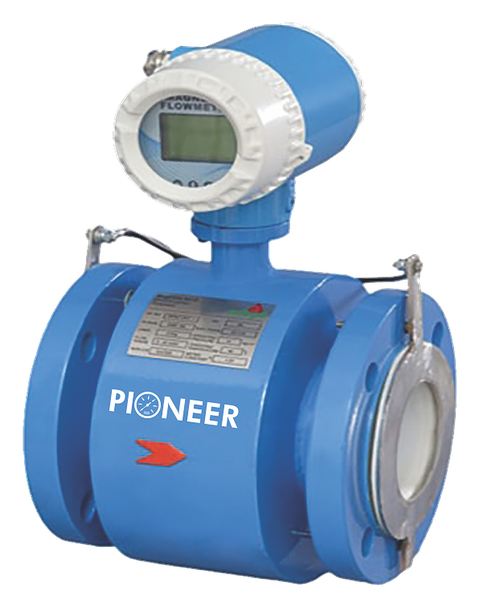
An electromagnetic flowmeter (magmeter) applies a magnetic field across the pipe. A conductive liquid moving through the field generates a small voltage at two electrodes, proportional to its average velocity (Faraday's law). There are no moving parts and nothing in the bore, so pressure loss is negligible.
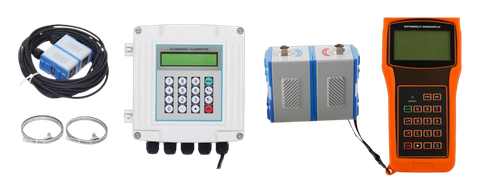
A transit-time ultrasonic meter sends sound pulses diagonally across the pipe, alternately with and against the flow. The pulse travelling with the flow arrives slightly sooner, and the time difference is proportional to velocity. Clamp-on versions fix the transducers to the outside of the pipe wall; inline versions build them into a spool piece installed like any flanged meter.
The physics sets the limits. A magmeter needs a conductive liquid and a completely full pipe. A transit-time meter needs a clean acoustic path: entrained air or suspended solids scatter the signal, and the pipe wall and lining must pass sound reliably.
Electromagnetic flowmeters: what to specify
Conductivity
The liquid must have a minimum electrical conductivity, typically above 5 µS/cm. Potable water, raw water, cooling and chilled water, sewage, and most acids, alkalis and food liquids qualify. Hydrocarbons, oils, solvents and high-purity demineralised water often do not, so measure conductivity before choosing a magmeter for these.
Liner and electrodes
Rubber liners suit water and wastewater and are Pioneer's standard; PTFE or PFA suit chemicals and higher temperatures. Pioneer rates integral PTFE-lined meters to 120 °C, remote PTFE versions to 180 °C and other liners to 70 °C. Electrodes are SS 316 as standard; nickel-alloy or tantalum electrodes are used where the liquid attacks stainless steel, such as acids and chloride-rich effluents.
Grounding
The signal is tiny, so the meter body, the liquid and the pipe must sit at the same potential. On bare metal pipe, bond both flanges to the meter body and to earth. On plastic pipe, or on lined and coated metal pipe, the liquid does not touch earthed metal, so fit grounding rings or a grounding electrode. Poor grounding is the usual cause of a noisy or drifting reading, especially near VFD-driven pumps.
Full pipe and orientation
A partly filled magmeter reads wrongly because it assumes the whole bore is moving. Install it on a rising vertical section or at a low point, never at a high point or just before an open discharge. Keep the electrode axis horizontal so air and sediment do not cover the electrodes. Empty-pipe detection, offered on some meters, flags the condition but does not cure it.
Size for velocity, not line size
Pioneer's electromagnetic flowmeters cover 10 to 2000 mm nominal bore and 0.2 to 12 m/s in both directions, at ±0.5% of measured value (±0.2% on request). Pressure ratings of 10, 16, 25 and 40 kg/cm² are available, with flanged (ANSI 150 standard), wafer or tri-clamp ends, in integral or remote versions. For water, designers commonly size for roughly 1–3 m/s at normal flow, so on an oversized line a meter one size smaller with concentric reducers usually measures better than a line-size meter.
Ultrasonic flowmeters: pipe, lining and straight run
Inline or clamp-on
An inline ultrasonic meter has its geometry fixed and calibrated at the factory, so its accuracy approaches a magmeter's without needing conductivity, but the pipe must still be cut. A clamp-on meter is the retrofit choice: no cutting, no shutdown, no leak path, and one transducer set covers a wide size range. Pioneer's clamp-on ultrasonic flowmeters use three transducer sizes covering 12–50 mm, 40–1000 mm and 1000–4570 mm pipes.
Pipe material and lining
Steel, stainless steel, ductile iron, copper, PVC and HDPE pipes all work if the meter is given the correct outside diameter, wall thickness, material and lining. Cement-mortar linings, thick epoxy or rubber linings, heavy internal scale and corrosion attenuate the signal and change the real internal diameter. A lining that has separated from the pipe wall can block the signal entirely.
Liquid condition
Pioneer specifies its transit-time meters for liquids with less than 2% suspended solids or aeration. Raw sewage, sludge and aerated condenser water near a cooling tower are poor candidates. Standard transducers handle liquids from −40 °C to 121 °C; high-temperature transducers go to 250 °C.
Mounting and straight run
Mount the transducers on the side of a horizontal pipe, not at the top (air) or bottom (sediment). Use the V method on small and medium pipes and the Z method, with transducers on opposite sides, on large pipes or where the signal is weak. A common rule of thumb is at least 10 diameters of straight pipe upstream and 5 downstream, and considerably more after a pump, a control valve or two elbows in different planes; follow the meter's installation table.
Clean the pipe to bare metal at the transducer positions and use a long-life couplant for permanent installations, as ordinary grease dries out. On chilled-water lines, remove insulation only where needed and reinstate it with a vapour seal, or condensation will corrupt the reading and corrode the pipe.
Accuracy you can expect in the field
A magmeter's accuracy is largely fixed at the factory because the bore is known. Pioneer specifies ±0.5% of measured value with ±0.2% of span repeatability, and installed performance stays close to that if the pipe is full, grounding is right and there is enough straight run.
A clamp-on meter's electronics are also precise (Pioneer specifies 1.0% of reading above 0.5 m/s and 0.2% repeatability), but flow is calculated from the pipe dimensions you enter. Because flow is velocity times area, a 1% error in the assumed internal diameter changes the calculated area, and so the flow, by about 2%. On old or unknown pipes, treat clamp-on readings as good monitoring data and check them against a known reference before using them for billing.
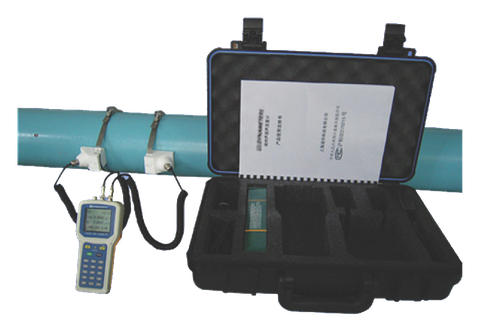
Both technologies lose relative accuracy at low velocity, below about 0.5 m/s. This is common in oversized building water lines and in chilled-water circuits at part load. A handheld ultrasonic flowmeter is the practical way to survey a line or verify an installed meter without shutdown.
What drives installation cost
- Shutdown and draining. Any inline meter, magnetic or ultrasonic, needs the line isolated, drained, cut and flanged. In a running chilled-water plant or a live water main, the shutdown can cost more than the meter.
- Pipe size. Inline meter price, weight and lifting effort rise steeply with diameter. Clamp-on cost changes little with pipe size, which makes it increasingly attractive on large mains.
- Isolation and bypass. An inline meter on a critical line should have isolation valves and a bypass so it can be removed; budget for them.
- Power and signal. Pioneer magmeters run on 24 V DC or 80–300 V AC with a 4–20 mA output as standard. The clamp-on meters offer 4–20 mA, pulse, relay and RS232C or RS485 outputs.
- Through-life cost. Magmeters have no moving parts and need little routine maintenance. Clamp-on installations need occasional checks of couplant and transducer mounting.
Side-by-side comparison
| Criterion | Electromagnetic (inline) | Transit-time ultrasonic (clamp-on) |
|---|---|---|
| Liquid must be conductive | Yes, typically above 5 µS/cm | No |
| Dirty liquids, slurries | Handles well with a suitable liner | Poor above 2% solids or aeration |
| Pipe must run full | Yes | Yes |
| Cutting and shutdown | Required | Not required |
| Pressure loss | Negligible (full bore) | None |
| Straight run (typical) | Shorter, around 5D upstream | Longer, 10D upstream and 5D downstream or more |
| Accuracy (Pioneer spec) | ±0.5% of measured value (±0.2% on request) | 1.0% of reading above 0.5 m/s; field result depends on pipe data |
| Pipe sizes (Pioneer) | 10–2000 mm | 12–4570 mm with three transducer sizes |
| Liquid temperature (Pioneer) | 70 °C (rubber), 120 °C / 180 °C (PTFE integral / remote) | −40 to 121 °C standard, up to 250 °C high-temperature |
| Cost trend with pipe size | Rises steeply | Nearly flat |
| Best fit | Water, wastewater, sludge, chemicals, billing meters | Retrofits, large mains, non-conductive or high-purity liquids, surveys |
Which meter for which application
| Application | Usually the better choice | Notes |
|---|---|---|
| Municipal and campus water mains | Magmeter for new bulk or billing points; clamp-on for surveys and retrofits | Check the lining of ductile iron and MS mains before choosing clamp-on |
| Building water, tank fill lines | Magmeter or electromagnetic water meter | Lines feeding tanks often run part full; use a rising section |
| Chilled and hot water, new build | Either; magmeter where energy billing depends on it | For tenant billing see energy and water meters |
| Chilled water, retrofit | Clamp-on | Reinstate insulation with a vapour seal |
| Condenser water | Magmeter | Open circuit carries air, debris and scale |
| STP inlet, raw sewage, sludge | Magmeter, rubber or PTFE liner | Transit-time loses signal on solids and air |
| STP/ETP treated-water outlet | Either | Gravity outfalls running part full need open-channel measurement, e.g. a flume with a non-contact level transmitter |
| ETP and chemical dosing | Magmeter, PTFE/PFA liner, matched electrodes | Check conductivity of solvent-based streams |
| DM water, RO permeate, oils, solvents | Ultrasonic, inline or clamp-on | Conductivity often too low for a magmeter |
| Commissioning, balancing, audits | Handheld ultrasonic | Verifies installed meters without shutdown |
Common mistakes
- Fitting a line-size magmeter on an oversized pipe, so it runs below 0.5 m/s most of the year.
- Installing a magmeter at a high point or just upstream of an open discharge, where the pipe is not full.
- Leaving out grounding rings on HDPE, PVC or lined pipes.
- Clamping ultrasonic transducers just downstream of a pump or butterfly valve.
- Entering nominal pipe data instead of the measured outside diameter and wall thickness.
- Leaving chilled-water pipe bare around clamp-on transducers.
Decision checklist
- Is the liquid conductive above about 5 µS/cm? If not, choose ultrasonic.
- Does it carry more than 2% solids or entrained air? If so, choose a magmeter.
- Can the line be shut down, drained and cut? If not, choose clamp-on.
- Will the pipe always run full at the meter position? If not, move the meter or measure in an open channel.
- Is the reading for billing or for monitoring? Billing favours an inline meter.
- Is there enough straight run: around 5D upstream for a magmeter, 10D or more for clamp-on?
- Do you know the pipe material, lining, wall thickness and condition? If not, survey with a handheld meter first.
- What output does the BMS or SCADA need: 4–20 mA, pulse or RS485?
Send Pioneer the liquid, pipe size and material, flow range, temperature, pressure rating and required output. We will recommend the meter type and quote, typically within 48 hours.