Key takeaways
- Ultrasonic suits clean, atmospheric water and chemical tanks, sumps and open channels; radar suits vapour, steam, pressure, vacuum, high temperature, dust and tall vessels.
- The speed of sound changes by roughly 0.17% per °C, so ultrasonic accuracy depends on temperature compensation; radar is largely unaffected by temperature and gas composition.
- Every ultrasonic sensor has a blocking distance near its face where it cannot measure; mount it so the highest level stays below that zone.
- A narrow beam avoids false echoes from walls, ladders, agitators and inlet streams; high-frequency radar gives the narrowest beam for a given antenna size.
- Heavy foam defeats ultrasonic and can weaken non-contact radar; guided wave radar or a different principle is the usual answer.
- Fit an independent high-level switch for overfill protection rather than relying only on the transmitter.
How each one measures
Both are top-mounted, non-contact instruments that measure the distance from the sensor down to the surface and subtract it from the tank height to give level.
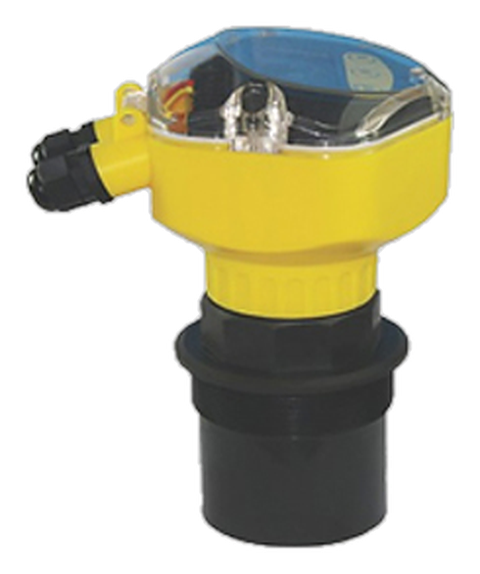
An ultrasonic transmitter sends a burst of sound, typically in the tens of kilohertz, from a transducer and times the echo. Sound travels at about 343 m/s in air at 20 °C, but that speed changes with temperature and with the composition of the gas. Most units compensate using a temperature sensor in the transducer. Sound needs a gas to travel through, so ultrasonic cannot work in a vacuum.
A radar transmitter sends microwaves from an antenna and measures the time of flight, either as short pulses or as a frequency-modulated continuous wave (FMCW). Microwaves travel at the speed of light, which is practically independent of temperature, pressure and the vapour above the product. The strength of the echo depends on the product's dielectric constant (εr). Water and most aqueous solutions reflect strongly; oils, solvents and plastic granules reflect weakly.
Guided wave radar (GWR) sends the pulse down a rod or cable probe that dips into the product. It is a contact instrument, but it handles foam, low-εr liquids, small or cluttered vessels and liquid–liquid interfaces better than non-contact designs.
Beam angle and false echoes
Neither type sends a thin line; each sends a cone. Anything inside that cone can return an echo, including the tank wall, ladders, agitators, heating coils, baffles, weld seams and the stream from a fill pipe. A false echo can be stronger than the real surface and lock the reading.
The diameter of the cone at the bottom of the tank is about 2 × distance × tan(half the beam angle):
- An 8° beam at 6 m covers a circle about 0.84 m across.
- A 3° beam at 6 m covers a circle about 0.31 m across.
Ultrasonic beams are generally wider than those of high-frequency radar. A higher radar frequency gives a narrower beam for a given antenna size, which is why high-frequency radar is used in narrow, tall or cluttered vessels. Lower-frequency radar with a larger antenna can still be the better choice for some dusty solids and condensing duties. Most modern transmitters can learn and suppress fixed false echoes, but it is better to keep obstructions out of the beam in the first place.
Dead band and blocking distance
After it transmits, an ultrasonic transducer keeps ringing for a short time and cannot hear an echo. This creates a blocking distance (dead band) immediately below the sensor face where it cannot measure. It is typically a few tenths of a metre on short-range sensors and more on long-range, low-frequency sensors. Check the figure on the datasheet of the specific model.
If the level rises into the blocking distance, the transmitter may lose the echo, hold the last reading or lock onto a multiple echo and report a lower level than the real one. On a filling tank this can lead to an overflow. To prevent it:
- Mount the sensor on a standoff or raised nozzle so that the maximum possible level stays below the blocking distance, with a margin.
- Set the span so that 100% is below the blocking distance.
- Fit an independent high-level level switch for overfill protection.
Radar also has a small near zone at the antenna, and long or narrow nozzles can create ringing. The usable top of range is still normally much closer to the flange than with ultrasonic.
Foam, vapour, dust and temperature
| Condition | Ultrasonic | Non-contact radar |
|---|---|---|
| Foam | Absorbs sound; light foam weakens the echo and heavy foam can stop measurement entirely | Can pass through light foam; dense or wet foam can still absorb or reflect the signal. Consider GWR |
| Vapour and steam | Changes the speed of sound and absorbs the signal; condensation on the transducer causes errors | Largely unaffected; choose an antenna that sheds condensate |
| Temperature layers in the air space | Errors, because compensation reads the temperature only at the transducer | Negligible effect |
| Dust during filling | Attenuated, often badly | Generally works; better with high-frequency radar or larger antennas |
| Process temperature | Limited by the transducer; usually for moderate temperatures | Wide range with a suitable antenna and process seal |
| Pressure or vacuum | Generally for atmospheric or low pressure; does not work in a vacuum | Suitable for pressure and vacuum within the flange and seal rating |
| Turbulent or agitated surface | Scattered echo | Scattered echo; handles it better with signal processing and a narrow beam |
| Build-up on the sensor | Self-cleaning to a degree from transducer vibration; heavy build-up blocks it | Tolerates thin layers; conductive build-up on the antenna causes problems |
The speed of sound changes by roughly 0.17% for each °C. If the air in the tank is 15 °C warmer near the liquid than at the transducer, an ultrasonic reading over several metres can be out by centimetres. Radar avoids this, which is one reason it is chosen for hot tanks and tanks heated by steam coils.
Tank geometry and mounting
- Position: avoid the centre of a domed or conical roof, which focuses multiple echoes back to the sensor, and keep clear of the wall. About a third to half of the tank radius from the wall is a common starting point. Stay out of the fill stream.
- Nozzles: for ultrasonic, mount the transducer flush with the nozzle end or use a short, wide nozzle, because a long, narrow nozzle reflects sound. For radar, follow the maker's nozzle height and diameter limits for the antenna, and keep the inside of the nozzle smooth with no weld beads protruding.
- Conical or dished bottoms: when the tank is nearly empty, the echo may scatter off the cone. Aim the sensor at the outlet, or accept a minimum level in the range.
- Stilling wells: a well or bypass pipe calms the surface and screens out internals. It is common with radar on low-εr liquids and turbulent tanks, but the pipe must be smooth, straight and of the right diameter, with vent holes above the maximum level.
- Solids silos: material piles at its angle of repose and leaves a sloping surface. Use an aiming flange to point the beam at the outlet, and remember that fill streams and dust are at their worst during filling.
- Outdoors: fit a sun shade on ultrasonic sensors, because direct sun heats the transducer and the air beneath it.
Open-channel flow
Ultrasonic transmitters are widely used to measure flow in open channels. The sensor measures the water level (head) at a defined point upstream of a flume or weir, and the transmitter converts head to flow using the equation for that structure. Thin-plate weirs are covered by ISO 1438.
- Mount the sensor at the head-measuring position for the flume or weir, not over the throat or the crest.
- The blocking distance applies here as well. Mount high enough that the maximum head stays below it.
- Shade the sensor from direct sun and shelter it from wind, which can affect the temperature reading and the sound path.
- Small errors in head become larger errors in flow, because flow rises faster than head over a weir or flume. Careful zeroing at no flow matters.
Radar is increasingly used for open channels and rivers. It is not affected by air temperature or wind, so it suits sites with large daily temperature swings and installations where the sensor has to be mounted well above the water.
Comparison table
| Criterion | Ultrasonic | Non-contact radar | Guided wave radar |
|---|---|---|---|
| Principle | Sound echo, time of flight | Microwave echo, pulsed or FMCW | Microwave pulse along a probe |
| Contact with product | No | No | Yes |
| Affected by temperature or gas | Yes; needs compensation | Practically no | Practically no |
| Beam | Wider cone | Narrow, especially at high frequency | Confined to the probe |
| Blocking distance | Significant; check the datasheet | Small | Small at the top of the probe |
| Foam | Poor | Fair, depending on the foam | Good |
| Vapour, steam, pressure | Poor to fair | Good | Good |
| Low-εr liquids | Not affected by εr | Weaker echo; check suitability | Good |
| Liquid–liquid interface | No | No | Yes |
| Open-channel flow | Standard choice | Good, especially outdoors | Not used |
| Relative cost | Lower | Higher | Higher |
What to specify
- Product, its dielectric constant if known, and whether it is liquid, slurry or solid
- Measuring range: the distance from the mounting flange to the tank bottom, and the maximum level relative to the flange
- Process temperature and pressure, including vacuum or steam-out conditions
- Air space conditions: foam, vapour, condensation, dust, agitation
- Tank drawing showing height, diameter, roof and bottom shape, nozzle positions and sizes, and internals
- Process connection and wetted materials, such as PP, PVDF, PTFE or SS 316, compatible with the product
- Output and power: 4–20 mA two-wire loop-powered or four-wire, HART if needed, and relays for pump control or alarms
- Required accuracy, display, enclosure rating, cable entries and ambient conditions
- Hazardous area classification, if any, so the right protection concept is quoted
- For open channels: flume or weir type and dimensions, and maximum head
Common mistakes
- Letting the maximum level reach the ultrasonic blocking distance.
- Mounting at the centre of a domed roof or directly over the fill stream.
- Using ultrasonic on a heated, vapour-filled or pressurised tank.
- Choosing non-contact radar for a low-εr oil in a turbulent tank without a stilling well.
- Using a long, narrow nozzle without checking the maker's limits.
- Relying on a single continuous transmitter for overfill protection.
What Pioneer supplies
Pioneer supplies radar and ultrasonic level transmitters, including FMCW, pulsed and guided wave radar. It also supplies float and vibrating fork level switches for high and low alarms and pump protection, and magnetic and glass level gauges for local indication. Send the specification list above with a tank drawing for a quotation, typically within 48 hours.