Key takeaways
- CO2 indicates how much outdoor air each occupant is receiving; it is a ventilation indicator, not a complete measure of indoor air quality.
- DCV saves the most energy in spaces with high and variable occupancy, such as conference rooms, classrooms, auditoria, cinemas and mall food courts.
- ABC self-calibration assumes the sensor sees outdoor-level CO2 every few days, so it drifts wrongly in spaces that are occupied around the clock or have their own CO2 sources.
- Wall sensors in each zone suit multi-zone systems; a return-duct sensor suits a single-zone AHU serving one large space.
- In Indian cities, pair CO2-based DCV with PM2.5 monitoring and good filtration, because more outdoor air can also mean more outdoor particulates.
- ASHRAE 62.1 and green-building rating systems use IAQ monitoring to show that ventilation is delivered, but the exact requirements differ between systems and versions.
Why CO2 is used to control ventilation
People exhale CO2 at a fairly predictable rate for a given activity, so the gap between indoor and outdoor CO2 shows how much outdoor air each occupant is getting. A rising indoor level means occupancy has gone up or ventilation has gone down. Demand-controlled ventilation (DCV) uses that signal to supply outdoor air in proportion to the people actually present, instead of supplying design outdoor air all day for a room that is full for only a few hours.
CO2 is a proxy. It does not detect formaldehyde from new furniture, VOCs from cleaning, cooking fumes or particulates. Outdoor levels are typically around 400 to 450 ppm, and higher next to busy roads. ASHRAE 62.1 does not set an indoor CO2 limit. The familiar 1000 ppm figure is a rule of thumb linked to older guidance on outdoor air per person, not a health limit.
Where DCV pays and where it does not
- Offices. Good for conference rooms, training rooms and cafeterias. In open-plan areas at normal density, the floor-area part of the ventilation requirement dominates and savings are smaller.
- Schools and colleges. Classrooms are densely occupied for fixed periods and empty in between, which suits DCV well. In naturally ventilated classrooms, a displaying sensor with a colour indicator prompts staff to open windows.
- Malls and cinemas. Atria, food courts, multiplex screens and banquet halls have large swings in occupancy and usually suit DCV.
- Hospitals. ASHRAE 170 sets minimum total and outdoor air change rates for many clinical spaces regardless of occupancy, so DCV is normally limited to non-clinical areas such as OPD waiting halls, administration and cafeterias. CO2 monitoring in wards is still useful to detect under-ventilation.
Do not use CO2 as the only ventilation control where contaminants come from sources other than people, such as laboratories, kitchens, workshops and car parks. Car parks need CO-based control; see Pioneer's CO and CO2 sensors.
How NDIR sensors work and which range to choose
Almost all ventilation-grade CO2 sensors use non-dispersive infrared (NDIR) sensing. Infrared light passes through a small sample chamber to a detector fitted with a filter at the wavelength that CO2 absorbs; the more CO2, the less light arrives. NDIR is selective and stable compared with chemical sensing methods, but the lamp and optics age, so the zero point slowly drifts.
- Single-channel sensors measure only at the CO2 wavelength and rely on ABC or manual calibration to correct drift.
- Dual-channel (dual-wavelength or dual-beam) sensors add a reference measurement that compensates for lamp ageing, so they hold calibration without needing to see fresh air.
Typical accuracy specifications for commercial NDIR sensors are in the order of ±30 to ±50 ppm plus a small percentage of reading. Check the stated accuracy across the range you will use, together with the temperature and pressure effect.
| Application | Usual range | Reason |
|---|---|---|
| DCV in offices, classrooms, meeting rooms | 0–2000 ppm | Best resolution where control happens |
| Crowded halls, IAQ surveys, naturally ventilated spaces | 0–5000 ppm | Captures peaks above 2000 ppm |
| Greenhouses, fermentation, CO2 storage areas | 0–10,000 ppm or higher | Process control or safety alarms, not comfort |
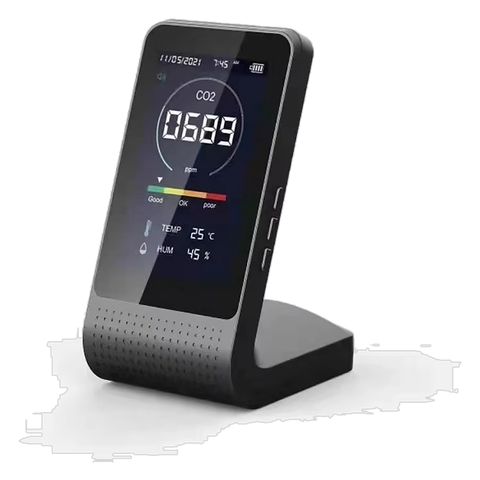
Pioneer's listed battery-powered IAQ monitor measures CO2 from 400 to 5000 ppm with 1 ppm sensitivity, alongside temperature and humidity, which suits surveys and spot checks.
ABC self-calibration and where it fails
Automatic baseline calibration (ABC) records the lowest reading over a rolling period of several days and assumes that it equals outdoor air. It then shifts the sensor zero to match. In an office or school that empties every night and is ventilated before opening, this works well and removes the need for routine calibration.
ABC fails when that assumption is false:
- Spaces occupied 24/7, such as hospital wards and ICUs, hotel rooms, control rooms, airport terminals, call centres and hostels. The lowest reading never falls to outdoor level, so ABC pulls the zero down and the sensor under-reads. Ventilation is then reduced exactly where it is needed.
- Spaces with their own CO2 sources, such as greenhouses, breweries, laboratories using dry ice or incubators, and kitchens.
- Buildings that shut ventilation off overnight and stay sealed, so CO2 does not fall back to outdoor levels before occupancy.
- Sites with high outdoor CO2 next to traffic or combustion sources, where the outdoor baseline differs from the value the sensor assumes.
For these spaces, specify dual-channel sensors with ABC disabled, check them against a calibrated reference instrument at commissioning, and recheck at the interval the manufacturer recommends. A sensor that reads close to outdoor air in an empty, well-ventilated room is a quick sanity check.
Mounting height and location
- Mount wall sensors in the breathing zone, typically 1.2 to 1.8 m above the floor; about 1.2 m suits rooms where people are mostly seated.
- Keep them on an internal wall or column, away from doors, operable windows, supply diffusers and the airstream of fan coil units, all of which dilute the reading.
- Keep them out of direct breath: not beside a reception desk, a seat or a queue.
- Avoid direct sunlight, lamps, coffee machines and other heat sources, which upset both the CO2 and the temperature reading.
- Fit at least one sensor in each ventilation zone that can be controlled separately. In large halls, use several sensors and control on the highest or the average reading, depending on the design intent.
- Seal the conduit entry behind the sensor so that air from the wall cavity does not reach it.
Duct sensors or wall sensors
| Option | Best for | Watch out for |
|---|---|---|
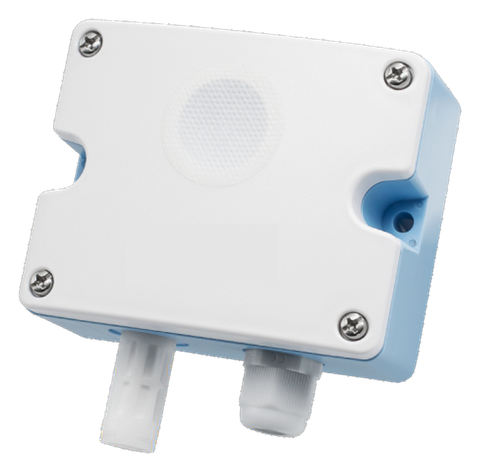
| Wall (space) sensor | Multi-zone VAV systems, meeting rooms, classrooms, wards | Placement errors; one sensor per zone adds cost |
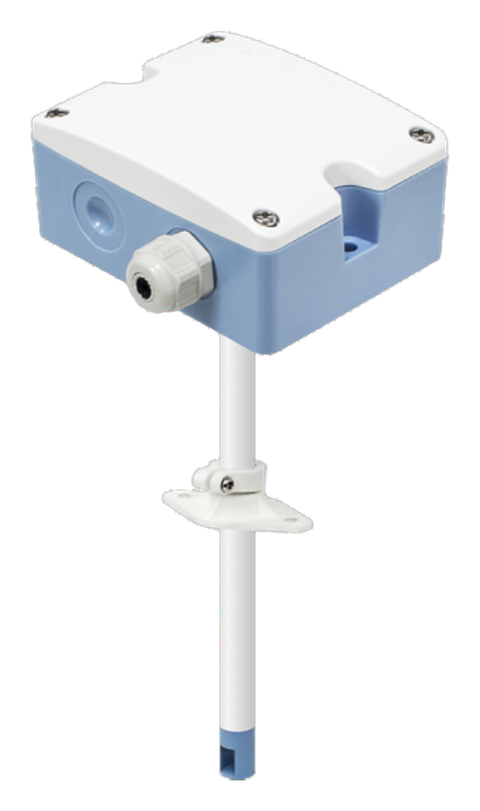
| Return-duct sensor | Single-zone AHUs serving one space: auditorium, cinema screen, atrium, banquet hall | Averages all zones served, so a crowded zone can be under-ventilated |
| Outdoor-air sensor | Differential (indoor minus outdoor) control at urban sites | Exposure to rain and dust; needs a weather shield |
| Multi-parameter IAQ sensor | Occupied spaces where PM2.5, TVOC, temperature and humidity also matter | Particle and TVOC elements need more maintenance than CO2 |
Install a return-duct sensor upstream of the point where return air mixes with outdoor air, clear of the return damper and of any leakage, with enough airflow across the probe as the manufacturer specifies. Leave access for cleaning and checks.
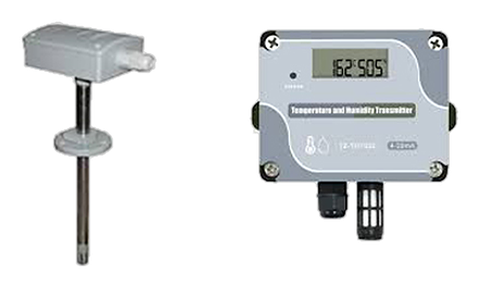
The same location often carries a return-air temperature and humidity sensor. Pioneer's duct humidity and temperature sensors come with 150 or 250 mm probes and a loop-powered 4–20 mA output.
Outputs and BMS integration
- Analogue 0–10 V or 4–20 mA: the simplest connection to a DDC controller. Match the scaling at both ends (for example, 0–2000 ppm = 0–10 V) and record it on the points schedule.
- RS485 with Modbus RTU or BACnet MS/TP: one cable can carry CO2, temperature, humidity and alarms from many sensors.
- Relay output: stand-alone switching of an exhaust fan or fresh-air damper where there is no BMS.
- Display: useful in classrooms and meeting rooms; blank covers suit public areas.
A common DCV sequence resets the outdoor-air damper or fresh-air fan in proportion to CO2 between a lower and an upper setpoint. It never goes below the floor-area-based minimum and never above design outdoor air. Pioneer's listed fixed CO2 detector gives up to three 0–10 V analogue outputs on a 16–28 V AC or 16–35 V DC supply, and the transmitters on its IAQ sensor page offer 4–20 mA, 0–10 V and RS485 outputs.
DCV only saves energy if the outdoor air actually changes. Verify outdoor-air quantities at commissioning with a duct traverse using an air velocity meter.
Multi-parameter IAQ: PM2.5, TVOC and more
Multi-parameter indoor air quality sensors combine CO2 with particulate matter (PM2.5, often PM10), TVOC, temperature and humidity, and sometimes formaldehyde or ozone.
- PM2.5 is usually measured by laser light scattering. Readings are good for trends, filter performance and indoor-versus-outdoor comparison, but high humidity affects them and they are not equivalent to reference gravimetric methods. Sample paths need periodic cleaning.
- TVOC sensors are typically metal-oxide types that respond to a broad mix of gases. They show changes such as cleaning, painting or new furniture well, but they cannot identify or quantify individual compounds.
This matters for DCV in India. When outdoor PM2.5 is high, raising outdoor air on a CO2 signal can bring particulates indoors. Monitoring PM2.5 inside and outside lets the BMS confirm that filtration is coping and gives facility teams data rather than complaints.
ASHRAE 62.1 and green-building ratings
ASHRAE 62.1 sets minimum outdoor air for acceptable indoor air quality. Under its Ventilation Rate Procedure, outdoor air has a people component and a floor-area component, and the standard allows the people component to be reset by DCV using CO2 or occupancy sensing. Its IAQ Procedure is a performance-based alternative built on target contaminant concentrations, which relies on measurement. In both cases, continuous monitoring is how an owner shows that the design ventilation is actually being delivered.
Rating systems used in India, including IGBC, GRIHA and LEED, include indoor environmental quality requirements. These typically cover minimum fresh air in line with ASHRAE 62.1 or local codes, CO2 monitoring in densely occupied spaces, outdoor-airflow monitoring, and testing for pollutants such as PM2.5 and TVOC before or during occupancy. Requirements and points differ between systems and versions, so confirm them against the current rating manual for your project.
Pioneer's green building and sustainability team, with IGBC AP, GEM CP and GRIHA credentials, provides IAQ testing and certification support for IGBC, GRIHA and GEM projects alongside the sensors.
Decision checklist
- Is occupancy dense and variable enough for DCV to save energy?
- Are people the main contaminant source? If not, add or substitute other sensing.
- Is the space empty and ventilated regularly? If yes, ABC is acceptable; if not, specify dual-channel sensors with ABC off.
- What range do you need: 0–2000 ppm for control, or 0–5000 ppm for crowded or naturally ventilated spaces?
- Is the system single-zone (return-duct sensor) or multi-zone (wall sensor per zone)?
- Which output does the BMS need: 0–10 V, 4–20 mA, Modbus RTU or BACnet MS/TP?
- Do you also need PM2.5, TVOC, temperature or humidity at the same point?
- Who will verify the sensors and outdoor airflow at commissioning, and how often after that?
Send Pioneer the space types, number of zones, mounting (wall or duct), parameters and BMS interface, and we will quote, typically within 48 hours.