Pressure Instruments · PDT
Differential Pressure Transmitter — Air, Liquid and Smart (HART)
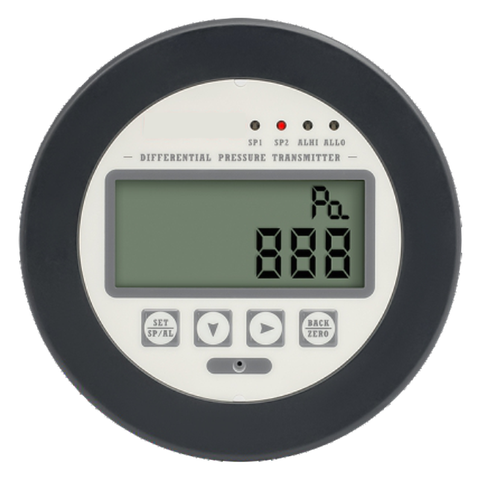
Pioneer supplies differential pressure (DP) transmitters that convert the pressure difference between two points into a 4–20 mA or 0–10 V signal. The low-range air type (±0.5% FS, IP 65, 12–30 V DC) is used for HVAC filters, ducts and cleanrooms; smart HART types with remote diaphragm seals are used for process flow, level and filter duty.
- Accuracy: ±0.5% FS (±0.25% FS optional)
- Output: 4–20 mA two-wire, or 0–10 V DC three-wire
- Electrical connection: Screw terminals, PG7 cable gland
Overview
What it does and where it fits.
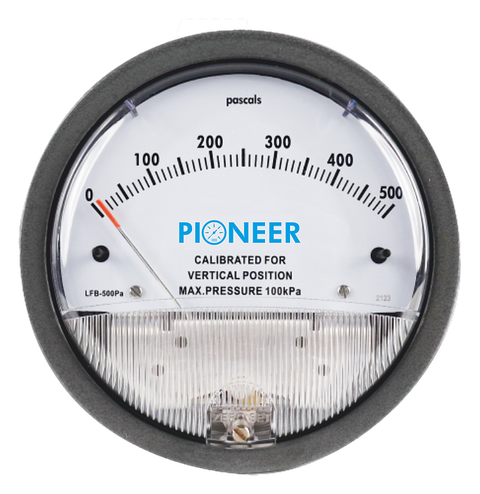
A DP transmitter does what a differential pressure gauge does, but sends the reading to a PLC, DCS, SCADA system or BMS. The common uses are filter and strainer pressure drop, flow across an orifice plate, venturi or flow nozzle, level in closed tanks, and room or duct pressure for cleanroom and HVAC control.
For air and non-combustible gases, the low-range transmitter has barbed fittings for 3/16" flexible tubing, a choice of 4–20 mA two-wire or 0–10 V DC three-wire output, and an IP 65 flame-retardant ABS housing. Accuracy is ±0.5% FS as standard, with ±0.25% FS as an option.
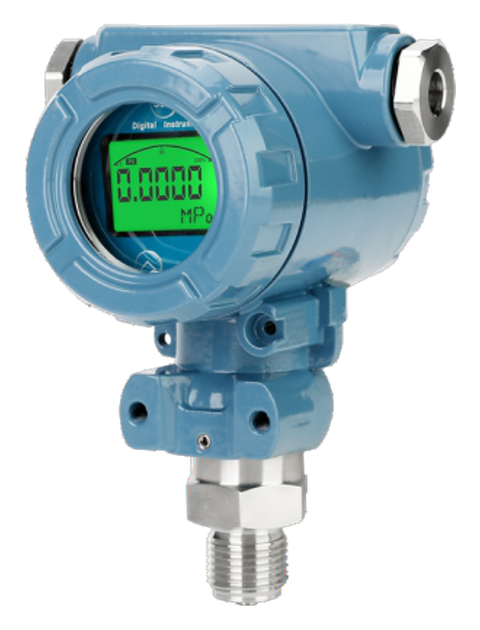
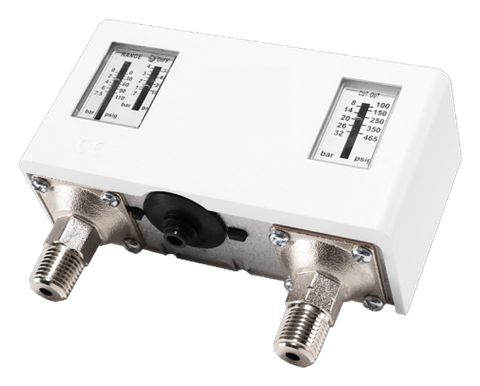
For liquids, steam and process duty, Pioneer supplies industrial smart DP transmitters with 4–20 mA plus HART output, an integral LCD and SS 316 wetted parts. Remote diaphragm seals with filled capillaries are used where the process is hot, corrosive or viscous. Where only an alarm contact is needed, for example 'filter dirty' or 'fan running', a differential pressure switch is the simpler choice.
Types
- Low-range air DP transmitterBox-type transmitter with barbed tube fittings, 4–20 mA or 0–10 V, for AHU filters, duct static pressure and cleanroom pressure.
- Wet and dry versionsDry versions are for air and gases; wet versions accept liquid at the ports for water-side pressure drop.
- Compact in-line DP transmitterTwo threaded process ports, for pressure drop across strainers, filters and heat exchangers on liquid lines.
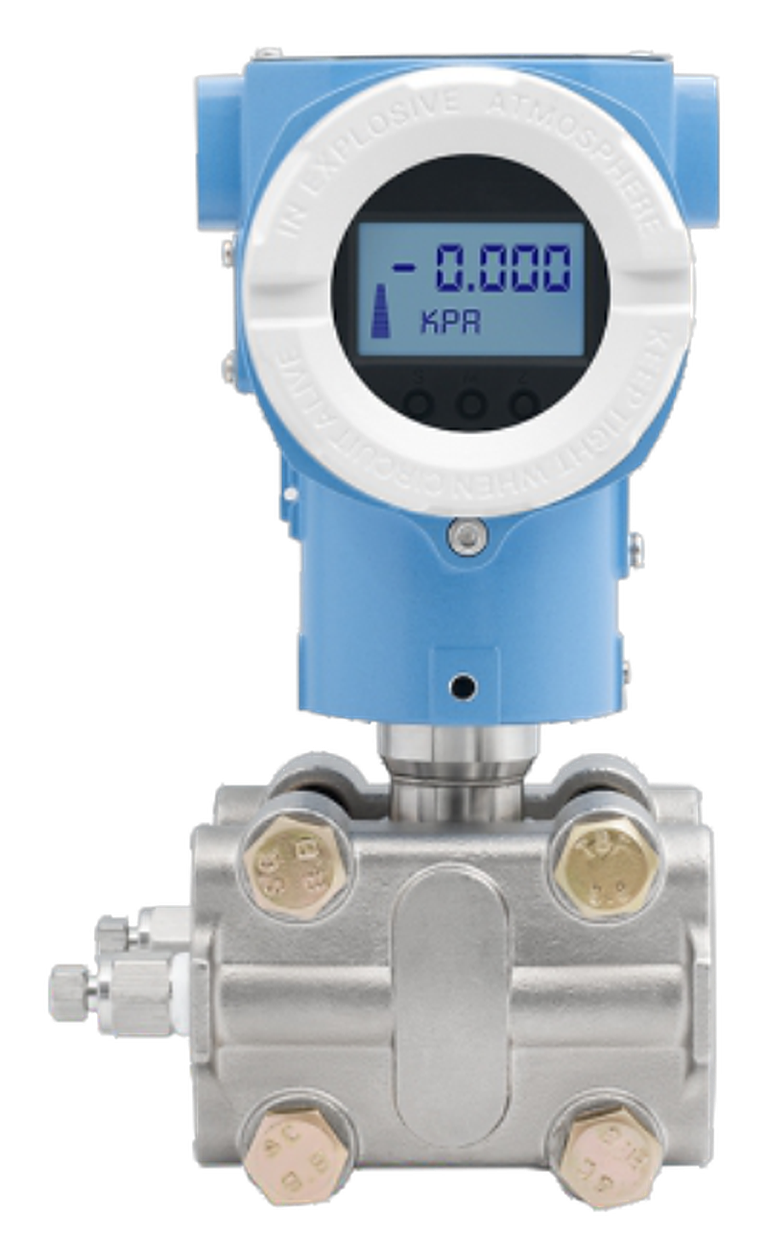
- Smart (HART) DP transmitterIndustrial housing with integral LCD, 4–20 mA with HART, for flow, level and process DP measurement.
- Remote diaphragm seal DP transmitterFlanged diaphragm seals with silicone-oil filled capillaries, for hot, corrosive, viscous or sanitary process media.
Features
- 4–20 mA (two-wire) or 0–10 V DC (three-wire) output
- ±0.5% FS accuracy, ±0.25% FS optional (air type)
- 12–30 V DC supply
- IP 65 enclosure
- Barbed fittings for 3/16" tubing (air type)
- Smart HART versions with integral LCD
- Remote diaphragm seal option with flanged connections
- Screw terminals with PG7 cable gland (air type)
Applications
- AHU filter monitoring and alarms in BMS
- Cleanroom and pharmaceutical room pressure
- Duct static pressure for VAV and fan speed control
- Flow measurement with orifice plates, venturis and nozzles
- Level in closed or pressurised tanks
- Water and wastewater filters and pumps
- Boiler and power plant flow
- Oil, gas and chemical processing
Specifications
Spec table.
Standard ranges and materials. Tell us your medium, range and connection and we will match the model.
| Parameter | Value |
|---|---|
| Type | Low-range differential pressure transmitter for air |
| Media | Air and compatible non-combustible, non-corrosive gases |
| Output | 4–20 mA two-wire, or 0–10 V DC three-wire |
| Supply | 12–30 V DC |
| Loop resistance | 250 Ω at 24 V DC |
| Accuracy | ±0.5% FS (±0.25% FS optional) |
| Non-linearity | ±0.10% FS |
| Hysteresis | ±0.15% FS |
| Stability | ±0.25% FS per year |
| Thermal effect | ±0.05% FS / °C |
| Operating temperature | −25 °C to 70 °C |
| Maximum pressure | Ranges up to 35 kPa: 100 kPa; ranges above 35 kPa: 200 kPa |
| Enclosure | IP 65 |
| Housing | Flame-retardant ABS |
| Electrical connection | Screw terminals, PG7 cable gland |
| Process connection | Barbed fittings for 3/16" flexible tubing |
Smart DP transmitter with remote seals — example configuration
| Parameter | Value |
|---|---|
| Type | Smart, remote seal, HART protocol |
| Output | 4–20 mA DC with HART digital communication, two-wire, loop powered at 24 V DC |
| Example range | 0–100 mbar |
| Base accuracy | ±0.075% of span |
| Turndown | 100:1 |
| Static pressure effect | ±0.2% of maximum span per 6.9 MPa change |
| Temperature effect | ±0.1% of calibrated span per 28 °C change, including zero and span |
| Display | Integral LCD in engineering units and %, with self-diagnostics |
| Housing | Low-copper die-cast aluminium, coated |
| Wetted parts | SS 316 sensor diaphragm, SS 316L remote seal diaphragms, SS 316 drain/vent |
| Fill fluid | Silicone oil |
| Process connection | 1" flange, ANSI B16.5 Class 150 RF, with 3 m capillary |
| Electrical entry | 2 × 1/2" NPT(F), integral terminal block |
| Protection | IP65 |
| Over-range protection | Above 130% of range |
| Response time | Under 3 seconds |
| Humidity | 0–100% RH |
Ranges are selected to suit the duty and confirmed at quotation, as are wet-side, in-line and remote seal configurations.
For consultants
Consultant spec clause.
Paste it into your technical specification or BOQ, then adjust ranges and quantities to your schedule.
1. Differential pressure transmitters for air service shall be electronic, low-range type for air and non-combustible, non-corrosive gases, with range as scheduled.
2. Output shall be 4–20 mA two-wire (0–10 V DC three-wire where specified); supply 24 V DC (12–30 V DC).
3. Accuracy shall be ±0.5% of full scale (±0.25% FS where specified), with stability of ±0.25% FS per year.
4. Enclosure shall be protected to IP 65, with screw terminals and cable gland entry; operating temperature −25 °C to 70 °C.
5. Process connections for air service shall be barbed fittings for 3/16" flexible tubing, connected to static pressure tappings on either side of the filter, fan or room boundary.
6. Transmitters for liquid, steam and process service shall be smart type with 4–20 mA and HART output, integral LCD, SS 316 wetted parts and IP65 housing, with base accuracy of ±0.075% of span; remote diaphragm seals with 1" ANSI Class 150 RF flanges where specified.
7. Liquid-service transmitters shall be installed with a three-valve (five-valve where specified) manifold.
8. Each transmitter shall be supplied with a manufacturer's calibration certificate.
Make: Pioneer Industrial Instruments, Pune, or approved equivalent.
FAQ
Questions about Differential Pressure Transmitter.
Anything else? Call or WhatsApp +91 93700 39974.
How does a DP transmitter measure flow?
A primary element such as an orifice plate, venturi or flow nozzle creates a pressure drop that rises with the square of the flow. The DP transmitter measures that drop, and flow is taken as proportional to the square root of DP, either in the transmitter or in the PLC/DCS. Because of the square-root relationship, the usable flow turndown of an orifice installation is limited to roughly 3:1 to 5:1.
Which transmitter should I use for AHU filters and cleanrooms?
Use the low-range air DP transmitter with barbed fittings and 3/16" tubing. Choose 4–20 mA for long runs or noisy environments, and 0–10 V where the BMS controller expects a voltage input and the cable run is short. Size the range so the alarm value, such as the filter change-out drop or the room setpoint, sits near mid-scale.
How is a DP transmitter used to measure level?
The high-pressure port connects near the bottom of the tank and senses the liquid head; the low-pressure port connects to the vapour space at the top, cancelling the tank pressure. The difference is proportional to level times liquid density. A liquid-filled (wet) reference leg or remote diaphragm seals on both sides keep condensate and process media from upsetting the reading.
What does turndown mean on a smart DP transmitter?
Turndown is how far the calibrated span can be reduced from the sensor's maximum while staying within specification. A 100:1 turndown means one sensor can be re-ranged over a very wide band, which cuts the number of models a site must stock. Accuracy is usually quoted as a percentage of the calibrated span, so check the specification at the span you will actually use.
Why is a three-valve manifold fitted with a DP transmitter?
The manifold has two isolation valves and an equalising valve. It lets you isolate the transmitter, equalise both sides to check zero in place, and bring the transmitter into service without one side seeing full line pressure alone, which can shift or damage the sensor. Five-valve manifolds add vent or test ports, which are common on gas and steam service.