Pressure Instruments · PS
Pressure Switches — Electronic, Mechanical and Air Differential
Pioneer supplies pressure switches that open or close a contact at a set pressure, for pump and compressor control, alarms and safety trips. The range covers electronic switches with an SS 316 body up to 600 bar, mechanical switches, and air differential pressure switches for filter and fan monitoring in HVAC.
- Range: 1 to 600 bar
- Switching outputs: 2, PNP / NPN
Overview
What it does and where it fits.
A pressure switch turns a pressure into an on/off signal. Typical jobs are starting and stopping a pump or compressor between two pressures, raising a high or low pressure alarm, and tripping equipment on overpressure. Where you need the actual value as well as a trip, use a pressure transmitter, or an electronic switch with an analogue output.
Mechanical switches are simple and need no power supply for the sensing element, which suits general-purpose duty with adjustable or fixed set points. Electronic switches give better repeatability and adjustable hysteresis, and often a display. Pioneer's electronic switch has an SS 316 body, two PNP/NPN switching outputs and a 4–20 mA output.
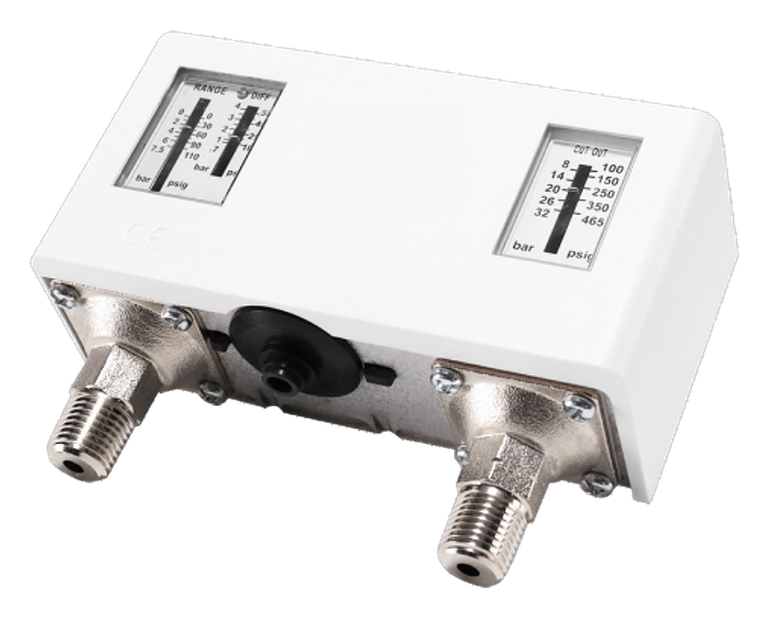
Air differential pressure switches compare two pressures, for example either side of an AHU filter or across a fan, and change over a contact when the difference passes the set point. They are the usual way to signal 'filter dirty' or 'fan running' to a BMS.
Types
- Electronic pressure switchSS 316 body, 1 to 600 bar, two PNP/NPN switching outputs plus 4–20 mA output.
- Mechanical pressure switchSimple, cost-effective switch with adjustable or fixed set point for general-purpose duty.
- Air differential pressure switchChange-over (NO/NC/COM) contact for filter monitoring, fan proving and duct or room pressure in HVAC.
Features
- Electronic version with SS 316 body
- Two switching outputs, PNP or NPN
- 4–20 mA analogue output on the electronic version
- Adjustable hysteresis (electronic)
- Adjustable or fixed set points (mechanical)
- Change-over NO/NC contact on air differential switches
Applications
- Pump start/stop and dry-run protection
- Compressor control and overpressure protection
- High and low pressure alarms
- Safety shut-off of equipment
- AHU filter monitoring and fan proving
- Process control of valves and actuators
Specifications
Spec table.
Standard ranges and materials. Tell us your medium, range and connection and we will match the model.
| Parameter | Value |
|---|---|
| Type | Electronic pressure switch |
| Range | 1 to 600 bar |
| Body | SS 316 |
| Switching outputs | 2, PNP / NPN |
| Analogue output | 4–20 mA |
| Supply | 15 to 35 V DC |
Air differential pressure switch
| Parameter | Value |
|---|---|
| Service | Air |
| Contact | Change-over: terminal 1 NC (break), 2 NO (make), 3 COM (supply line) |
Set point range, contact rating and process connection are confirmed at quotation for each switch type.
For consultants
Consultant spec clause.
Paste it into your technical specification or BOQ, then adjust ranges and quantities to your schedule.
1. Pressure switches for pump, compressor and process duty shall be electronic type with SS 316 wetted body, range as scheduled within 1 to 600 bar.
2. Each switch shall have two independently adjustable switching outputs (PNP / NPN as specified) with adjustable hysteresis, and a 4–20 mA analogue output.
3. Supply voltage shall be 24 V DC (15 to 35 V DC range).
4. Set point shall lie between about 25% and 75% of the switch range; set points and reset values shall be scheduled for each switch.
5. Air differential pressure switches for filter monitoring and fan proving shall have an adjustable set point and a change-over (SPDT, NO/NC/COM) contact.
6. Switches shall be installed with an isolation valve on liquid lines and with flexible tubing on air service.
7. Each switch shall be supplied with a manufacturer's test certificate stating set point and reset value.
Make: Pioneer Industrial Instruments, Pune, or approved equivalent.
What is the difference between set point, reset point and differential?
The set point is the pressure at which the contact changes state. The reset point is where it changes back. The gap between the two is the differential, or hysteresis. A pump control switch needs a wide enough differential to stop the pump short-cycling, while an alarm switch usually needs a narrow one. Electronic switches let you set hysteresis directly.
Should I choose a mechanical or an electronic pressure switch?
Choose mechanical for simple on/off duty such as pump or compressor control, where a simple switch without electronics is enough. Choose electronic where you need better repeatability, adjustable hysteresis, more than one switching point, or a 4–20 mA signal from the same device. Pioneer's electronic switch has an SS 316 body, two PNP/NPN outputs and a 4–20 mA output.
Should the contact be normally open or normally closed?
Wire safety trips and alarms fail-safe: the circuit should be healthy when the contact is closed, so a broken wire or lost supply also trips. For a high-pressure trip, use the contact that opens on rising pressure. A change-over (SPDT) contact, as on Pioneer's air differential pressure switch, lets you choose NO or NC on site.
How do I set an AHU filter switch?
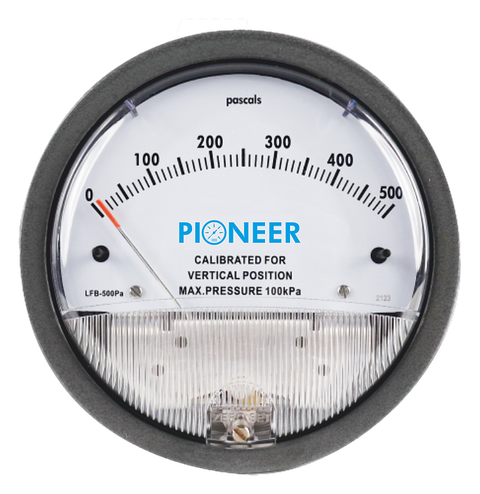
Set the switch at the filter's recommended final pressure drop from the filter data sheet, or at about twice the clean-filter pressure drop measured at commissioning. Connect the high-pressure port upstream of the filter and the low-pressure port downstream. Many sites also fit a low differential pressure gauge across the same filter, so staff can see how close it is to the alarm.
Related