Pressure Instruments · PT
Pressure Transmitters — Gauge and Absolute, 4–20 mA
Pioneer supplies pressure transmitters that convert gauge or absolute pressure into a 4–20 mA signal for PLC, DCS, SCADA and BMS. Ranges go up to 0–1600 bar, with SS 316 wetted parts, 1/2" NPT or BSP connections, and 0.1% or 0.25% FS accuracy depending on the sensor.
- Range: Up to 0–1600 bar
- Process connection: 1/2" NPT, 1/2" BSP
- Protection: IP65
Overview
What it does and where it fits.
A pressure transmitter is what you use when the pressure reading has to leave the pipe: for remote monitoring, control loops, trending or alarms in a control system. Gauge transmitters measure relative to atmosphere and suit most process, utility and HVAC duty. Absolute transmitters measure from a perfect vacuum and are used where changes in atmospheric pressure would upset the reading.
Two sensor types are offered. The SS 316 diaphragm sensor is 0.1% FS and takes three times its span in overload. The ceramic sensor is 0.25% FS, takes twice its span, and works down to −40 °C. Both measure liquids, gases and vapour and are rated IP65.
For media that would block a standard port or damage the sensor, choose a flush diaphragm transmitter with a flanged end, or a remote diaphragm seal with capillary. Compact and OEM versions suit machines, hydraulics and packaged equipment; versions with an integral digital display give a local reading as well as the signal.
Types
- General purpose / compact transmitterThreaded 1/2" NPT or BSP, SS 316 wetted parts, 4–20 mA, for water, air, oil and utility service.
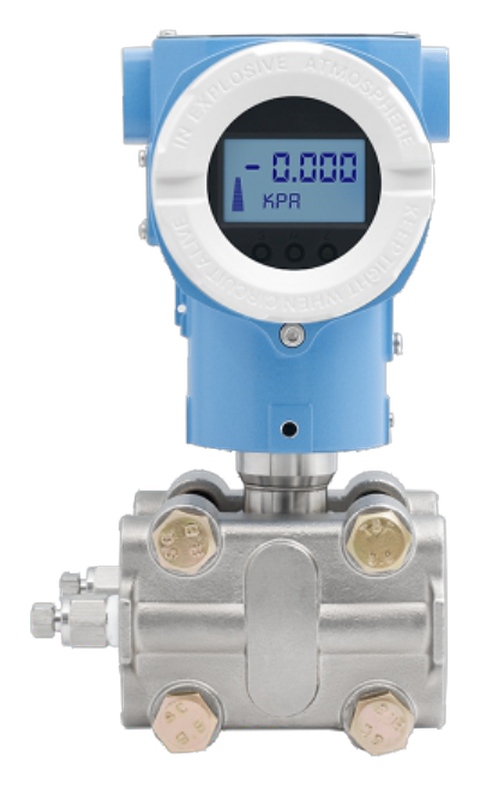
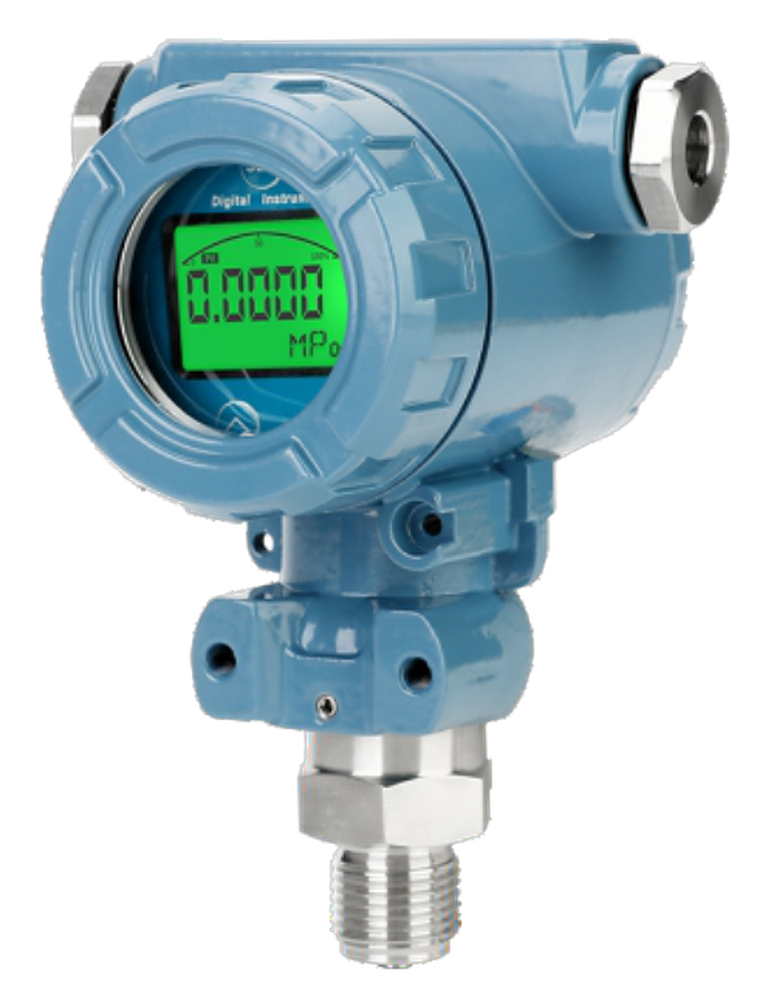
- Transmitter with digital displayIndustrial housing with local display, for points that need both a field reading and a control-room signal.
- Flush diaphragm transmitter, flanged endDiaphragm flush with the process face, mounted on a flanged nozzle with a stop valve, for viscous, slurry or crystallising media.
- Remote diaphragm seal transmitterDiaphragm seal and filled capillary keep hot, corrosive or sticky process media away from the transmitter.
- OEM pressure sensorCompact sensor with plug connector, wired in a two-wire loop with power supply and meter, for machines and packaged equipment.
- High purity transmitterFor clean process lines; construction and finish confirmed at enquiry.
Features
- Ranges up to 0–1600 bar
- Gauge or absolute pressure
- Two-wire 4–20 mA output
- 8 to 30 V DC supply
- SS 316 or ceramic sensing element
- 0.1% FS (SS) or 0.25% FS (ceramic) accuracy
- IP65 protection
- 1/2" NPT or 1/2" BSP process connection
Applications
- Pump and booster-set pressure control
- Chilled-water and condenser-water systems
- Hydraulics and pneumatics
- Pumps and compressors
- Process plant and harsh environments
- Research and test rigs
Specifications
Spec table.
Standard ranges and materials. Tell us your medium, range and connection and we will match the model.
| Parameter | Value |
|---|---|
| Range | Up to 0–1600 bar |
| Pressure reference | Gauge or absolute |
| Output | 4–20 mA DC, two-wire (ceramic sensor version listed with four-wire 0–10 mA DC) |
| Supply | 8 to 30 V DC |
| Accuracy | 0.1% FS (SS 316 sensor), 0.25% FS (ceramic sensor) |
| Wetted material | SS 316 (ceramic sensor option) |
| Process connection | 1/2" NPT, 1/2" BSP |
| Medium | Liquid, gas and vapour |
| Protection | IP65 |
| Humidity | Below 95% RH |
Sensor options compared
| Parameter | SS 316 sensor | Ceramic sensor |
|---|---|---|
| Accuracy | 0.1% FS | 0.25% FS |
| Measuring range | 0–600 bar | 0–600 bar |
| Medium | Liquid, gas and vapour | Liquid, gas and vapour |
| Operating temperature | −10 °C to 80 °C | −40 °C to 80 °C |
| Storage temperature | −40 °C to 125 °C | −40 °C to 125 °C |
| Temperature effect | < 0.02% / °C | < 0.015% / °C |
| Overload | 3 × span | 2 × span |
| Protection | IP65 | IP65 |
| Humidity | Below 95% RH | Below 95% RH |
| Output | Two-wire 4–20 mA DC | Four-wire 0–10 mA DC |
Range, output and connection are confirmed at quotation for flush, remote seal and display versions.
For consultants
Consultant spec clause.
Paste it into your technical specification or BOQ, then adjust ranges and quantities to your schedule.
1. Pressure transmitters shall be electronic, two-wire, loop powered, with 4–20 mA DC output proportional to pressure; supply 24 V DC (8 to 30 V DC).
2. Sensing element shall be SS 316 diaphragm with SS 316 wetted parts, suitable for liquid, gas and vapour.
3. Accuracy shall be 0.1% of full scale, with overload capability of three times span.
4. Range shall be as scheduled, gauge reference (absolute where specified), selected so that normal operating pressure is between about 50% and 75% of span.
5. Process connection shall be 1/2" NPT (1/2" BSP); flush diaphragm with flanged end for viscous, slurry or crystallising media; remote diaphragm seal with capillary for hot or corrosive media.
6. Enclosure shall be protected to IP65; transmitters requiring local indication shall have an integral digital display.
7. Each transmitter shall be installed with an isolation valve and supplied with a manufacturer's calibration certificate.
Make: Pioneer Industrial Instruments, Pune, or approved equivalent.
Should I specify a gauge or an absolute pressure transmitter?
Use gauge pressure for almost all pump, pipeline, HVAC and hydraulic duty, because the process and the equipment ratings are referenced to atmosphere. Use absolute pressure for vacuum processes, vapour-pressure and boiling-point work, and barometric or altitude-sensitive measurements, where atmospheric changes of around 1–3% would show up as error. Pioneer offers both references.
Why is two-wire 4–20 mA the standard output?
The same two wires carry the supply and the signal, which keeps cabling simple over long runs. A current signal is not affected by cable resistance and resists electrical noise. Because the live zero is 4 mA, a reading of 0 mA immediately shows a broken wire or a failed transmitter. Most PLCs, DCS and BMS controllers accept 4–20 mA inputs directly.
SS 316 or ceramic sensor: which should I choose?
The SS 316 diaphragm sensor gives the better accuracy (0.1% FS) and the higher overload (3 × span), and suits most liquids, gases and steam-condensate service. The ceramic sensor (0.25% FS) resists abrasion and many corrosive media well and works down to −40 °C, but takes only 2 × span in overload. Check chemical compatibility of the seal material too.
When do I need a flush diaphragm or a remote diaphragm seal?
Use a flush diaphragm transmitter, with its diaphragm level with the process face, where slurry, pulp, sludge, viscous or crystallising media would block a standard threaded port. Use a remote diaphragm seal with capillary where the process is too hot or corrosive for the transmitter, or must be kept sterile. Both add some temperature effect, so keep capillaries short and protected from sun.
How should a pressure transmitter be installed?
Fit an isolation valve, and a test tee if site calibration is planned. On liquid lines, mount the transmitter below the tapping so the impulse line stays full of liquid; on gas lines, mount it above so condensate drains back. On steam, use a siphon. Keep away from pump vibration, and check that the loop supply and total loop resistance suit the transmitter.
Related