Pressure Instruments · PDI
Magnehelic Gauge — Low Differential Pressure Gauge
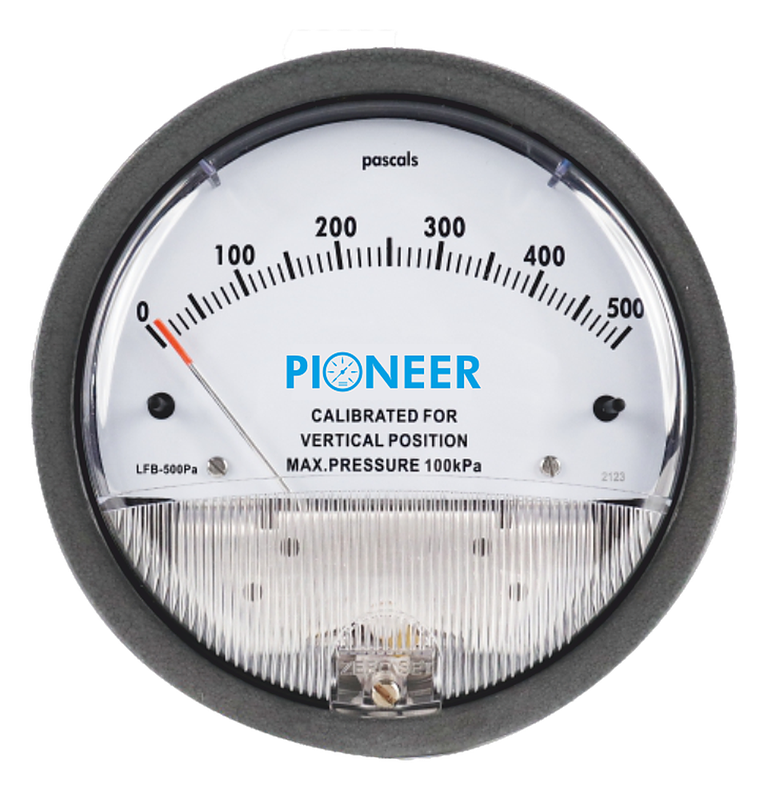
Pioneer supplies low differential pressure gauges, commonly called Magnehelic® gauges (a Dwyer Instruments trademark), for air and non-combustible gases. Ranges run from 0–60 Pa to 0–8 kPa, including centre-zero ±60 Pa, on a 100 mm (4") dial with ±3% FS accuracy and front zero adjustment.
- Dial: 100 mm (4") diameter
- Accuracy: ±3% of full scale
Overview
What it does and where it fits.
A low differential pressure gauge reads very small pressure differences in air. Typical readings are the pressure drop across an AHU filter, the pressure difference between a cleanroom and its corridor, and the velocity pressure from a pitot tube. These are measured in pascals, where a standard Bourdon gauge cannot read at all.
Inside, a diaphragm moves against a calibrated spring, and a magnet turns a helix that carries the pointer. There are no linkages to stick, which gives a smooth, repeatable reading at very low pressures. The case and bezel are die-cast aluminium with a clear acrylic cover. High and low pressure taps are duplicated on the side and back, so the gauge can be surface, flush or panel mounted.
The gauge is for dry, clean, non-corrosive air and compatible gases only, and must be mounted with the diaphragm vertical. For a 4–20 mA or 0–10 V signal to a BMS, use a differential pressure transmitter; for an alarm contact, use an air differential pressure switch.
Types
- Positive range0–60 Pa up to 0–8 kPa, for filter pressure drop and positive room or duct pressure.
- Centre-zero range60–0–60 Pa, for rooms or zones that may be either positive or negative to the reference.
Features
- Reads from 0–60 Pa full scale
- Frictionless magnetic-helix movement
- Zero adjustment at the front
- 100 mm (4") dial
- Die-cast aluminium case and bezel, acrylic cover
- Duplicate 1/8" NPT(F) high and low taps, side and back
- Supplied with plugs, tubing adapters and flush-mounting adapters
Applications
- AHU and FFU filter monitoring
- Cleanroom pressure cascades
- Fume hood exhaust checks
- Air velocity with a pitot tube
- Duct static pressure and HVAC balancing
- Isolation and pharmaceutical room pressure
Specifications
Spec table.
Standard ranges and materials. Tell us your medium, range and connection and we will match the model.
| Parameter | Value |
|---|---|
| Ranges | 0–60, 0–125, 0–250, 0–500, 0–750 Pa; 60–0–60 Pa; 0–1, 0–1.5, 0–2, 0–3, 0–4, 0–5, 0–8 kPa |
| Accuracy | ±3% of full scale |
| Service | Air and non-combustible compatible gases (dry, clean, non-corrosive) |
| Pressure limits | −70 kPa to 100 kPa |
| Temperature limits | −6.7 °C to 60 °C |
| Dial | 100 mm (4") diameter |
| Housing | Die-cast aluminium case and bezel, acrylic cover, grey coated finish |
| Zero adjustment | Front |
| Mounting orientation | Diaphragm vertical |
| Connections | 1/8" NPT(F) high and low pressure taps, duplicated: one pair side, one pair back |
| Weight | 500 g |
| Standard accessories | Two 1/8" NPT plugs for the spare taps, two 1/8" pipe-thread to rubber-tubing adapters, three flush-mounting adapters with screws |
Accuracy on the lowest ranges is confirmed at quotation.
For consultants
Consultant spec clause.
Paste it into your technical specification or BOQ, then adjust ranges and quantities to your schedule.
1. Low differential pressure gauges shall be diaphragm-actuated, magnetic-helix type, with no mechanical linkage between diaphragm and pointer, for air and non-combustible gases.
2. Dial shall be 100 mm (4"), with die-cast aluminium case and bezel, acrylic cover and front zero adjustment.
3. Range shall be as scheduled: 0–250 Pa for pre-filters (0–500 / 0–750 Pa for fine and HEPA filters; 0–60 Pa or 60–0–60 Pa for room pressure).
4. Accuracy shall be ±3% of full scale; pressure limits −70 kPa to 100 kPa; operating temperature −6.7 °C to 60 °C.
5. Gauges shall have duplicated 1/8" NPT(F) high and low pressure taps (side and back), and shall be supplied with plugs, tubing adapters and flush-mounting adapters.
6. Gauges shall be mounted with the diaphragm vertical, connected with flexible tubing to static pressure tappings on each side of the filter or room boundary.
7. Each gauge shall be supplied with a manufacturer's test certificate.
Make: Pioneer Industrial Instruments, Pune, or approved equivalent.
What range of Magnehelic gauge do I need for an AHU filter?
Pick a range whose middle covers the filter's final (change-out) pressure drop. As a guide, 0–250 Pa suits pre-filters, 0–500 Pa suits fine filters, and 0–500 or 0–750 Pa suits HEPA filters. Always check the filter manufacturer's recommended final pressure drop. Mark the change-out value on the dial so maintenance staff can see it at a glance.
Which range suits a cleanroom pressure cascade?
Room-to-room differentials in cleanrooms and pharmaceutical areas are commonly 10 to 15 Pa, so a 0–60 Pa gauge gives a readable scale. Where a room may swing positive or negative to its reference, for example an airlock or an isolation room, use the 60–0–60 Pa centre-zero range. Keep the reference tube in a still location, away from supply diffusers and doors.
How do I convert pascals to mm WC or inches WC?
1 mm water column is about 9.81 Pa, and 1 inch water column is about 249 Pa. So 0–60 Pa is about 0–6 mm WC (0–0.25 in WC), 0–250 Pa is about 0–25 mm WC (0–1 in WC), and 0–500 Pa is about 0–51 mm WC (0–2 in WC). State the unit your drawings use when you enquire.
Why must the gauge be mounted vertically, and how is it zeroed?
At these pressures the weight of the diaphragm and magnet affects the reading, so the gauge is calibrated with the diaphragm vertical and must be installed the same way. To zero it, disconnect or vent both ports so they see the same pressure, then turn the zero screw on the front cover until the pointer sits on zero. Re-check zero at each maintenance visit.
Can a Magnehelic-type gauge be used on water or natural gas?
No for water: the gauge is designed for dry, clean, non-corrosive air and compatible non-combustible gases, and liquid will damage the diaphragm and movement. Do not use the standard gauge on natural gas, LPG or other combustible gases either. For liquid service, use a stainless steel differential pressure gauge with dual bottom connections.