Key takeaways
- Normal air is 20.9 % oxygen; 19.5 % vol is the widely used definition of oxygen-deficient air and the usual first alarm, with a second alarm at 18 % vol.
- Inert gases such as nitrogen, argon and helium have no smell or colour, and low oxygen gives little warning, so a fixed monitor with an alarm outside the door is the main safeguard.
- One litre of liquid nitrogen makes roughly 700 litres of gas, so even a small spill or a venting dewar can lower oxygen in a closed room quickly.
- Mount sensors where the leaking gas will collect: about breathing height for nitrogen, low for argon and cold vapour, high for helium.
- Electrochemical O2 sensors have a finite life of about two to three years; bump-test and calibrate on a fixed schedule and keep records.
- Where CO2 is the gas in use, fit a CO2 monitor as well: CO2 is harmful at levels that barely change the oxygen reading.
Why oxygen deficiency is a hidden hazard
Air contains about 20.9 % oxygen by volume. Nitrogen, argon, helium and carbon dioxide do not burn and are not toxic in the usual sense, but when they leak into a room they displace air and lower the oxygen concentration. None of these gases can be seen or smelt, and a person breathing oxygen-deficient air often does not feel short of breath, because the body's breathing reflex responds to carbon dioxide, not to falling oxygen. Judgement and coordination fail first, so people may not recognise the danger or be able to leave.
This is why oxygen deficiency causes a steady number of accidents in laboratories, hospitals, food plants and industrial gas areas, and why rescuers who enter without breathing apparatus are often the second casualties.
| Oxygen, % vol | Typical effect on a healthy adult |
|---|---|
| 20.9 | Normal air |
| 19.5 | Widely used limit for oxygen-deficient air (for example OSHA); first alarm |
| 18 | Common second alarm; leave the area and do not re-enter without control measures |
| 15–19 | Reduced ability to work, early impairment of attention and coordination |
| 12–14 | Faster breathing and pulse, poor judgement, fatigue |
| 10–12 | Nausea, blue lips, serious impairment |
| Below 10 | Loss of consciousness, collapse and death within minutes |
At the other end, air above about 23.5 % oxygen is oxygen-enriched and greatly increases fire risk, so many monitors also carry a high alarm for areas with oxygen storage or liquid oxygen.
Where you need an oxygen deficiency monitor
Carry out a risk assessment for every room or enclosure where inert gas is stored, used or could leak. A fixed monitor is normally needed where the worst credible leak could bring the oxygen level below 19.5 % in an occupied space. Typical locations:
- Liquid nitrogen stores and cryogenic labs – dewars, cryostorage freezers, IVF and biobank rooms. One litre of liquid nitrogen expands to roughly 700 litres of gas at room temperature, so filling, spills and normal boil-off all matter in a small room.
- MRI and NMR rooms – helium boil-off or a quench. Helium rises, so the sensor goes high.
- Nitrogen generator and inert gas manifold rooms, gas cylinder stores and gas cabinets.
- Food and beverage plants – nitrogen for packaging and blanketing, CO2 for carbonation and dry ice (see the note on CO2 below).
- Pharma and chemical plants – nitrogen purging and blanketing of reactors, glove boxes, lyophilisers.
- Welding and laser bays using argon or nitrogen shielding gas in enclosed areas.
- Confined spaces – tanks, pits, sewers, vessels. Here the test is done with a portable multi-gas or O2 detector before and during entry, under a permit.
Oxygen sensor types compared
Four sensing principles cover almost all oxygen measurement. For room safety the choice is usually between electrochemical and optical; the others are for process or combustion analysis.
| Sensor | How it works | Best for | Limits |
|---|---|---|---|
| Electrochemical (galvanic) | O2 reacts at an electrode and produces a current proportional to oxygen partial pressure | Fixed and portable ambient safety monitors, 0–25 or 0–30 % vol | Consumed over time, typical life 2–3 years; affected by large pressure and temperature swings |
| Optical (luminescence quenching) | Oxygen quenches the light emitted by a dye; the change is measured | Long-life ambient monitors, dissolved oxygen in water | Higher cost; still needs periodic checks |
| Zirconia | Heated ceramic cell produces a voltage set by the oxygen difference across it | Combustion and flue gas, boiler trim, high temperature | Runs hot; combustible gases in the sample affect the reading; not usual for room safety |
| Paramagnetic | Uses the strong magnetic susceptibility of oxygen | Analysers needing high accuracy, gas purity, process control | Analyser, not a wall-mounted safety detector; sensitive to vibration and flow |
Fixed monitor or portable detector?
The two do different jobs and many sites need both.
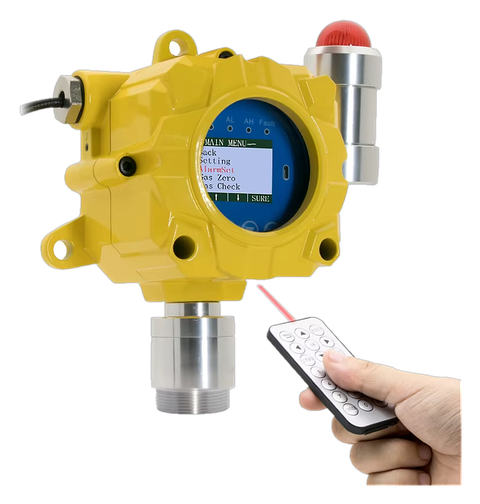
- Fixed monitor: a wall-mounted sensor and controller that watches one room 24 hours a day, sounds a horn and beacon, and can switch extract ventilation, close a gas supply valve or send a 4–20 mA or relay signal to the BMS. Use it for any room with a permanent inert gas risk. Put a repeater display or beacon outside the door so people can see the status before they walk in.
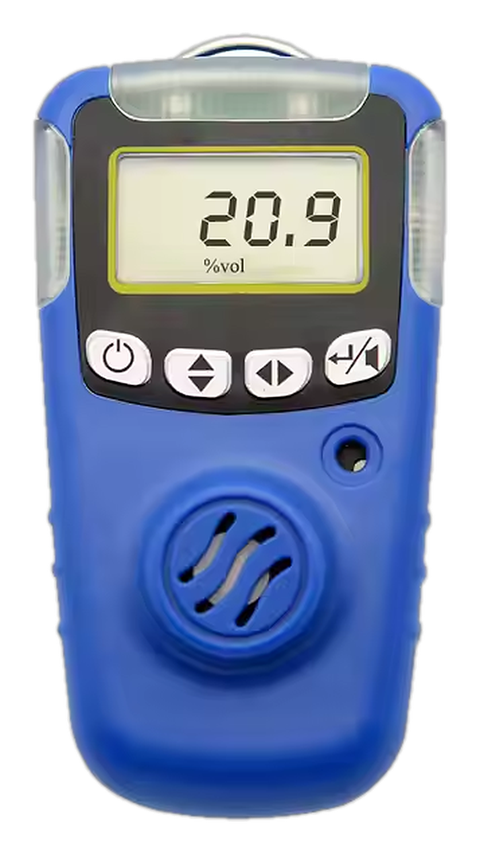
- Portable detector: a personal, battery-powered O2 or multi-gas detector worn in the breathing zone, with vibration, sound and light alarms. Use it for confined-space entry, maintenance staff, people filling dewars, and areas too small or too occasional for a fixed system.
A portable detector is not a substitute for a fixed monitor in a room where people work alone or where the leak can happen while nobody is watching.
Where to mount the sensor
The sensor must be where the leaking gas will collect and where people breathe. Density relative to air decides the height:
| Gas | Density vs air | Sensor height (guide) |
|---|---|---|
| Nitrogen (room temperature) | Slightly lighter (about 0.97) | Breathing height, about 1.2–1.8 m |
| Cold nitrogen vapour from liquid | Heavier while cold | Lower, about 0.3–1 m, near the dewar or freezer |
| Argon | Heavier (about 1.4) | Low, about 0.3–0.5 m from floor |
| Carbon dioxide | Heavier (about 1.5) | Low, plus a CO2 sensor |
| Helium | Much lighter (about 0.14) | High, near ceiling |
Other practical points: keep the sensor 1–2 m from the likely leak source but not in a direct blast of cold gas; avoid supply-air diffusers that dilute the reading; put the controller and alarm reset outside the room; and fit enough sensors that no part of a large room is out of range. Follow the gas supplier's and detector manufacturer's guidance for the exact layout.
Alarm, calibration and maintenance routine
- Alarm levels: low alarm 19.5 % vol (or 19 %), low-low 18 % vol; high alarm 23.5 % vol where oxygen enrichment is possible. Latch alarms so they need a manual reset.
- Actions: link the first alarm to increased extract ventilation and the second to evacuation and, if possible, closing the gas supply.
- Bump test: expose the sensor to a low-oxygen test gas (for example nitrogen or a certified low-O2 mix) and confirm the alarm operates. Portables are commonly bump-tested before each day's use.
- Calibration: zero with nitrogen and span in clean fresh air (20.9 %) or with certified gas, at the interval the manufacturer states, typically every 3–6 months for fixed systems.
- Sensor replacement: replace electrochemical cells at end of life, usually 2–3 years, or earlier if the reading drifts or responds slowly.
- Records: keep a log of tests, calibrations and alarms; auditors and insurers will ask for it.
Relevant references include EN 50104 (performance requirements for oxygen detectors), the OSHA definition of oxygen-deficient atmospheres (below 19.5 %) and your gas supplier's safety data sheets and cryogenic handling guidance.
A note on carbon dioxide
Carbon dioxide is a special case. It is not only an asphyxiant; it acts on the body at concentrations far below those that would noticeably lower oxygen. Raising CO2 from about 0.04 % to 5 % drops oxygen by only about 1 % vol, yet 5 % CO2 is already hazardous. In rooms with CO2 cylinders, dry ice, carbonation or CO2 incubators, fit an NDIR CO2 monitor with alarms set to occupational exposure limits, in addition to or instead of an oxygen monitor.