Pressure Instruments · PDI
Differential Pressure Gauges — Filter, Flow and Level Monitoring
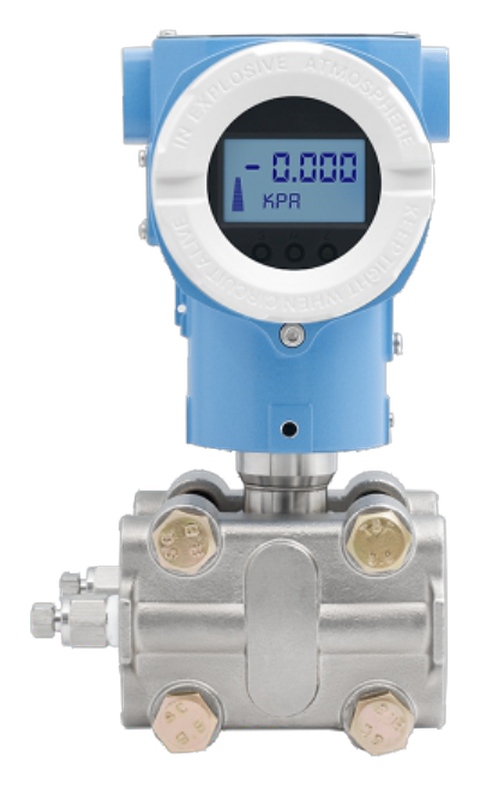
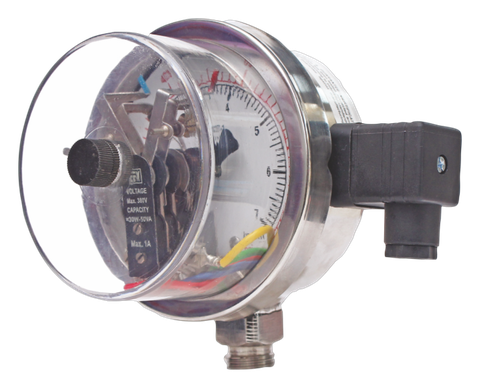
A differential pressure gauge shows the difference between two pressures on one dial, for monitoring filters and strainers, flow across an orifice or venturi, and liquid level. Pioneer supplies stainless steel DP gauges with dual bottom connections and front zero adjustment, remote seal versions for process liquids, and low-range gauges for air.
- Connection block: Stainless steel

Overview
What it does and where it fits.
A differential pressure gauge has two process ports, high (+) and low (−), and reads the difference between them directly. Two separate gauges would need subtracting, and the error of each would add up. One DP gauge gives a single, direct reading of the pressure drop, even at high line pressure.
Its most common job is filter and strainer monitoring: the pressure drop rises as the element loads, and the gauge shows when to clean or change it. With an orifice plate or venturi, a DP gauge indicates flow; on a closed tank, it can indicate level.
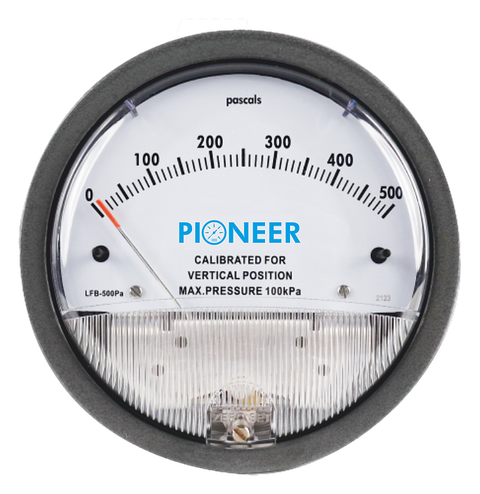
For water and process liquids, Pioneer supplies stainless steel DP gauges with an SS connection block and dual bottom entry, and remote diaphragm seal versions where the medium must be kept away from the gauge. For air and clean gases at very low pressures, such as AHU filters and cleanrooms, use a low differential pressure gauge (Magnehelic type).
Types
- Stainless steel DP gaugeSS case and SS connection block with dual bottom-entry threaded ports, for water, oil and process liquids.
- Remote seal DP gaugeDiaphragm seals with silicone-oil filled capillaries, for corrosive, hot, viscous or dirty liquids and for skid mounting away from the tapping.
- Low differential pressure gauge for airMagnehelic-type gauge reading from 0–60 Pa, for AHU filters, cleanrooms and duct pressure.
Features
- Reads the pressure difference directly on one dial
- Dual bottom-entry high (+) and low (−) connections
- Stainless steel case and connection block
- Black micro-adjustable pointer with front zero adjustment
- White dial with black numerals
- Glass or shatter-resistant polycarbonate window
- Remote seal option with SS 316 diaphragms
Applications
- Filter and strainer monitoring
- Flow indication across orifice plates and venturis
- Liquid level in closed tanks
- Chiller, cooling tower and heat exchanger pressure drop
- HVAC system balancing
- Leak detection between two points
Specifications
Spec table.
Standard ranges and materials. Tell us your medium, range and connection and we will match the model.
| Parameter | Value |
|---|---|
| Pressure type | Differential pressure (Δp) |
| Process connections | Dual, bottom entry, male threaded; typically 1/4" or 1/2" NPT / BSP |
| Case | Stainless steel |
| Connection block | Stainless steel |
| Dial | White background, black numerals and graduations |
| Pointer | Black, micro-adjustable, front zero-adjustment screw |
| Window | Clear instrument glass or shatter-resistant polycarbonate |
| Mounting | Direct mounting on the bottom process connections |
Remote seal DP gauge — example configuration
| Parameter | Value |
|---|---|
| Range | 0–100 mbar |
| Type | Remote seal, diaphragm operated |
| Dial | 150 mm, linear scale, black on white |
| Diaphragm | SS 316 |
| Case / bezel | SS 304, bayonet bezel ring |
| Movement | SS 304, geared |
| Pointer | Black aluminium, micrometer adjustment, 270° deflection |
| Window | Toughened glass with rubber ring |
| Process connection | 1", ANSI Class 150 RF flanged remote seals |
| Capillary | 3 m, silicone-oil filled |
| Flushing connection | 1/4" NPT, SS 316 |
| Over-range protection | 150% of maximum pressure |
| Zero and span adjustment | External micro screw |
| Blow-out disc | Provided |
| Protection | IP 65 |
| Mounting | Surface mounting with bracket and U-clamp |
Range, connection and seal configuration are confirmed at quotation for each duty.
For consultants
Consultant spec clause.
Paste it into your technical specification or BOQ, then adjust ranges and quantities to your schedule.
1. Differential pressure gauges shall indicate the pressure difference between high (+) and low (−) ports on a single dial, with a stainless steel case and stainless steel connection block.
2. Dial shall be 150 mm, white with black graduations, with black micro-adjustable pointer and front zero adjustment; window shall be glass (shatter-resistant polycarbonate where specified).
3. Range shall be as scheduled, selected so that the alarm or change-out pressure drop is about 50% to 75% of full scale.
4. Process connections shall be dual bottom entry, 1/2" NPT (1/4" NPT / 1/2" BSP).
5. Where specified for corrosive, hot or viscous media, gauges shall have SS 316 remote diaphragm seals with silicone-oil filled capillary and flanged process connections (1", ANSI Class 150 RF).
6. Each gauge shall be installed with a three-valve or five-valve manifold, or with isolation valves and an equalising valve.
7. Each gauge shall be supplied with a manufacturer's test certificate.
Make: Pioneer Industrial Instruments, Pune, or approved equivalent.
Why use a differential pressure gauge instead of two pressure gauges?
Subtracting two gauge readings adds the error of both gauges to the result. On a 0–10 bar line with ±1% gauges, that can be ±0.2 bar, which may be bigger than the filter drop you want to see. A DP gauge measures the difference directly, so a small drop can be read accurately even at high line pressure.
How do I choose the range for filter monitoring?
Find the clean pressure drop and the recommended final (change-out) pressure drop from the filter or strainer data. Choose a full-scale range so the change-out value sits at roughly 50% to 75% of the scale, leaving the clean reading clearly above zero. Mark the change-out point on the dial, or add a DP switch to raise an alarm.
What is the static (line) pressure rating, and why does it matter?
Static pressure is the line pressure applied to both ports at once. A DP gauge with a 0–100 mbar range may sit on a line at several bar, so its body must be rated for the full line pressure and must survive full pressure on one side only, which happens during start-up and maintenance. Always state both the DP range and the maximum line pressure when enquiring.
How should a DP gauge be valved and commissioned?
Install it with a three-valve manifold: two isolation valves and an equalising valve. To bring it into service, open the equaliser, open the high side, then the low side, then close the equaliser. Reverse the order to take it out. This stops one side seeing full line pressure alone, which can over-range the gauge.
When is a remote seal DP gauge needed?
Use remote diaphragm seals when the liquid is corrosive, hot, viscous, crystallising or carries solids that would block small ports, or when the gauge must be mounted away from the tapping. The SS 316 diaphragms and silicone-oil filled capillaries transmit the pressure to the gauge. Keep both capillaries the same length and at the same temperature to limit errors.