Key takeaways
- Survey before you order: real flows, pipe material and wall thickness, existing pockets, straight runs and the BMS protocol decide the meter, not the old meter's nameplate.
- For tenant billing, replace like for like with an inline flow sensor and immersion temperature pair during a planned shutdown; clamp-on suits monitoring and plants that cannot stop.
- Old line-size meters are often oversized for today's part-load flows; a retrofit is the moment to resize the flow sensor to the real flow range.
- Never reuse one sensor of an old temperature pair or mix immersion and surface sensors; replace the pair as a matched set.
- Record final readings of the old meter and opening readings of the new one, signed by both parties, so billing continues without dispute.
When a BTU meter needs retrofitting or replacing
Most retrofit enquiries fall into one of four situations:
- No metering yet: an existing building moves from area-based to measured chilled-water billing, or an energy audit needs measured cooling at the plant header.
- Failed or drifting meters: mechanical flow sensors worn by debris, flat batteries, damaged temperature sensor cables, or readings tenants no longer trust.
- Obsolete communication: meters that only give pulses, or a protocol the new BMS or billing software cannot read.
- Changed loads: tenant fit-outs, new AHUs or a move to variable primary flow that leave the original meter running outside its flow range.
Each case starts the same way: a site survey, because an existing system rarely matches its as-built drawings.
Survey the existing installation first
Collect these facts for every metering point before choosing a meter:
| Item | Why it matters |
|---|---|
| Pipe size, material and wall thickness | Sets the inline meter size and reducers; clamp-on meters need exact outside diameter and wall thickness, and the pipe condition (scale, lining) |
| Design flow and lowest part-load flow | The flow sensor must cover both; check BMS trends or a temporary handheld ultrasonic reading rather than design drawings alone |
| Supply and return temperatures, typical ΔT | A small part-load ΔT magnifies temperature-pair error |
| Existing thermowells or pockets | Whether a new matched pair can use them, and whether their depth and diameter suit the new sensors |
| Straight run available | Decides the flow technology and position |
| Isolation valves and bypass | Whether the branch can be isolated without shutting the riser |
| Power and communication | Mains or battery, and M-Bus, Modbus RTU, BACnet or pulse to match the BMS |
| Purpose | Tenant billing needs a sealed, verifiable meter; monitoring and audits can accept more uncertainty |
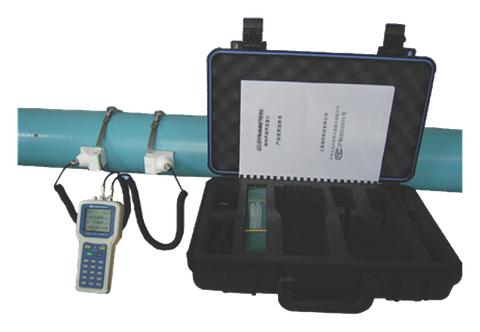
A temporary clamp-on reading with a handheld ultrasonic flowmeter over a few days often shows that actual flows are well below design, which changes the meter size.
Inline or clamp-on: choosing the retrofit route
| Route | What it involves | Best for | Watch out for |
|---|---|---|---|
| Inline replacement (electromagnetic or ultrasonic) | Isolate and drain the section, cut in the flow sensor with reducers if needed, fit new pockets | Tenant billing, plant header meters where a shutdown can be planned | Needs a shutdown window, flange or spool work and refilling and venting |
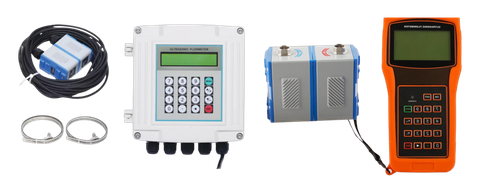
| Clamp-on ultrasonic flow with immersion temperature pair | Transducers strapped to the pipe; temperature sensors in existing or newly added pockets | Plants that cannot stop, large pipes, monitoring and audits | Accuracy depends on correct pipe data and coupling; insulation must be cut back and resealed |
| Fully non-intrusive (clamp-on flow and surface temperature sensors) | Nothing enters the pipe | Short-term surveys and audits | Surface sensors respond more slowly and are more affected by ambient conditions; not a billing solution |
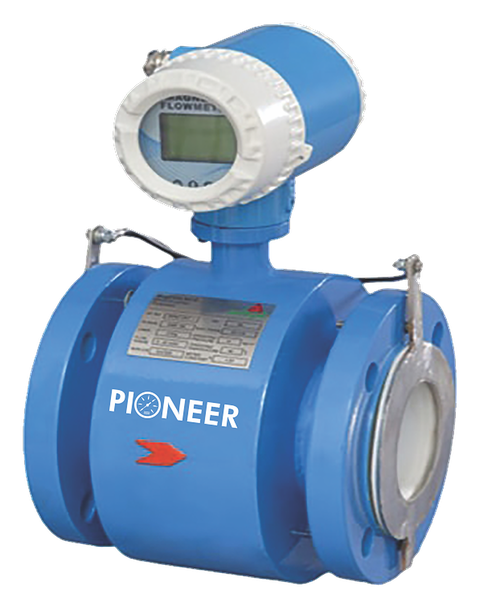
For billing, an inline electromagnetic flowmeter remains the first choice: no moving parts, a short straight run and stable readings at low velocity. A clamp-on ultrasonic flowmeter is the practical route where cutting the pipe is not possible, provided it is verified after commissioning. Our electromagnetic vs ultrasonic comparison covers the trade-offs in more detail.
Resize the flow sensor, do not copy the old one
Many original BTU meters were selected at line size. In chilled-water risers sized for future load, that often means velocities well under 1 m/s at design and much lower at part load, where every flow technology loses accuracy. A replacement is the right time to correct this.
- Take the real design flow and lowest part-load flow from the survey, not the old meter's size.
- Choose the meter size whose range covers both, with concentric reducers if the meter is smaller than the pipe.
- Check that the added pressure drop is acceptable for the pump; with gentle reducers it is usually small.
- If loads will grow, include the future flow in the range check now.
The BTU meter selection guide works through a sizing example for a 100 TR tenant floor.
Temperature sensors in an existing system
Temperature-pair error is the most common reason a retrofitted meter disagrees with expectations, because chilled-water ΔT is small. An error of 0.1 K between sensors is 2% of a 5 K difference and 5% of a 2 K difference.
- Replace the pair as a set. Never pair a new sensor with an old one, even of the same type.
- Install both sensors the same way: both in pockets or both direct immersion, at similar insertion depth. Do not mix an immersion sensor with a surface sensor.
- Check existing pockets for length, bore and condition; a pocket that is too short or packed with corrosion gives a lagging, biased reading.
- Keep the factory cable length on 2-wire sensors; use 4-wire or higher-resistance elements (Pt500, Pt1000) for long runs.
- Insulate pockets and sensor heads after installation so condensation and ambient heat do not bias the supply reading.
Where no pocket exists and the line cannot be drained, adding a pocket under pressure by hot tapping is an established technique, but it is specialist work for a qualified contractor with the right equipment and a method statement.
Plan the shutdown and the billing handover
A retrofit on an occupied building needs coordination between the facility team, the HVAC contractor and the tenants:
- Agree the window: night or weekend, with the chiller plant team, and confirm which branches lose cooling.
- Read and photograph the old meter: cumulative energy and volume registers, date and time, signed by the landlord and tenant where it is used for billing.
- Install, refill and vent: trapped air disturbs every flow technology, so vent high points before commissioning.
- Commission: with no load and equal supply and return temperatures, the two sensors should read within a small fraction of a degree of each other. Compare flow against a handheld ultrasonic reading or the pump curve.
- Record opening readings of the new meter, seal it and update the BMS point list and billing sheet with the new meter serial number.
If the old and new meters run side by side for a few days before the old one is removed, the comparison gives everyone confidence in the new readings.
Connecting the new meter to the BMS
Confirm the interface before ordering. M-Bus suits multi-tenant meter reading, Modbus RTU over RS485 is widely supported by BMS controllers, BACnet integrates natively with BACnet systems, and pulse outputs suit legacy counters. Map cumulative energy, cumulative volume, flow, supply and return temperatures, ΔT and alarm status, and bill from the meter's own cumulative energy register rather than from instantaneous power integrated in the BMS. Pioneer's BTU and water meters page lists the meter types we supply for sub-metering.