Environmental Monitoring · EI
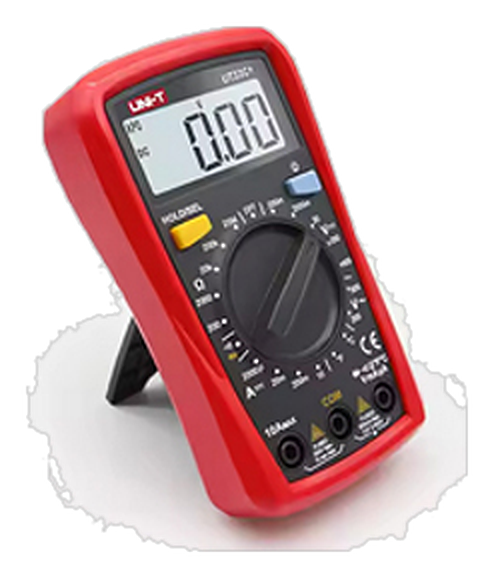
Digital Multimeters — True RMS, Auto-Ranging Electrical Testers
Pioneer supplies digital multimeters (DMMs) that measure AC and DC voltage and current, resistance, capacitance, frequency, continuity and diode test, with temperature on selected models, and with auto-ranging, True RMS, data hold, min/max/average and CAT safety ratings chosen to suit the work.
- Display: Digital, backlit on selected models
Overview
What it does and where it fits.
A multimeter is the first tool for electrical troubleshooting: it confirms whether supply is present, whether a circuit is continuous and whether components are within value. In building services it is used on control panels, motor circuits, sensors and transmitters, lighting circuits and HVAC/R equipment.
Three choices matter most. True RMS gives correct readings on distorted AC waveforms from variable speed drives, UPS systems, LED drivers and other electronic loads, where an average-responding meter can read wrong. The CAT safety rating must match where the meter is used, from electronics benches to distribution boards and the incoming supply. High input impedance matters when measuring voltage on sensitive electronic circuits.
Ranges, resolution, accuracy and CAT rating depend on the model. Pioneer confirms them on the model datasheet with the quotation.
Types
- General-purpose digital multimeterHandheld meter for voltage, current, resistance and continuity checks in site and maintenance work.
- True RMS multimeterGives correct AC readings on non-sinusoidal waveforms from electronic loads.
- Multimeter with temperature inputAdds temperature measurement with a probe to the electrical functions.
Features
- AC/DC voltage and current
- Resistance, capacitance and frequency
- Continuity and diode test
- Temperature with probe on selected models
- Auto-ranging
- True RMS
- Data hold and Min/Max/Avg
- Backlit display on selected models
- CAT safety ratings to suit the point of use
Applications
- Control panel and wiring troubleshooting
- HVAC/R electrical diagnostics
- Sensor and transmitter loop checks
- Electronics testing and repair
- Battery testing
- Appliance and automotive electrical faults
Specifications
Spec table.
Standard ranges and materials. Tell us your medium, range and connection and we will match the model.
| Parameter | Value |
|---|---|
| Electrical functions | AC/DC voltage, AC/DC current, resistance, capacitance, frequency, continuity, diode test |
| Temperature | With probe, on selected models |
| Ranging | Auto-ranging |
| AC measurement | True RMS on selected models |
| Reading functions | Data hold, Min/Max/Avg |
| Display | Digital, backlit on selected models |
| Safety | CAT-rated; category to suit the point of use |
Ranges, resolution, accuracy and CAT rating depend on the model. Pioneer confirms them on the model datasheet with the quotation.
For consultants
Consultant spec clause.
Paste it into your technical specification or BOQ, then adjust ranges and quantities to your schedule.
1. Supply of a handheld digital multimeter for electrical testing during commissioning, to be handed over with the facility management instrument kit.
2. The multimeter shall measure AC/DC voltage, AC/DC current, resistance, capacitance, frequency, continuity and diode test, with auto-ranging and a digital display.
3. The multimeter shall be True RMS, with data hold and Min/Max/Avg functions.
4. The CAT safety rating, ranges and accuracy shall suit the highest-energy point at which the meter will be used and shall be stated in the bidder's technical datasheet for approval.
5. The multimeter shall be supplied with test leads, batteries, carrying case, operating manual and a manufacturer's test/calibration certificate.
Make: Pioneer Industrial Instruments, Pune, or approved equivalent.
Why do I need a True RMS multimeter?
An average-responding meter assumes a pure sine wave. On circuits feeding variable speed drives, UPS systems, LED drivers, computers and other electronic loads, the current and voltage waveforms are distorted, and such a meter can read well below the real value. A True RMS meter measures the actual heating value of the waveform, so readings stay correct. For modern buildings and plants, specify True RMS.
What CAT rating should a multimeter have?
Choose by where you measure. CAT II covers sockets and plug-in equipment; CAT III covers distribution boards, fixed wiring, motors and panels inside the building; CAT IV covers the origin of the installation, such as the incoming supply, energy meters and overhead lines. The rating protects you against voltage transients, so a meter for panel work should be at least CAT III at the system voltage, with leads rated to match.
Why does my multimeter show voltage on a disconnected wire?
This is usually ghost voltage. A dead conductor running alongside live cables picks up voltage by capacitive coupling, and a high-impedance digital meter displays it because it draws almost no current. The reading collapses under any load. Confirm with a low-impedance function, if your meter has one, or a proper voltage tester, and always follow safe isolation procedure before touching conductors.
Can I measure motor current with a multimeter?
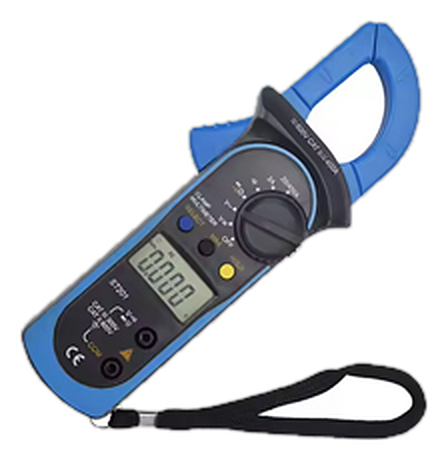
Only small currents, by breaking the circuit and connecting the meter in series through its fused current input. For motor running current and other load currents in a panel, use a clamp meter: it measures through its jaws without breaking the circuit and handles much higher currents. Keep the multimeter for voltage, resistance, continuity and low-current signal checks such as 4–20 mA loops.
Related