Environmental Monitoring · II
Clamp Meters — AC and AC/DC Clamp-On Ammeters
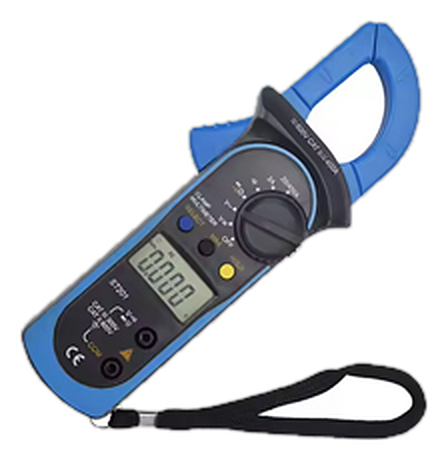
Pioneer supplies clamp meters (clamp-on ammeters) that measure AC, or AC and DC, current by clamping the jaws around a conductor without breaking the circuit, with True RMS, data hold and min/max, and voltage, resistance, capacitance, frequency and temperature functions on selected models.
- Display: Digital, backlit on selected models
Overview
What it does and where it fits.
A clamp meter measures current by sensing the magnetic field around a single conductor, so readings are taken on a running motor or live feeder without disconnecting anything. It handles much higher currents than a multimeter's current input and is the standard tool for checking motor, compressor, heater and feeder loads.
AC-only clamp meters use the jaws as a current transformer: the alternating field around the conductor induces a current in a winding on the core. Measuring DC needs a Hall-effect sensor in the jaws, because a steady DC field induces nothing. AC/DC clamp meters are therefore needed for solar PV strings, battery banks, UPS DC links and DC drives.
Select by current type, current range, jaw opening to fit the largest conductor, True RMS for electronic loads and a CAT rating that suits the panel. Pioneer confirms these on the model datasheet with the quotation.
Types
- AC clamp meterCurrent-transformer jaws for AC loads such as motors, heaters and lighting feeders.
- AC/DC clamp meterHall-effect jaws that measure both AC and DC, for PV, battery, UPS and DC drive circuits.
- Multi-function clamp meterAdds voltage, resistance, capacitance, frequency and temperature to current measurement.
Features
- Current measurement without breaking the circuit
- AC and AC/DC models
- True RMS
- Voltage, resistance, capacitance, frequency and temperature on selected models
- Data hold and Min/Max
- Backlit display on selected models
- CAT safety ratings to suit the point of use
Applications
- Motor and compressor running current checks
- Panel and feeder load surveys and phase balance
- HVAC/R equipment diagnostics
- Industrial maintenance on machinery
- Solar PV and battery DC current (AC/DC models)
- Appliance and automotive electrical faults
Specifications
Spec table.
Standard ranges and materials. Tell us your medium, range and connection and we will match the model.
| Parameter | Value |
|---|---|
| Current type | AC; AC/DC models |
| Measurement | Jaws clamped around a single conductor, circuit not broken |
| AC measurement | True RMS on selected models |
| Other functions | Voltage, resistance, capacitance, frequency, temperature (model-dependent) |
| Reading functions | Data hold, Min/Max |
| Display | Digital, backlit on selected models |
| Safety | CAT-rated; category to suit the point of use |
Current range, jaw opening, accuracy and CAT rating depend on the model. Pioneer confirms them on the model datasheet with the quotation.
For consultants
Consultant spec clause.
Paste it into your technical specification or BOQ, then adjust ranges and quantities to your schedule.
1. Supply of a handheld digital clamp meter for measuring running current of motors, compressors and feeders during commissioning, to be handed over with the facility management instrument kit.
2. The clamp meter shall be True RMS, measuring AC current (AC/DC where DC circuits such as solar PV, battery or UPS systems are in scope), with jaw opening to suit the largest conductor to be measured.
3. The meter shall also measure voltage and resistance, with data hold and Min/Max functions and a digital display.
4. Current range, accuracy and CAT safety rating shall suit the highest current and installation category at the point of use and shall be stated in the bidder's technical datasheet for approval.
5. The meter shall be supplied with test leads, batteries, carrying case, operating manual and a manufacturer's test/calibration certificate.
Make: Pioneer Industrial Instruments, Pune, or approved equivalent.
Do I need an AC or an AC/DC clamp meter?
If you only work on AC motors, heaters, lighting and feeders, an AC clamp meter is enough. Choose AC/DC if any of your work involves DC: solar PV strings, battery banks, UPS and telecom DC supplies, DC drives or EV chargers. AC-only meters use a current-transformer core that cannot sense DC, while AC/DC meters use a Hall-effect sensor that reads both.
Why does my clamp meter read almost zero around a cable?
Because the whole cable is inside the jaws. In a single-phase or three-phase cable the currents in the conductors cancel, so the net magnetic field is close to zero. Clamp around one conductor only, either one phase or the neutral. For a multi-core cable, measure at the terminals where the cores are separated, or use a line-splitter adaptor for plug-in equipment.
How do I check phase balance on a three-phase motor?
With the motor at steady load, clamp each phase conductor in turn and record the three currents. Current unbalance is the largest deviation from the average, divided by the average. Small differences are normal; a large unbalance points to supply voltage unbalance, a loose connection or a winding fault, and it raises motor temperature. Compare readings with the nameplate full-load current as well.
How do I measure small currents accurately with a clamp meter?
Loop the conductor several turns through the jaws and divide the reading by the number of turns. This multiplies the signal and improves resolution near the bottom of the range, for example on control circuits and small fans. Centre the conductor in the jaws, make sure they close fully, and keep away from other current-carrying conductors, which add error.
Related