Flow Instruments · FT
Open Channel Flowmeters — Ultrasonic Flow Meters for Weirs and Parshall Flumes
An open channel flowmeter measures flow in channels, drains and effluent outfalls by measuring the water level upstream of a weir or Parshall flume with a non-contact ultrasonic sensor and converting it to flow. Pioneer supplies integral and split-type ultrasonic open channel flowmeters covering 0.1 L/s to 99999.99 m³/h, with 1, 2 or 3 m level range, 4–20 mA output and optional Modbus.
- Level range: 1 m, 2 m or 3 m
- Level measurement accuracy: 0.5%
- Analogue output: 4–20 mA, 4-wire, 600 Ω load
Overview
What it does and where it fits.
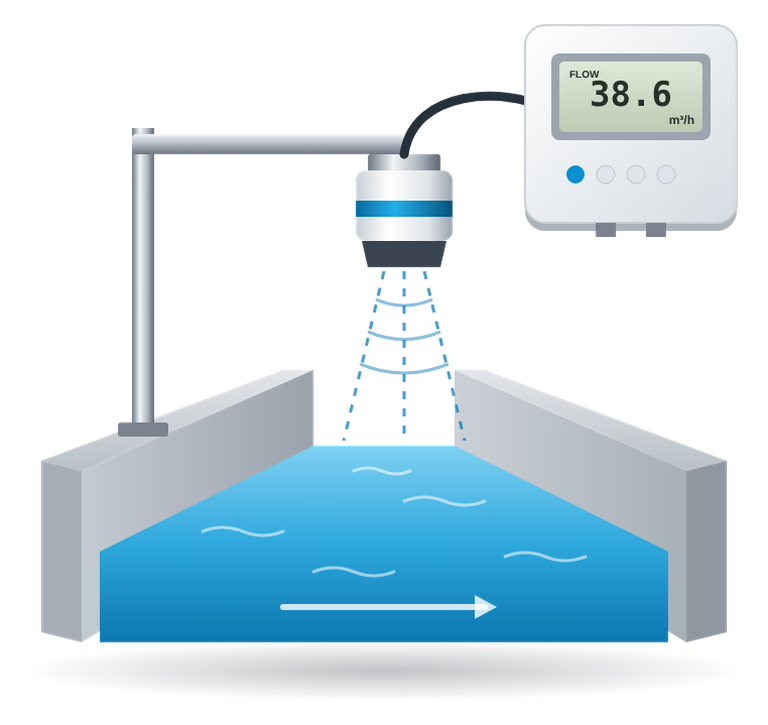
A weir or flume creates a fixed relationship between upstream water depth (head) and flow. The ultrasonic sensor above the channel measures the head without touching the water, and the transmitter applies the weir or flume equation to calculate flow rate and total volume.
Overall accuracy depends mostly on the primary element. With a standard weir or flume built to the national standard, flow accuracy is 1–5%; with non-standard structures it can be 10–50%. Install the flume correctly, level and free-flowing, before relying on the reading.
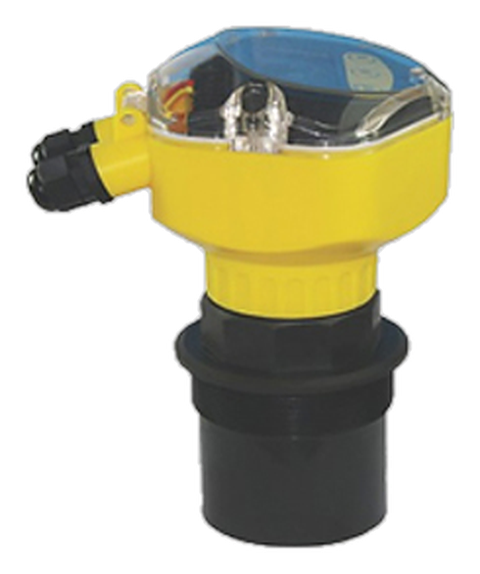
The integral type combines sensor and display in one unit for compact sites. The split type has a separate wall-mounted display with up to 100 m probe cable, useful where the channel is in a pit or the display must be in a control room.
Types
- Integral typeSensor and display in one housing mounted over the channel; display IP65, probe IP68.
- Split typeProbe over the channel with a separate display unit; 10 m cable standard, up to 100 m; display IP64, probe IP68.
Features
- Non-contact ultrasonic level measurement, no wetted moving parts
- Works with Parshall flumes and standard weirs
- Flow range 0.1 L/s to 99999.99 m³/h, depending on the weir or flume
- Level range 1 m, 2 m or 3 m; resolution 3 mm or 0.1%
- 4–20 mA output; two optional relay outputs
- Optional RS 485 or RS 232 with Modbus
- Mains, 24 V DC, 12 V DC, battery or solar power options
Applications
- Sewage treatment plant (STP) inlet and outlet
- Effluent treatment plant (ETP) discharge
- Storm water and drainage channels
- Irrigation canals
- Industrial wastewater outfalls for pollution control reporting
- Cooling water return channels
Specifications
Spec table.
Standard ranges and materials. Tell us your medium, range and connection and we will match the model.
| Parameter | Value |
|---|---|
| Principle | Ultrasonic level measurement over a weir or flume |
| Versions | Integral or split |
| Flow range | 0.1 L/s to 99999.99 m³/h, depending on the weir or flume |
| Totaliser | Up to 4,290,000,000.00 m³ |
| Level range | 1 m, 2 m or 3 m |
| Level measurement accuracy | 0.5% |
| Resolution | 3 mm or 0.1%, whichever is greater |
| Flow measurement accuracy | 1–5% with standard weirs and flumes meeting national standards; 10–50% with non-standard weirs and flumes |
| Display | LCD |
| Analogue output | 4–20 mA, 4-wire, 600 Ω load |
| Relay output | Optional, 2 relays, 220 V AC / 8 A or 24 V DC / 5 A |
| Power supply | 220 V AC +15%, 50 Hz or 24 V DC, 120 mA; optional 12 V DC, battery or solar |
| Communication | Optional RS 485 or RS 232, Modbus |
| Ambient temperature | Display −20 to 60 °C; probe −20 to 80 °C |
| Process temperature | −20 to 80 °C |
| Process pressure | Atmospheric |
| Humidity | Up to 90% RH, non-condensing |
| Protection | Integral: display IP65, probe IP68. Split: display IP64, probe IP68 |
| Probe cable (split type) | 10 m standard, 100 m maximum |
| Probe material | ABS standard; corrosion-resistant material for corrosive environments |
Probe selection for Parshall flumes
| Parameter | Value | |
|---|---|---|
| Flume | Probe | Measuring range |
| No. 1 to 4 | 100 kHz, M48 × 2 thread | 1 m |
| No. 5 to 25 | 64 kHz, M48 × 2 thread | 2 m |
Flow range depends on the weir or flume size. Send the channel drawing or flume number for selection.
For consultants
Consultant spec clause.
Paste it into your technical specification or BOQ, then adjust ranges and quantities to your schedule.
1. Open channel flowmeter shall be of non-contact ultrasonic type measuring head upstream of the specified Parshall flume (weir) and computing flow from the standard flume (weir) equation.
2. Flowmeter shall be of integral type (split type, with probe cable of 10 m, extendable to 100 m) with LCD showing flow rate, head and totalised volume.
3. Level range shall be 1 m (2 m / 3 m) with level accuracy 0.5% and resolution of 3 mm or 0.1%, whichever is greater; the probe blind zone shall be considered in mounting height.
4. Output shall be 4–20 mA into 600 Ω (two relay outputs and RS 485 Modbus as specified).
5. Power supply shall be 220 V AC, 50 Hz (24 V DC / solar as specified).
6. Probe shall be IP68, ABS (corrosion-resistant material for corrosive effluent), rated −20 to 80 °C; display enclosure IP65 for integral type (IP64 for split type).
7. Flume or weir shall be constructed to the applicable national standard, and the probe mounted vertically above the head measuring point, clear of channel walls.
8. Each flowmeter shall be supplied with a manufacturer's test certificate and installation manual.
Make: Pioneer Industrial Instruments, Pune, or approved equivalent.
How does an ultrasonic open channel flowmeter work?
A Parshall flume or weir creates a known relationship between water depth (head) and flow. The ultrasonic sensor, mounted above the channel, measures the distance to the water surface and so the head, without touching the effluent. The transmitter applies the equation for that flume or weir to calculate flow rate in L/s or m³/h, and totalises the volume.
How accurate is open channel flow measurement?
The level measurement is 0.5% accurate, but overall flow accuracy depends on the primary element. With a standard weir or flume built and installed to the national standard, expect 1–5%. With non-standard or poorly built structures, errors of 10–50% are possible. Check flume dimensions, level and free discharge before commissioning.
Which probe do I need for a Parshall flume?
For Parshall flumes No. 1 to 4, use the 100 kHz probe: 1 m range and only 10 cm blind zone, so it can be mounted low without echoes from the flume walls. For flumes No. 5 to 25, use the 64 kHz probe with 2 m range and 30 cm blind zone. Mount the probe so the highest water level stays below the blind zone.
Integral or split type: which should I choose?
Choose the integral type where the channel is easy to reach and a single compact unit is enough. Choose the split type when the channel is in a pit, sump or hazardous-to-access location, or when the display needs to be in a panel room. Its probe cable is 10 m as standard and can be extended up to 100 m.
Related